
Most strategic plans do not fail because the ambition is wrong. They fail because the people who must carry them out never argued the choices through, never agreed on a handful of priorities and never saw how their own work connects to the goal. To improve strategic planning, fix the conversation first: put the right people in the room, give them a few big issues to settle, and build a rhythm that keeps the plan alive after the offsite. That is also where facilitated team experiences earn their place, because a leadership group that communicates openly plans better. Our Singapore programs at AdvenTOUR are built around exactly that goal of collaboration and communication.
Key Takeaways
- Start planning from the few strategic issues with the greatest impact on future performance, not from a template or last year’s budget.
- Include the most knowledgeable and influential people, and make the debate honest and interactive rather than a stack of presentations.
- Limit the plan to three to five priorities that employees can remember and act on.
- Run the planning workshop in stages, with analysis between sessions, and agree who owns each initiative before anyone leaves.
- Review progress on a fixed rhythm, tracking inputs as well as financial results, so the plan can adapt when conditions change.
Table of Contents
- Why strategic plans stall before they start
- Start with the issues that matter most
- Choose three to five priorities, and say what you will not do
- How to run the planning workshop
- Activities that help a team align on priorities
- Make the plan stick: track, review, adapt
- Where AdvenTOUR fits in your planning calendar
- Our perspective
- FAQ
- Sources
Why strategic plans stall before they start
A McKinsey survey by Renée Dye and Olivier Sibony found that more than a quarter of respondents said their companies had strategic plans but no path to execute them, and 45% said their planning processes failed to track the execution of strategic initiatives. The survey is from 2007, but the pattern will be familiar to any HR lead or operations head who has sat through an annual planning cycle.
The same research points to why. Respondents who were satisfied with their planning process praised three things: the most knowledgeable and influential people took part, the process stimulated and challenged their thinking, and discussions of difficult issues were honest and open. Among dissatisfied respondents, 27% said their planning had none of those virtues. The authors argue that too many companies pour effort into collecting and packaging data and neglect the interactive part, where people actually debate.
APQC makes a related point from a different angle: in its view most plans fail at the connection stage rather than the ambition stage. Process performance, business outputs and organizational goals are never linked into one chain, so nobody can say how their daily work moves the company’s goal.
Three problems, then, show up repeatedly:
- The wrong issues get discussed, usually because the calendar, not the business, sets the agenda.
- The right people are absent or silent.
- Nothing tracks the plan once the document is finished.
Everything below addresses one of the three.
Start with the issues that matter most
McKinsey’s first recommendation is to begin planning by deliberately identifying and discussing the strategic issues with the greatest impact on future business performance. That sounds obvious, yet many planning cycles begin with a budget template and work backward.
A practical way to do this before your workshop:
- Ask each member of the planning group to submit the three issues they believe will most affect performance over the next three years.
- Group the submissions and count how many people raised each one.
- Take the top handful into the workshop as the agenda, and park the rest.
It matters how far ahead you look. BCG’s authors Kachaner, King and Stewart suggest three time horizons: a long term of five years or more that defines or redefines the company’s direction by examining megatrends and scenarios, a medium term of three to five years that lists actionable multiyear initiatives, and a short term that challenges the current strategy instead of simply rolling the budget forward. Their example is Philips shifting from consumer electronics to health care.
Keep strategy and budgeting on separate tracks
McKinsey’s Chris Bradley argues that strategy and planning are different modes of thinking, and that once they are combined, planning tends to win. His fix is a two-track process: an efficient annual planning and budget track, plus a parallel strategy track on its own timing, supported by regular meetings with an evolving agenda of big strategic topics.
For a Singapore team, this can be as simple as a quarterly strategy session that is not a budget meeting, with its own agenda and its own attendees.
Choose three to five priorities, and say what you will not do
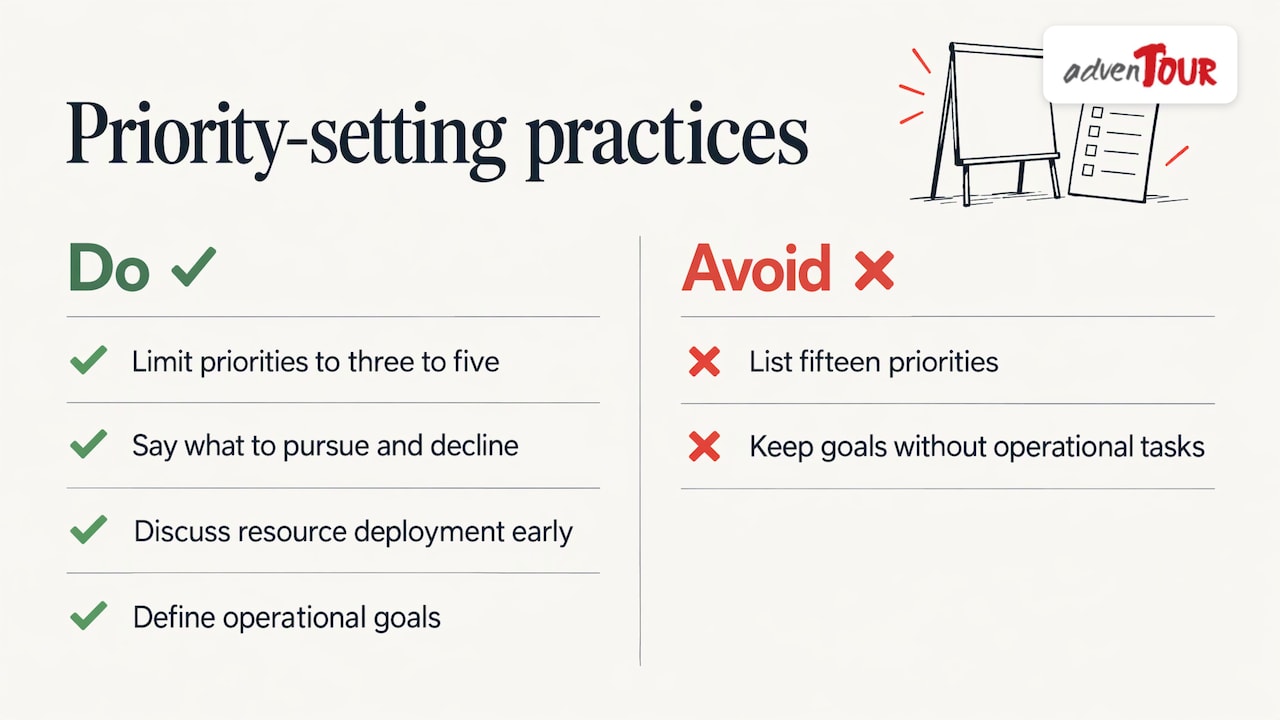
A plan that lists fifteen priorities is a plan nobody remembers. Research published in MIT Sloan Management Review by Sull, Turconi, Sull and Yoder recommends limiting priorities to three to five, which are easier to understand, communicate and recall. They also serve as “strategic guardrails”, letting managers and employees fill in the blanks using their own local knowledge.
Mankins and Steele, studying high-performing companies such as Barclays, Cisco, Dow Chemical, 3M and Roche in the Harvard Business Review, offer rules that fit the same idea: describe the strategy in clear language about what the company will and will not do, discuss resource deployment early, prioritize tactics so people know where to direct effort, and keep monitoring performance so assumptions can be reset.
Harvard Business School Online adds a useful test: a strategic goal is only worth keeping if the team can define operational goals that would achieve it. If no one can name the tasks that would deliver it, spend the time and money elsewhere.
A worked example
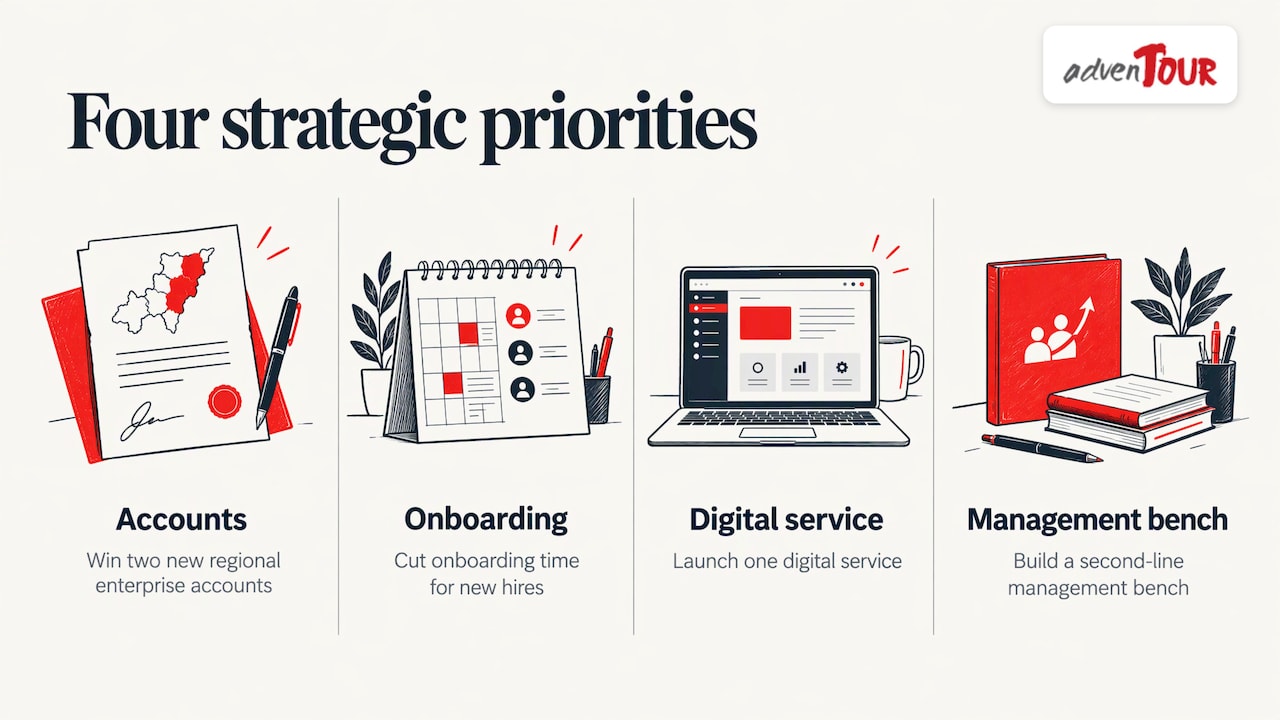
Imagine a 120-person regional services firm in Singapore. Its leadership group of eight lists twelve ideas. After the debate, it keeps four priorities: win two new enterprise accounts in the region, cut onboarding time for new hires, launch one digital service, and build a second-line management bench. Each priority gets a named owner, one or two measurable results for the year, and a line that says what the firm is declining to pursue. Every department head can now explain, in a sentence, how their team contributes. That is the connection APQC says most plans lack.
How to run the planning workshop
The workshop is where the debate happens, so its design matters more than its venue. Evidence from consulting practice suggests staging the work rather than cramming it into one day.
L.E.K. Consulting describes an issue-driven model with two strategic dialogue workshops per cycle. In the first, participants select the issues with the greatest potential impact on business value. Teams then complete external and internal analysis between sessions. In the second, the group resolves the issues into actionable initiatives that are built into performance management and incentives. L.E.K. also describes a longer “boot camp” variant over three months, with no stand-up presentations and executives coached on asking good strategic questions.
Who should be in the room
OEC Singapore’s practitioner guide suggests a planning team of five to twelve members. Groups of about five are typically most effective at problem-solving, while groups above twelve limit contribution and reduce accountability. It also recommends that the CEO and senior executives take part every year and that the team be reconstituted annually.
For a larger organization, BCG advises engaging beyond the central strategy team: business leads, board members, agile teams, even customers and suppliers. A common approach is a small core group for decisions, with wider groups feeding ideas in before and reviewing after.
A sample two-session structure
| Stage | Purpose | Output |
|---|---|---|
| Pre-work | Each participant submits the three most important issues | Ranked list of issues |
| Workshop 1 | Debate and select the top issues, agree ground rules | Three to five issues, each with an owner |
| Between sessions | Teams analyze their issue, inside and outside the company | Short fact base per issue |
| Workshop 2 | Turn issues into initiatives, resources and measures | Draft priorities, owners, KPIs |
| Follow-up | Share a one-page summary with staff | Plan everyone can explain |
Activities that help a team align on priorities
The query many planners type is “strategic planning workshop activities”. The useful ones share a trait: they force a group to choose, not just brainstorm.
- A vision-to-objectives question. ISCA’s Chartered Accountants Lab suggests opening departmental workshops with one question: to fulfil the company’s vision, what should the objectives be across learning and growth, internal process, stakeholders and financial perspectives? Workshops are run by a head of department or an independent facilitator to identify each department’s critical success factors and KPIs.
- Top-down and bottom-up feedback. The same ISCA guidance recommends two-way feedback to set SMART targets, meaning specific, measurable, attainable, relevant and time-bound.
- Issue ranking with a scarce budget. Give each participant a fixed number of votes, or a fixed pool of imaginary resources, so that choices have a cost.
- A one-page plan. ISCA also recommends condensing the planning steps into a single-page sheet shared with employees to set KPI expectations.
- Shared experiences that build candor. Honest debate needs trust. A leadership group that has worked through a challenge together tends to argue more openly afterward, which is the quality McKinsey’s satisfied respondents rated highly.
That last point is where team building and planning connect. Our executive team building programs and leadership team activities are designed for senior groups who need to communicate and decide together, and they can sit alongside a planning offsite as its own block of the agenda.
Pacing a full day
Facilitators who run offsites often split the agenda so that open-ended topics come before decision topics, with a long break between them, and vary formats frequently to keep energy up. A morning of debate, a hands-on team activity over lunch, and an afternoon of decisions is a rhythm many Singapore teams find workable. Our guide on how to choose team building activities can help you match a format to the group.
Make the plan stick: track, review, adapt
A plan without a review rhythm is a document. OEC Singapore’s guide describes a cycle with weekly or monthly self-reviews by accountable managers, quarterly or biannual formal reviews where senior leaders examine KPI trends, diagnose root causes and adjust action plans, and an annual review that feeds the next planning year. It frames the whole thing as a loop, not a straight line, with the last step feeding into the first step of the next cycle.
Three practices make the rhythm work:
- Track inputs as well as outputs. McKinsey advises measuring inputs, such as the quality of available talent or the number of ideas and projects at each development stage, in addition to outputs such as new-product revenue, because many strategic decisions cannot be tracked on financial targets alone.
- Protect priority initiatives. BCG says the best planners track priority initiatives on a shared performance dashboard and protect them from day-to-day pressures.
- Treat year one as a pilot. MIT Sloan Management Review’s Kaplan and Beinhocker recommend learning by doing: pilot the redesigned process with volunteer business units, then modify it based on lessons learned.
Goals should also be monitored continuously. OpenStax’s marketing text notes that SMART goals need ongoing checks to see whether they are on track or need refining when circumstances change.
Keep employees in the loop
The plan only changes behavior if people understand it. Share the one-page summary, explain how each role contributes, and revisit it in team meetings. A team that has already built communication habits finds this far easier, which is why many HR leaders pair planning with team communication and collaboration work.
Where AdvenTOUR fits in your planning calendar
If your planning offsite needs a session that helps leaders and managers understand how each other works, our facilitated workshops are built for that. Programs are tailored to each client’s objectives and scalable for group size and budget, and they focus on experiential learning and skill transfer rather than passive entertainment. Published per-person prices include:
| Program | Published price per person |
|---|---|
| Modified DISC Workshop | $70-82 |
| Office Dynamics Workshop | $80-90 |
| Office Shark Tank | from $92 |
| DISC Personality Profiling | $150-159 |
For a budget-conscious team, our budget-friendly activities start at $35 per person. Large groups, regional meetings and visiting MNC teams can talk to us about scaling a format to the headcount.
To plan a session around your own offsite, see our premium team building programs or get in touch through our site.
Our perspective
Strategic planning is a team sport that most companies play as a paperwork exercise. The research is consistent: plans improve when the right people debate the right issues honestly, and they decay when nobody owns what comes next.
We design team building around that same insight. A program is only worth running if people leave communicating better and ready to apply something at work. That is why we tailor every program to the organization’s goals rather than handing every client the same activity, and why we focus on experiential learning and skill transfer.
For a leadership group heading into a planning cycle, we would pair the planning sessions with a shared experience. Our DISC-based workshops give managers a common language for how colleagues prefer to communicate and decide, and our executive and leadership formats put senior teams in situations where they must align quickly. The planning room then starts from more trust and less guarding.
Our measure of a good session is what happens the following week: clearer conversations, faster decisions, and teams that can explain the plan in their own words.
Joshua
FAQ
How do you improve a strategic planning process?
Start by identifying the few strategic issues with the greatest impact on future performance, and involve the most relevant people in debating them. Then put a system in place to measure and monitor progress, as McKinsey recommends. Keep the resulting priorities to three to five.
What makes a strategic plan effective and actionable?
It translates strategy into a short list of forward-looking priorities, each with an owner and measures. Harvard Business School Online adds that every strategic goal needs operational goals the team can complete to reach it. If employees cannot explain how their work links to the plan, it is not yet actionable.
How often should we review the strategic plan?
OEC Singapore’s guide prescribes weekly or monthly self-reviews by managers, quarterly or biannual leadership reviews and an annual review that feeds the next cycle. Planview’s guidance similarly suggests reviewing and updating strategy quarterly and at least once every three years.
How many people should join a strategic planning workshop?
OEC Singapore recommends a planning team of five to twelve people, since larger groups limit contribution and reduce accountability. For bigger organizations, keep a small decision group and gather input from wider teams before and after the sessions.
Can team building help with strategic planning?
Yes, in a supporting role. Honest, open discussion is one of the qualities satisfied planners rated highly in McKinsey’s survey, and shared experiences help leaders build the trust that makes that discussion possible. Our executive and leadership programs in Singapore are designed for this purpose.
Sources
- How to improve strategic planning, McKinsey
- A practical guide to jumpstart strategic planning, McKinsey
- Strategic Planning Consulting Best Practices, BCG
- Four Best Practices for Strategic Planning, BCG
- Turning Strategy Into Results, MIT Sloan Management Review
- The Real Value of Strategic Planning, MIT Sloan Management Review
- Turning great strategy into great performance, PubMed
- How to Formulate a Successful Business Strategy, Harvard Business School Online
- How Can I Improve My Company’s Strategic Planning Process?, APQC
- Strategic Planning: Complete Practitioner Guide, OEC Singapore
- Strategic Planning and Balance Scorecard (Part 2), ISCA
- Successful Strategic Planning Processes, L.E.K. Consulting
- 2.1 Developing a Strategic Plan, OpenStax
- Developing a New Strategic Planning Process, Planview
Recommended
- How to Improve Leadership Communication Across Your Team
- How to Improve Employee Motivation: What Works and How to Start
- Leadership Team Activities That Build Real Skills in Singapore