
Leaders improve their communication fastest when they practice it with their own team, in a setting where the feedback is immediate and the stakes are low. Reading tips or sitting through a briefing helps, but a facilitated activity with a proper debrief lets a manager try out clear instructions, listening and feedback, then see how colleagues actually react. For HR leaders and event planners in Singapore, that makes a well-designed team building session one of the most practical places to start. At AdvenTOUR, we design programs around exactly this kind of experiential learning.
This guide covers what good leadership communication consists of, why it moves team results, the habits worth practicing, which activities train which habit, and how to carry the work into ordinary weeks.
Key Takeaways
- Leadership communication is a set of learnable habits: listening, setting clear expectations, explaining decisions, giving feedback and creating safety to speak up.
- Official Singapore teamwork frameworks tie clear communication to trust, psychological safety and cohesion, so the goal is a team that understands the leader, not a leader who talks more.
- Practice works better than theory: activities followed by a structured debrief let leaders test habits and hear the effect straight away.
- Different formats train different skills, from a race that rewards clear briefing to a profiling workshop that shows how colleagues prefer to receive messages.
- The gains last only if the team agrees on working practices and revisits them regularly.
Table of Contents
- What leadership communication actually covers
- Why it matters for collaboration and performance
- Six habits that improve how leaders communicate
- Why practice beats briefing
- Leadership communication activities and what each one trains
- A debrief that turns an activity into a leadership lesson
- Making it stick in everyday work
- Leading across cultures in a regional team
- Putting it into a program
- Our perspective
- FAQ
- Sources
What leadership communication actually covers
Leadership communication is how a leader gets direction, reasons and feedback across to a team, and how well they take information back. It is two-way. A manager who delivers a polished town hall but never hears what people think has covered half of it.
In practice it breaks into five jobs:
- Setting expectations. People know what a good result looks like and by when.
- Explaining the reason behind decisions. The team understands why, not only what.
- Listening. Questions are asked, views are heard, and the leader checks understanding.
- Giving and receiving feedback. Praise and correction are specific, and the leader invites feedback in return.
- Making it safe to speak. People raise problems early because doing so carries no penalty.
Each of these can be practiced, which is why it is a training topic rather than a personality trait.
Why it matters for collaboration and performance
The Singapore Immigration and Checkpoints Authority’s Psychology Division publishes a teamwork framework that links shared understanding of team tasks and communication channels with clarity, task effectiveness and collaboration. It names trust, psychological safety, cohesion and team efficacy as the elements of effective teamwork. It describes psychological safety as feeling safe enough to voice opinions so that views are openly shared, heard and understood. Leaders create or erode that safety every day by how they respond to a question or a mistake.
Academic work points the same way. A 2009 study of leaders’ communication styles found that style was related to knowledge sharing, perceived leader performance, satisfaction with the leader and team commitment. A 2025 systematic review of team leader communication in ad hoc teams, drawn from emergency departments and intensive care units, reported positive associations between leader communication strategies and both technical and non-technical performance. Those are high-pressure clinical settings, but they show the same principle: how the leader communicates shapes how the team performs.
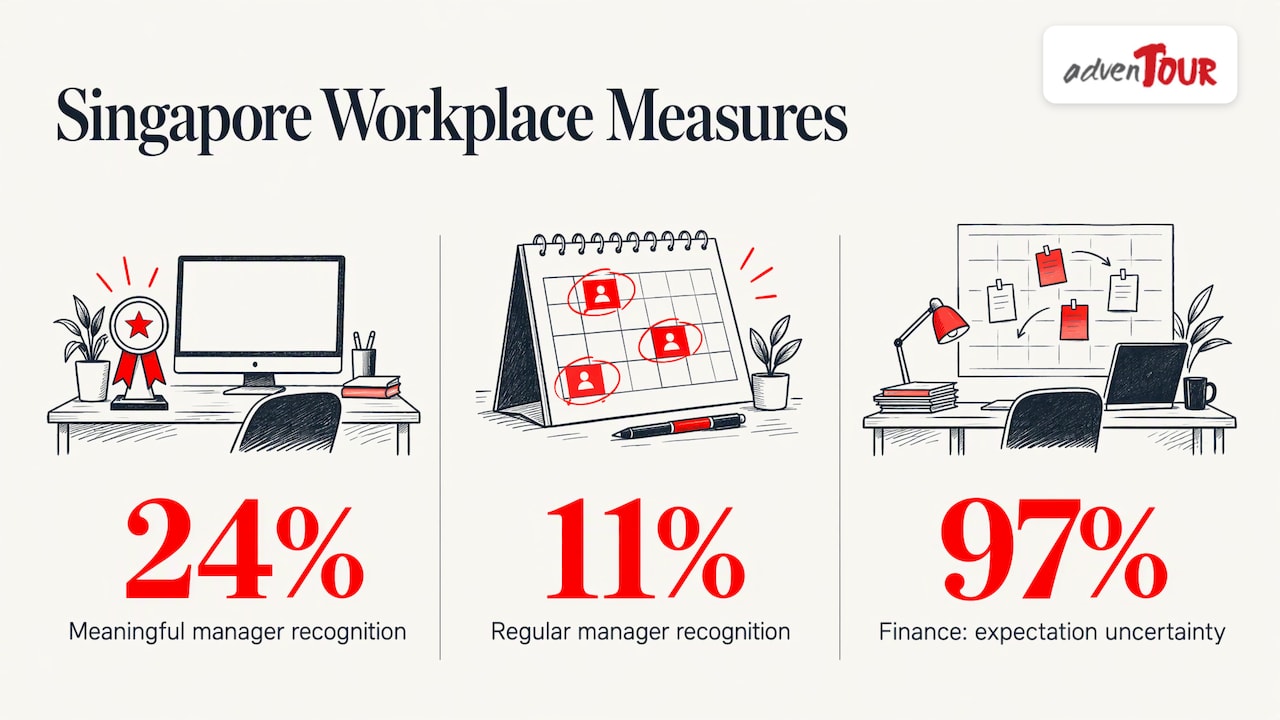
The gap shows up in Singapore workplaces too. A 2025 recognition report found that 24% of Singaporean workers feel meaningfully recognized by their manager and 11% feel regularly recognized. Among financial-services employees in Singapore, 97% feel some uncertainty about workplace expectations. Recognition and expectations are communication jobs, and a large share of teams are not getting them.
Six habits that improve how leaders communicate
The guidance from universities and professional bodies converges on a short list. Here is each habit with what it looks like on a Monday morning and where leaders typically slip.
1. Listen without interrupting
Harvard Business School Online advises leaders to ask employees for opinions, ideas and feedback, listen without interrupting or distractions, and invite people to elaborate. The common slip is answering a question before the person has finished it, or typing during a one-to-one. A simple fix: wait two beats after someone stops talking, then ask one follow-up question.
2. Specify the result and the milestones
The same source recommends specifying desired results and milestone outcomes so people understand priorities, and simplifying expectations when targets are missed. Where it goes wrong: “get this done soon” means a different day to each person. Name the outcome, the date and the checkpoint.
3. Be accessible and transparent
The Center for Creative Leadership’s communication guide advises leaders to be accessible and visible, communicate clearly and confidently, and invite input from people across organizational levels. For hybrid teams, visibility has to be designed: a fixed slot for open questions beats an open-door policy nobody uses.
4. Adapt the message and the channel
MIT Sloan Executive Education advises choosing a suitable channel and adapting the detail and presentation of a message to the audience. A finance director may want the numbers first, while a frontline team may want what changes for them this week. The same announcement in the same words fails one of them.
5. Build trust through fairness and openness
ICA describes team trust as confidence in and reliance on teammates, supported by fairness, honesty and openness. Leaders show this by explaining how decisions were made, including when the answer is not the one people hoped for.
6. Give feedback and ask for it
ICA’s New Leader Resources include guidance on feedback channels and types, and a three-phase 360-feedback guide: complete self-ratings, interpret the feedback, then create an action plan for growth. The habit that separates strong leaders is the last step. They act on what they hear and tell the team what changed. For team-level feedback routines, our piece on team building feedback strategies goes deeper.
Why practice beats briefing
A workshop that only presents these six habits tends to leave them as a list. The skill is in doing them while something else is competing for attention: a clock, a puzzle, a disagreement about the route.
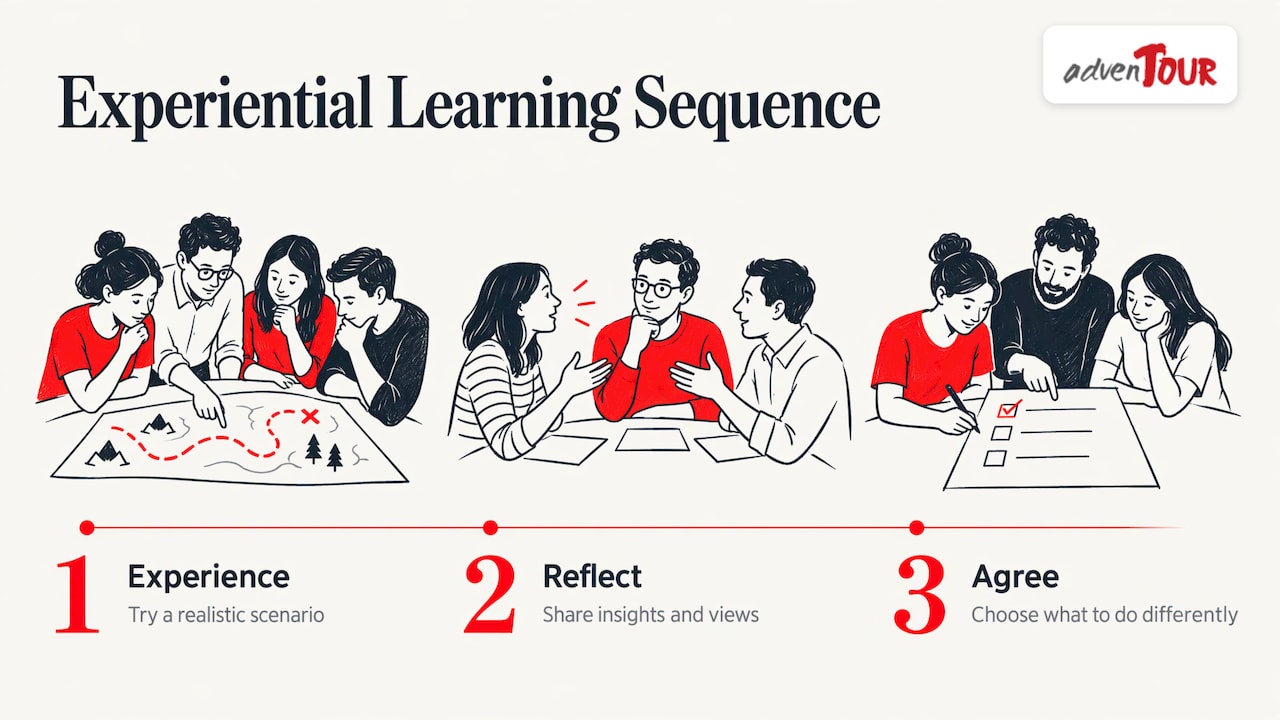
Singapore’s own leadership-development guidance reflects this. The SAFTI Military Institute’s team building and team learning practices ask members to examine their current ways of working, identify strengths and weaknesses, agree preferred collaboration practices and create action plans. It describes team learning as reflecting on experience, sharing insights, respecting differing views and building shared mental models. Note the order: experience first, then reflection, then agreement on what to do differently.
That sequence is the design principle behind experiential programs. Our programs focus on experiential learning and skill transfer rather than passive entertainment, with experienced facilitators and a focus on measurable outcomes in engagement, collaboration and communication. The activity creates the moment; the debrief turns it into a habit the leader can name.
A Singapore-based randomized trial with 120 medical and nursing students offers a related lesson. Both virtual-reality and live-simulation groups improved their attitudes toward interprofessional teamwork, and the training used structured tools such as check-back and call-out. The takeaway for corporate teams is that simple, named communication routines, practiced in a realistic scenario, are teachable.
Leadership communication activities and what each one trains
Choose the activity by the habit you want leaders to exercise. These are the formats we offer, with the published per-person prices from our site.
| Activity | Communication habit it exercises | Price per person |
|---|---|---|
| App-based Amazing Race | Briefing, splitting tasks, checking in under time pressure | $40 to $55 |
| Amazing Race | Shared decisions across a larger route, handing over information between legs | $65 to $78 |
| Combat Skirmish Laser Tag | Short, clear calls and role clarity in fast action | $37 to $45 |
| Modified DISC Workshop | Adapting your message to different working styles | $70 to $82 |
| DISC Personality Profiling | A fuller look at style differences and how colleagues prefer to receive messages | $150 to $159 |
| Office Dynamics Workshop | Reflecting on how the team works together day to day | $80 to $90 |
| Office Shark Tank | Persuading and explaining a decision to a panel | from $92 |
| Corporate Sailing Team Building | Coordinating roles and giving clear instructions as one crew | $125 |
The first five rows are the easiest starting point for most groups. Races and laser tag put leaders in a position where unclear instructions cost the team something visible within minutes. The DISC workshops address a quieter problem: the leader’s message is clear to the leader, yet lands differently with people who think and decide in another way. For a deeper look, see our pages on DISC profiling benefits and leadership team activities.
Matching format to group
- Budget-led groups. The budget-friendly programs run from $35 to $55 per person for most formats and still give a race or game that a debrief can build on.
- Mid-level leadership groups. The quality programs add the Modified DISC Workshop and larger-scale races.
- Executive and regional groups. The premium programs include the DISC Personality Profiling, Office Shark Tank and the Katong/Joo Chiat Cultural Food Immersion at $82 to $98 per person, a good option when visiting colleagues are in Singapore for a regional meeting.
- Large groups. Programs scale for group size and budget, so a department or a whole regional gathering can run the same structure.
A debrief that turns an activity into a leadership lesson
The activity alone does not change behavior. The debrief does. A simple structure borrowed from the reflection-and-action-plan pattern in SAFTI’s guidance works well:
- What happened? Each team describes, without judgment, how instructions were given and received.
- What did it feel like? Ask team members what helped and what confused them. This is where psychological safety is built or tested.
- What would we do differently? Leaders name one habit, such as asking a check-back question or stating the milestone, that they will try next.
- What will we agree? The group writes one or two team working practices, such as how urgent requests are flagged.
Leaders should speak last in step 2. If the most senior person goes first, the rest of the room tends to agree with them, and the session teaches the opposite of what it set out to teach.
Making it stick in everyday work
One session will not rewire habits. SAFTI describes these team-building practices as continuous throughout a team’s life: agree a shared vision, roles, rules and relationships, review how the team works, reflect on experience, share insights and set action plans. It points to shared vision, well-defined roles, clear rules and good interpersonal relationships as the heart of team effectiveness.
The Center for Creative Leadership’s Singapore hybrid-work research names four elements for team success: core agreements about how people work, team culture, cohesion and cross-team connections. It also says hybrid leaders need behaviors that build trust, communicate effectively and set clear expectations. Turn that into three routines:
- A working agreement. One page covering response times, which channel is for what, and how decisions are communicated. Revisit it each quarter.
- A recurring open-feedback slot. Fifteen minutes in a team meeting where the leader asks what is working and what is not, then reports back the next time.
- A short check-back habit. After giving direction, the leader asks the other person to say what they will do and by when.
Leading across cultures in a regional team
Many Singapore teams include colleagues from several countries. The 2024 Singapore Global Network Fellowship playbook on diverse teams recommends learning the cultural norms of overseas counterparts and not assuming that practices from one culture will work in another. It also recounts a leader who used open dialogues to share good practices and seek ongoing feedback on what was working, which helped build trust and relationships.
For regional meetings held in Singapore, that points to a practical choice: put the visiting and local leaders on mixed teams in an activity, so the first time they negotiate meaning is in a game, not in a budget discussion. A food immersion or a race gives people a shared story to refer back to in the meeting rooms afterward.
Putting it into a program
If you are planning a session for managers or a full team, we build it around your objective, whether that is clearer briefings, better feedback or stronger cross-team ties. Our programs are customizable to organizational goals and scale for group size and budget. You can browse formats on our team building programs page or see the corporate activities that work in Singapore.
To plan a leadership communication session with a facilitator, start from our quality team building programs or contact us through AdvenTOUR with your group size, objective and preferred format.
AdvenTOUR was recognized as one of Asia’s Top 10 Corporate Team Building Companies in 2023, and our programs cover outdoor retreats, indoor workshops, gamified activities, executive offsites and corporate wellness events.
Our perspective
Most leaders we meet do not have a communication problem they can see. They think they were clear. The team heard something else. That gap is hard to close in a classroom, because nobody in a classroom is racing the clock or trying to decide which route to take.
That is why we build programs around experience and skill transfer rather than entertainment. When a manager gives a brief at the start of a challenge and watches half the team head the wrong way, the lesson is immediate and no one has to lecture them. The facilitated debrief then gives the team words for what happened and something to try on Monday.
We also believe the program should match the objective. A group that needs to improve how feedback flows needs a different format from one that needs to understand different working styles. That is why we customize programs to a client’s goals, group size and budget, from a $35 to $45 Kinball afternoon to a premium executive profiling day.
Pick the habit you want your leaders to practice, choose the format that forces it, and make sure the debrief ends with an agreement the team will keep.
Joshua
FAQ
How can a leader improve communication quickly?
Start with two habits: ask a check-back question after giving direction, and state the desired result and the date for every request. Both are small, visible and easy to repeat. Then ask your team once a month what is unclear and report back what you changed.
What activities improve leadership communication?
Activities where leaders must brief others, make decisions with partial information and hear the effect of their words work best. Races, laser tag and sailing exercise briefing and coordination, while DISC workshops show how to adapt a message to different working styles. A debrief after each one is what turns the activity into learning.
How long does it take for communication to improve?
A single session can change awareness, but habits form through repetition. Pair the session with a recurring routine such as a monthly feedback slot or a quarterly review of your team’s working agreement, in line with the continuous practices SAFTI describes.
Is a team session or individual coaching better for leaders?
Communication happens between people, so practicing with the actual team gives leaders feedback from the people they lead. A team session also builds shared agreements, such as how decisions and feedback are handled, which an individual session cannot create.
Sources
- Team Discovery Programme, ICA Psychology Division
- New Leader Resources, ICA Psychology Division
- Leadership = Communication? The Relations of Leaders’ Communication Styles, PMC
- Team leader communication in ad hoc teams, BMC Health Services Research
- Singapore: Recognition report, 2025
- 8 Essential Leadership Communication Skills, HBS Online
- 15 Ways to Improve Leadership Communication Skills, CCL
- Communication Skills for Leaders, MIT Sloan Executive Education
- Team Building and Team Learning, SAFTI Military Institute
- Nurse-Physician interprofessional teamwork trial, Journal of Medical Internet Research
- Reimagining Leadership in a Hybrid World, Singapore report, CCL
- Effective Communication in Leading Diverse Teams, SGLN Fellowship 2024
Recommended
- Master Effective Team Communication Strategies Today
- Effective Team Building Feedback Strategies For Team Growth
- Team Communication Success
- Communication Workshops for Teams in Singapore: A Guide