
Manager relationships are built in daily conversations, and they are strengthened fastest when managers get a structured, shared experience where rank matters less than how people communicate. For HR leaders, that means pairing a few consistent manager habits with a facilitated programme designed around a clear objective. We design and run those programmes for companies in Singapore, from budget-friendly sessions to premium offsites.
Key Takeaways
- Gallup’s 2026 Singapore Workplace Report attributes 70% of the variance in team engagement to the manager, so the manager relationship is where engagement is won or lost.
- Trust grows through clear communication, explained decisions and two-way feedback, not through one-off events alone.
- Team building works best when it creates shared problems to solve and ends with a debrief that links the activity to daily work.
- Choose the format by objective, group size and budget. Published per-person rates in Singapore range from $35 to $159 across our programmes.
Table of Contents
- Why the manager relationship deserves your attention
- The daily habits that carry the relationship
- Why a facilitated experience speeds this up
- Choosing a format: goal, group size and budget
- Making an event count after the day
- Perspective
- Plan your manager programme with us
- FAQ
- Sources
Why the manager relationship deserves your attention
The same Gallup report found that leaders rated their managers only 3.32 out of 5 on effectiveness, and that engagement comes from the day-to-day relationship rather than town halls or annual surveys. A strong relationship, as McKinsey describes it, rests on mutual trust, encouragement, empathy and good communication, which make employees feel psychologically safe (able to speak up without fear of embarrassment or punishment).
Trust is also a local issue. Great Place To Work Singapore found that declines in company trust scores were driven mainly by drops in Collaboration and Communication. The 2026 Edelman Trust Barometer for Singapore reports that 80% of employees see teams of people with different values working together as an effective trust-building strategy. For a regional or multicultural management group, that is a direct argument for designed, shared experiences.
The daily habits that carry the relationship
Events help, but the relationship is maintained between events. Four habits recur across the research.
Explain the reasoning and ask for input
TAFEP says managers build mutual trust by explaining the rationale behind changes, asking for feedback and encouraging team members to share views. It also lists warning signs: teams bringing problems only to the manager, frequent conflict, or silence when opinions are asked for. HR can turn these into a simple observation list for manager coaching.
Communicate clearly and consistently
Gallup advises that leaders make messages clear, consistent and timely, set clear expectations and create openings for questions. MOM’s managers’ guide adds practical points for Singapore workplaces: listen and clarify, avoid jargon and confusing Singlish, and share values and expectations at the start.
Make space for informal contact
The Civil Service College recommends opening meetings with a check-in on each member’s wellbeing and inviting everyone to share views, returning the conversation to anyone who was interrupted. It also advises treating disagreement as healthy debate rather than personal conflict.
Coach individually
Gallup’s three practices of great managers include individual coaching, frequent recognition and clear accountability. A manager who treats people as individuals gets different results from one who treats the team as a block.
Why a facilitated experience speeds this up
Habits take months to show. A well-designed session compresses the first step: managers who rarely work side by side face a shared task, communicate under light pressure, and see each other’s styles. Programmes with experienced facilitators and a debrief turn that into something managers can reuse on Monday. Our programmes focus on experiential learning and skill transfer rather than passive entertainment, and we tailor each one to the client’s objectives.
For manager groups, three objectives come up most often.
| Objective | Format that fits | Published rate per person |
|---|---|---|
| Understand each other’s working styles | Modified DISC Workshop | $70-82 |
| Deeper profiling for senior teams | DISC Personality Profiling | $150-159 |
| Decision-making and cross-functional collaboration | Office Shark Tank | from $92 |
| Communication under time pressure | Amazing Race | $65-78 |
| Informal bonding for a regional group | Katong/Joo Chiat Cultural Food Immersion | $82-98 |
| Executive offsite away from the office | Corporate Sailing Team Building | $125 |
DISC is a behavioural model that sorts working styles into four broad types, giving managers a shared vocabulary for how colleagues prefer to communicate and decide. It is a practical tool for the style-alignment conversation that the ICA’s leadership induction package recommends when starting to work with someone new.
The Office Dynamics Workshop ($80-90 per person) is also built for working relationships inside the office.
Active formats for energy and rapport
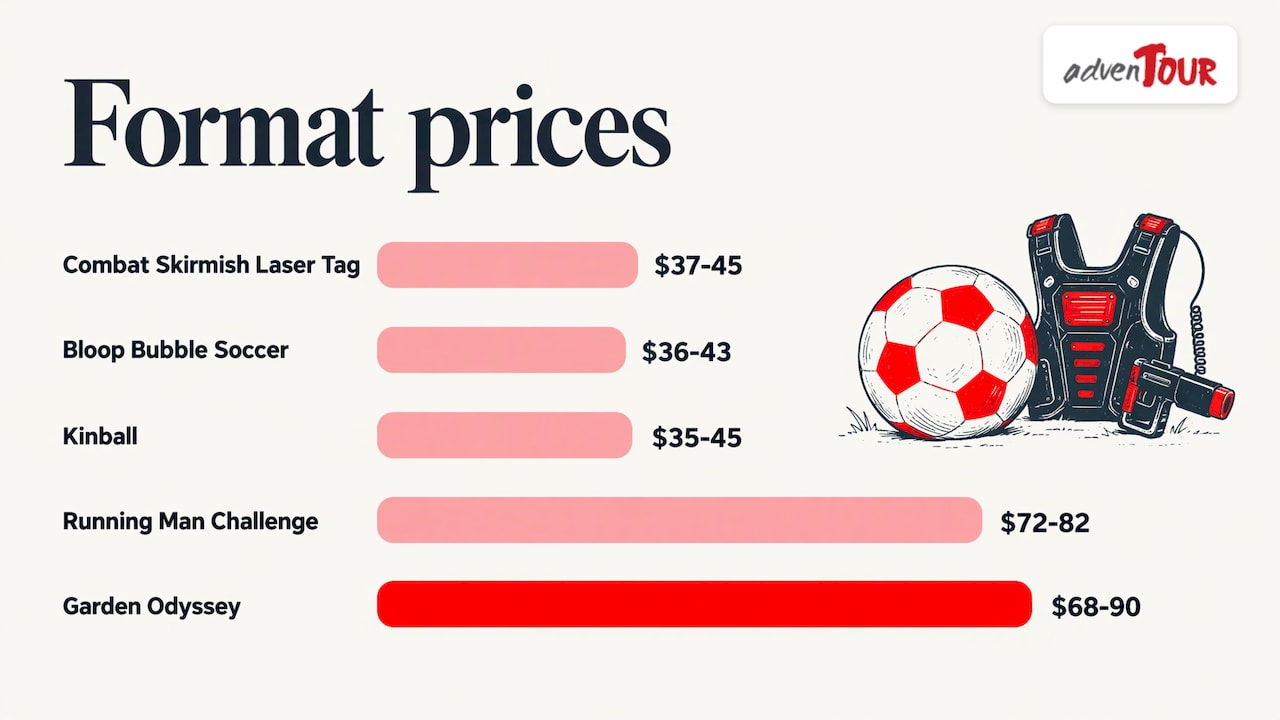
When managers are tired of workshops, active games break hierarchy quickly. Combat Skirmish Laser Tag ($37-45), Bloop Bubble Soccer ($36-43) and Kinball ($35-45) suit larger groups and tighter budgets, while the Running Man Challenge ($72-82) and Garden Odyssey ($68-90) add problem-solving. See the full budget-friendly range and the quality programmes. Rates are as published on our site and vary with group size and format.
Choosing a format: goal, group size and budget
Start with the outcome, not the activity. Write one sentence such as “our regional managers should be able to give each other direct feedback by the end of the quarter.” Then check three things.
- Goal. Style understanding points to a DISC workshop. Cross-border rapport points to a food immersion or a sailing day. Collaboration under pressure points to a race or a challenge.
- Group size. Large groups suit formats that split into teams and run in parallel, such as laser tag, Amazing Race or bubble soccer. Small senior groups suit workshops and sailing.
- Budget. Per-person rates start at $35 and reach $159, so a fixed budget usually settles the tier. You can also read our guide to team bonding activities for every company size.
MOM’s managers’ guide also offers low-cost routines to run alongside any event: regular team lunches that respect dietary restrictions, informal activities such as sports, and celebrating cultural holidays. In a multicultural Singapore team, these matter.
Making an event count after the day
A session changes little unless managers carry something back. Ask facilitators to close with a debrief that names two or three behaviours to try, then have each manager commit to one in their next one-to-ones.
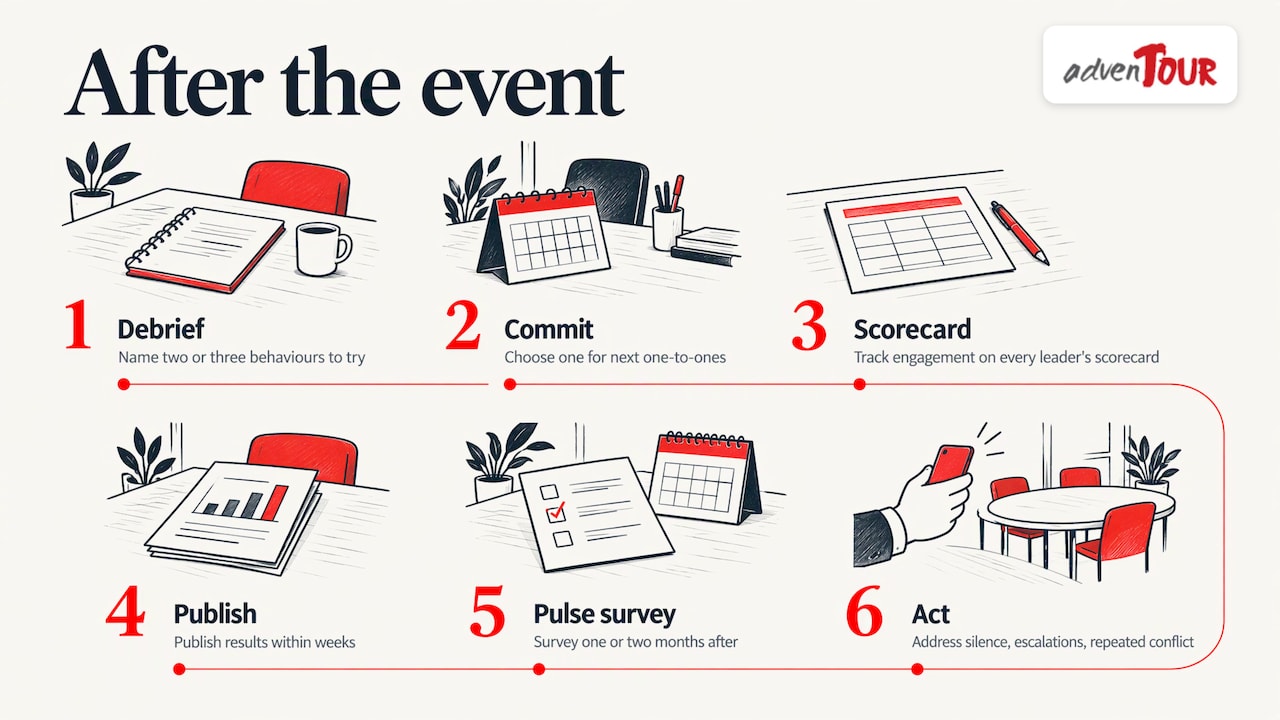
To see whether it worked, look at day-to-day signals rather than only the annual survey. Gallup’s report notes that top-performing organisations treat engagement scores as a KPI on every leader’s scorecard, publish results within weeks and act on them, because measuring without acting breeds cynicism. A short pulse survey a month or two after the event, plus the TAFEP warning signs (silence, escalations to the senior manager, repeated conflict), gives HR a usable read.
Perspective
Most requests we hear start with an activity. The better starting point is the working relationship you want to see afterwards. When the objective is clear, we can tailor the programme to it, scale it to your headcount and budget, and build the debrief so that managers leave with something they can use.
Managers who see each other solve a problem, make mistakes and laugh in a low-stakes setting tend to talk more openly back at work. That is why our programmes put people in shared challenges and then link the experience to daily behaviour, whether through a DISC workshop, an Amazing Race or a sailing day.
For regional meetings held in Singapore, we suggest adding a facilitated session to the agenda rather than leaving bonding to the dinner.
Joshua
Plan your manager programme with us
We plan and run team building for MNCs and SMEs in Singapore, including offsites and regional meetings, with formats from budget-friendly to premium. We were named one of Asia’s Top 10 Corporate Team Building Companies in 2023. Tell us your objective, headcount and budget, and we will shape the programme around them.
See our premium programmes for senior groups, or visit adventour.com.sg to start a conversation.
FAQ
What manager team building activities work best?
Activities that give managers a shared task and a debrief work best. Style workshops such as DISC, collaborative races, and informal food or sailing experiences each address a different objective. Match the format to the relationship outcome you want.
How often should managers invest in relationship building?
Daily habits matter more than any single event. Gallup finds engagement is created by the day-to-day relationship. Many HR teams add a facilitated session once or twice a year to reinforce those habits.
How do managers build trust with a multicultural team?
Explain decisions, ask for feedback and invite quieter members into the conversation, as the Civil Service College advises. Marking cultural holidays and sharing food are simple ways to show respect.
How much does manager team building cost in Singapore?
Our published per-person rates run from $35 for the lightest active formats to $159 for DISC Personality Profiling. Final cost depends on group size, format and venue.
Sources
- Singapore Workplace Report 2026, Gallup
- The boss factor, McKinsey
- Matter of Trust: Leadership Amidst Challenges, Great Place To Work Singapore
- 2026 Edelman Trust Barometer, Singapore report
- Cultivating Collaborative Networks, TAFEP
- How to Improve Leadership Communication, Gallup
- Creating inclusive and harmonious workplaces, MOM
- Making the Most of Diversity through Inclusive Workplace Practices, Civil Service College
- Leadership Induction Package, ICA Psychology Division
Recommended
- Manager Team Development: Building High-Performing Teams
- Team Building Event Ideas in Singapore
- Corporate Team Building Activities: What Works
- How to Improve Workplace Culture: A Practical Plan for Singapore Teams