
Manager team development is the ongoing work of turning a group of capable individuals into a team that shares goals, trusts one another and delivers together. The evidence says the manager sets the pace, and that a well-designed, externally facilitated team building session is one of the most effective ways to lift trust and communication. At Adventour we design and run such programmes for companies in Singapore, from budget-friendly games to premium facilitated workshops.
Key Takeaways
- Managers carry most of the weight: Gallup’s Singapore research attributes 70% of the variance in team engagement to the manager.
- Start with diagnosis, then choose measurable interventions with clear KPIs, rather than picking an activity first.
- Team building interventions make a moderate contribution to performance, with moderate-to-large effects on trust, cohesion and internal communication, and work best when led by someone external and tied to real team problems.
- Shared goals, information-sharing and regular reflection are what separate high-performing teams from groups that merely sit together.
- Follow every session with an action plan and a manager who follows up on it.
Table of Contents
- What manager team development actually involves
- Why the manager is the lever in Singapore
- The stages every team passes through
- A practical routine for building an effective work team
- Choosing the right format for your team
- Measuring whether the team is improving
- Developing the managers themselves
- Plan your team’s next step with us
- FAQ
- Sources
What manager team development actually involves
The ICF defines team development as an intentional, ongoing process of improving a team’s efficiency and its progress toward a common goal. It is not a one-off event or an annual offsite. It is a routine the manager owns.
MIT’s guidance for managers sets out the scope: getting to know employees, supporting their learning, preparing them for future roles and guiding careers. It splits the work into talent planning led by the manager, collaborative performance development, and career planning driven by the employee with manager guidance.
For an HR professional, this means two jobs. You help managers build the day-to-day habits, and you provide moments that reset the team: a retreat, a workshop, a shared challenge.
What a team is, and why it matters
The CIPD’s 2023 evidence review defines a team as a formally established group with autonomy and mutual interdependence. That matters because a department of people doing parallel tasks is not yet a team. The same review finds that team-level goals can outperform individual goals, because shared goals improve planning, cooperation, communication and morale, especially when the team pauses to reflect.
Why the manager is the lever in Singapore
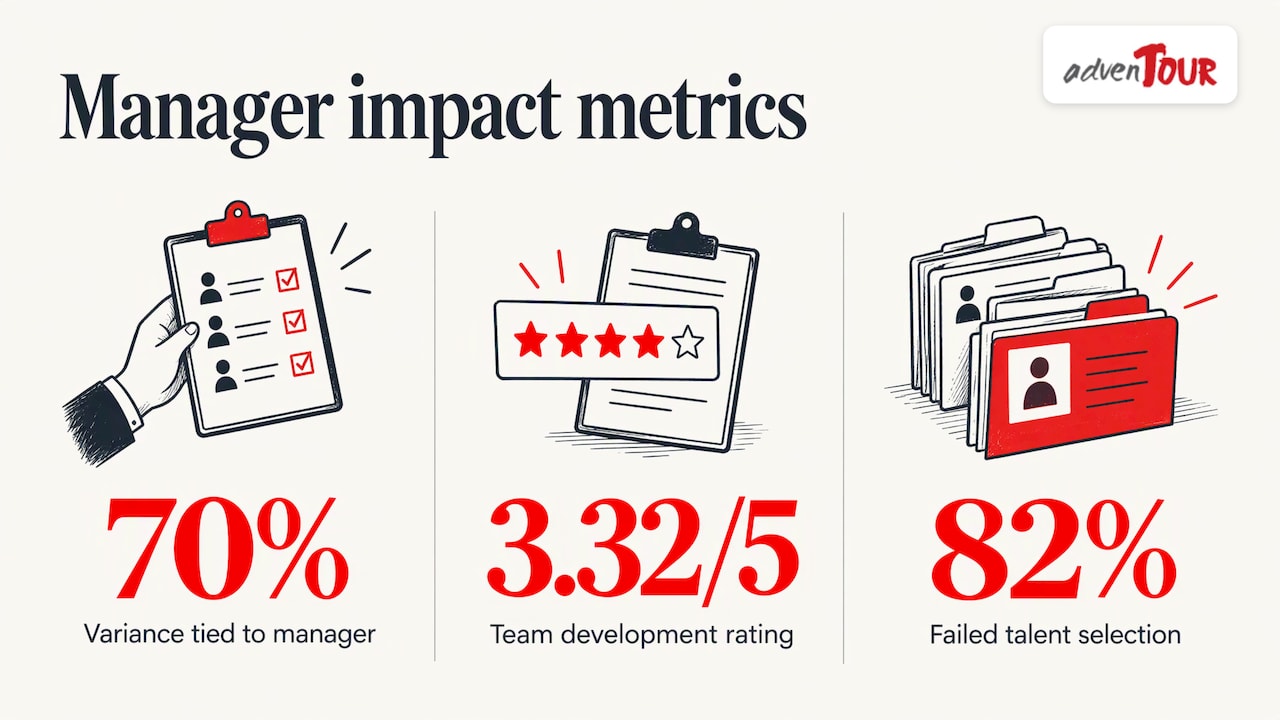
Gallup’s Singapore workplace report, published with the Singapore Institute of Directors, finds that 70% of the variance in team engagement is attributable to the manager. Singapore leaders rated their people managers only 3.32 out of 5 for developing and engaging teams, and the report says companies fail to pick manager candidates with the right talent 82% of the time.
The practical reading: strategy decks, town halls and annual surveys do not create engagement. The daily relationship between a manager and their people does. The report also argues that frontline managers need different development from senior leaders, and that they should be rewarded for managing teams well, not only for individual output.
One Singapore-inclusive multi-country study found that leader humility improved team performance by building the team’s shared psychological capital and helping the team allocate tasks more effectively. Self-aware, humble leadership is a skill managers can practise.
The stages every team passes through
Tuckman’s model, as summarised by Talogy, describes five stages:
- Forming: people learn the objectives and each other. Conflict is low.
- Storming: people challenge ways of working, and turnover can follow.
- Norming: the team agrees goals, roles and working methods.
- Performing: commitment is high, the team is stable and handles conflict well.
- Adjourning: the team reflects, celebrates and plans the next transition.
The process is not linear. A new leader or shifted objectives can send a team back to storming. This is why a regional team that has just absorbed a reorganisation, or a newly merged group, benefits from a structured reset rather than being left to settle on its own.
A practical routine for building an effective work team
1. Diagnose before you intervene
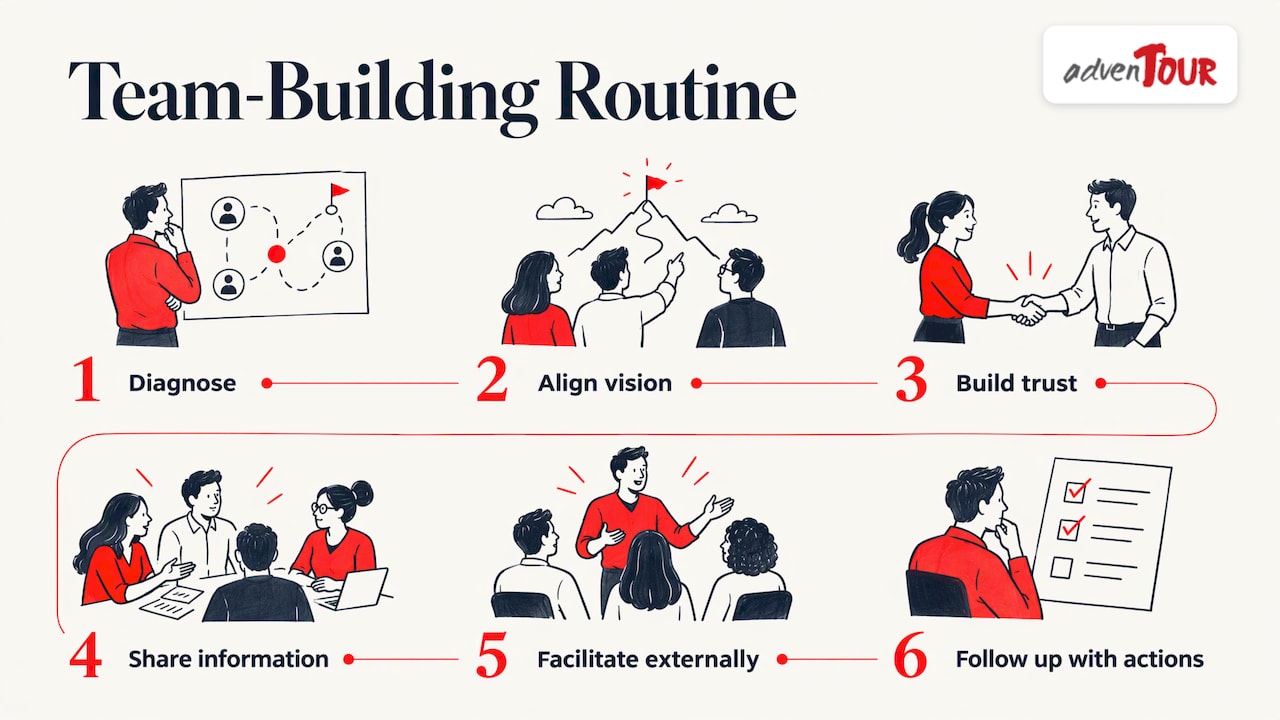
The ICF recommends starting with one-on-one interviews, surveys, focus groups and talent assessments, then choosing interventions with specific KPIs. Ask three questions: Is the goal clear? Do people share information freely? Do they trust one another enough to disagree?
2. Set a common vision and behavioural expectations
Singapore’s Ministry of Manpower advises managers to establish a common team vision that transcends differences, remove “us versus them” divisions and set behavioural expectations that are reviewed regularly in mentoring sessions, performance reviews and team meetings. This is especially relevant for teams spanning several nationalities, as most Singapore-based regional teams do.
3. Build trust deliberately
The US National Cancer Institute’s team science field guide calls trust the foundation of any successful collaboration. Its recommended habits include regular meetings where every member presents and receives feedback, modelling constructive feedback, encouraging debate, creating psychological safety, holding people to their commitments and agreeing in advance how disagreements will be handled.
4. Make information flow
The CIPD finds that information-sharing predicts performance across team types and sizes. Its recommendations include a shared record of who knows what, channels for exchanging information with recognition for those who share, and regular non-evaluative time for the team to reflect.
5. Use an external, facilitated session
Per the CIPD review, team building interventions work best when initiated by someone external to the team, supported by management and focused on the group and on tangible problems rather than on individuals. This is where an experienced facilitator earns the fee: they run the session so the manager can take part as a member of the team, and they steer the activity toward the team’s real issues.
6. Capture an action plan and follow up
The APA’s paper on team development interventions stresses that interventions should end with action plans or agreements so nobody is unsure what to do next, and that managers must follow up to maintain accountability. A session that ends on a high and a group photo, without commitments, fades within weeks.
Choosing the right format for your team
Match the activity to the problem, then to the budget. All prices below are Adventour’s published per-person ranges, and your final quote depends on group size and programme design.
| Team need | Format | Published price per person |
|---|---|---|
| Energy and quick bonding on a tight budget | Combat Skirmish Laser Tag | $37-45 |
| Communication across mixed groups | App-based Amazing Race | $40-55 |
| Problem-solving and cooperation | Amazing Race | $65-78 |
| Understanding working styles | Modified DISC Workshop | $70-82 |
| Deep dive into personality and collaboration | DISC Personality Profiling | $150-159 |
| Team dynamics at work | Office Dynamics Workshop | $80-90 |
| Leadership offsite with a memorable setting | Corporate Sailing Team Building | $125 |
A few pairings work well in practice. A newly formed team in the forming stage suits a lighter, active format where people learn each other’s names and habits. A team stuck in storming suits a profiling workshop such as DISC, which gives people a shared vocabulary for how colleagues prefer to communicate and decide. Large regional groups gathering in Singapore for a conference can take an outdoor or app-based format that scales, with the programme sized to head count.
Measuring whether the team is improving
Pick measures before the session, as the ICF advises. A useful frame, described in this guide to team effectiveness, covers four areas:
- Performance: productivity, quality, error rates, ideas implemented.
- Teamwork: goal clarity and trust, measured by short surveys, plus coordination failures.
- Influence on members: well-being, growth and development.
- Reputation: how colleagues outside the team see it.
Run the same short survey before and after a programme and again a few months later. The CIPD’s finding that team building lifts trust, cohesion and internal communication tells you which survey items to watch first.
Developing the managers themselves
Gallup’s roundtable framework, the Three Es, names what managers need: to engage (trust, commitment, regular one-on-ones), to enhance (structured capability development) and to empower (delegating decisions). The skills it highlights are frequent feedback, active listening, removing operational blockers and holding people accountable.
A 2024 study of Asian workplaces by Tan, van Dun and Wilderom found that 11 leader behaviours grouped as envisioning, energizing and enabling predicted followers’ innovative work behaviour four months later. Managers who want to apply this consistently can pair training with structured support such as blended digital programmes for corporate health and manager development, which help leaders keep engaged, high-performing teams on track between sessions.
Our perspective
A team does not become high-performing because it had a fun afternoon. It becomes high-performing because the afternoon was designed around a real objective, run by a facilitator the team trusts, and followed by something the manager does on Monday.
That is how we build programmes at Adventour. Our approach is customised to each client’s objectives, scalable for group size and budget, and centred on experiential learning and skill transfer rather than passive entertainment. We run everything from budget-friendly laser tag and Amazing Race formats to premium DISC profiling and sailing, so the choice can follow the team’s need and not the other way round.
When HR leaders brief us, the strongest briefs name one behaviour they want to see more of: sharing information earlier, disagreeing openly, handing over work cleanly. Start there, and the activity almost chooses itself.
Joshua
Plan your team’s next step with us
Adventour was recognised as one of Asia’s Top 10 Corporate Team Building Companies in 2023. We plan and run team building, retreats, workshops, wellness events and CSR programmes for companies in Singapore and for regional teams visiting for meetings and conferences, at a fixed per-person or per-event fee.
If you are choosing between formats, start with our budget-friendly, quality and premium programme pages, then brief us on the team’s goal and headcount. You can also see what works in corporate team building in Singapore.
FAQ
What is the manager’s role in team development?
The manager leads talent planning, supports each person’s learning and career, sets expectations and keeps the team accountable. MIT’s guidance describes this as getting to know employees, supporting development and preparing people for future roles. Gallup’s Singapore research shows how much of team engagement depends on this relationship.
How do you build an effective work team?
Diagnose first, agree a shared goal, build trust through regular feedback and open discussion, and keep information flowing. Add a facilitated team building session when the team needs a reset, then agree an action plan and follow up on it.
Does team building actually improve performance?
The CIPD’s 2023 review finds a moderate contribution to team performance, driven by moderate-to-large effects on trust, social cohesion and internal communication. Results are strongest when management supports the session, an outside party runs it and it focuses on tangible team problems.
How much does corporate team building cost in Singapore?
Our published per-person ranges run from $35-45 for Kinball and $36-43 for Bloop Bubble Soccer, to $65-78 for Amazing Race and $125 for corporate sailing. Final pricing depends on the programme and group size, so send us your headcount and objective for a quote.
Sources
- Why Team Development is Key to Organizational Success, ICF
- Developing Your Team, MIT Human Resources
- High-performing teams: An evidence review, CIPD
- Powering Singapore’s Future, Gallup and Singapore Institute of Directors
- Leader humility and team performance study
- What Is Team Development in Management, Talogy
- Managers’ guide to workplace diversity, Ministry of Manpower
- Collaboration and Team Science Field Guide, NIH
- Team Development Interventions, APA
- An in-depth guide to team effectiveness
- What leader behaviours evoke employee innovative work behaviour in Asia, Journal of Management & Organization
Recommended
- Effective Team Building Feedback Strategies For Team Growth
- How to Choose Team Building Activities
- Corporate Team Building Activities: What Works