
The best sales team building ties the activity to something your reps do every week: coordinating handoffs, handling pressure, sharing information and competing without splitting the team. Pick activities that clarify roles, align goals and give reps real problems to solve together. Then debrief them back to the sales floor. In Singapore, that can cost from $35 per person for a high-energy half-day to $159 for a profiling programme. This guide shows how to choose, what to expect and how to plan.
TL;DR
- Choose activities that match a sales goal: trust, coordination, resilience under pressure, or role clarity. Fun alone will not carry over to the pipeline.
- A 2009 meta-analysis of 2,650 teams found moderate positive effects of team training on teamwork and performance outcomes. Content and team size affect the result.
- Budget formats in Singapore run roughly $35 to $55 per person, mid-tier $65 to $90, premium $82 to $159 (our published ranges).
- Always end with a debrief that links the activity to deals, handoffs and targets.
- Check venue, permit and safety requirements early, especially for large or covered outdoor events.
Table of Contents
- Why sales teams need team building that is different
- What team building can realistically improve
- Match the activity to the sales problem
- What it costs in Singapore
- How to plan it step by step
- Logistics specific to Singapore
- Ideas for large groups and CSR
- Our perspective
- Plan your sales team’s event with us
- FAQ
- Sources
Why sales teams need team building that is different
Sales is an odd mix. Reps are measured individually, often compete for leads or territories, and still depend on colleagues: sales development reps passing leads to account executives, inside sales working with field sales, sales engineers supporting pitches. When these links are weak, deals stall quietly.
The research backs the collaboration point. A 2023 study in the Journal of the Academy of Marketing Science found that the collaboration experience of inside-outside sales pairs affected customer-level sales outcomes, and that customers with more complex needs bought more when the pair’s collaboration was long or intensive. Another study of 73 B2B cross-functional sales teams reported that social capital inside and between teams supported adaptive selling and sales performance, especially as tasks got more complex.
That tells you what to aim for: stronger working relationships between the specific people who hand work to one another, not just a pleasant afternoon.
What team building can realistically improve
Be precise with your leadership about outcomes. A meta-analysis of 93 effect sizes found moderate, positive relationships between team-training interventions and cognitive, affective, teamwork-process and performance outcomes. The authors noted that content, membership stability and team size moderate how well it works.
A second meta-analysis on team building found a positive, moderate effect overall, strongest for affective and process outcomes, with goal setting and role clarification showing the largest effects among the components studied.
In plain terms:
- Likely gains: trust, communication habits, shared understanding of who does what, smoother coordination.
- Possible downstream gains: helping behavior, effort and sales results. In a study of 185 pharmaceutical sales teams, team climate and leader empowerment were linked to team potency, which in turn translated into helping, effort and sales performance. Those are associations within that study, not a promised lift from a single event.
- Not realistic: a one-off event that fixes a broken compensation plan or a weak pipeline.
Singapore’s Ministry of Manpower makes a related point at national level. In a 22 June 2026 speech on the Workplace Report 2026, it linked good relationships with supervisors, colleagues and teams to belonging, ownership and purpose, and said engaged workforces benefit productivity, retention and innovation.
Match the activity to the sales problem
Start with the problem, then choose the format. Here is how we map common sales challenges to activities.
| Sales challenge | What to practise | Activity types that fit |
|---|---|---|
| Handoffs between SDRs, AEs and support are messy | Clear roles, fast communication | Amazing Race formats, Office Dynamics-style workshops |
| New and veteran reps do not mix | Trust across tenure and region | Mixed-team scavenger hunts, food immersion walks |
| Reps clash because of different styles | Understanding how colleagues prefer to communicate | DISC profiling workshops |
| Team is flat after a tough quarter | Energy, shared laughs, light competition | Laser tag, bubble soccer, Kinball |
| Pitches need sharpening | Structured persuasion under time pressure | Shark Tank-style pitch challenge |
| Leadership offsite for sales managers | Strategy, reflection, deeper conversation | Sailing, premium facilitated retreats |
Competitive formats that keep it collaborative
Sales people like to win, so use it. The trick is to compete team against team, with scoring that rewards cooperation: shared clues, split tasks, a team result rather than an individual leaderboard. Brainshark suggests group problem-solving tasks such as a scavenger hunt and mixing reps by region or tenure for role-play, which fits this approach.
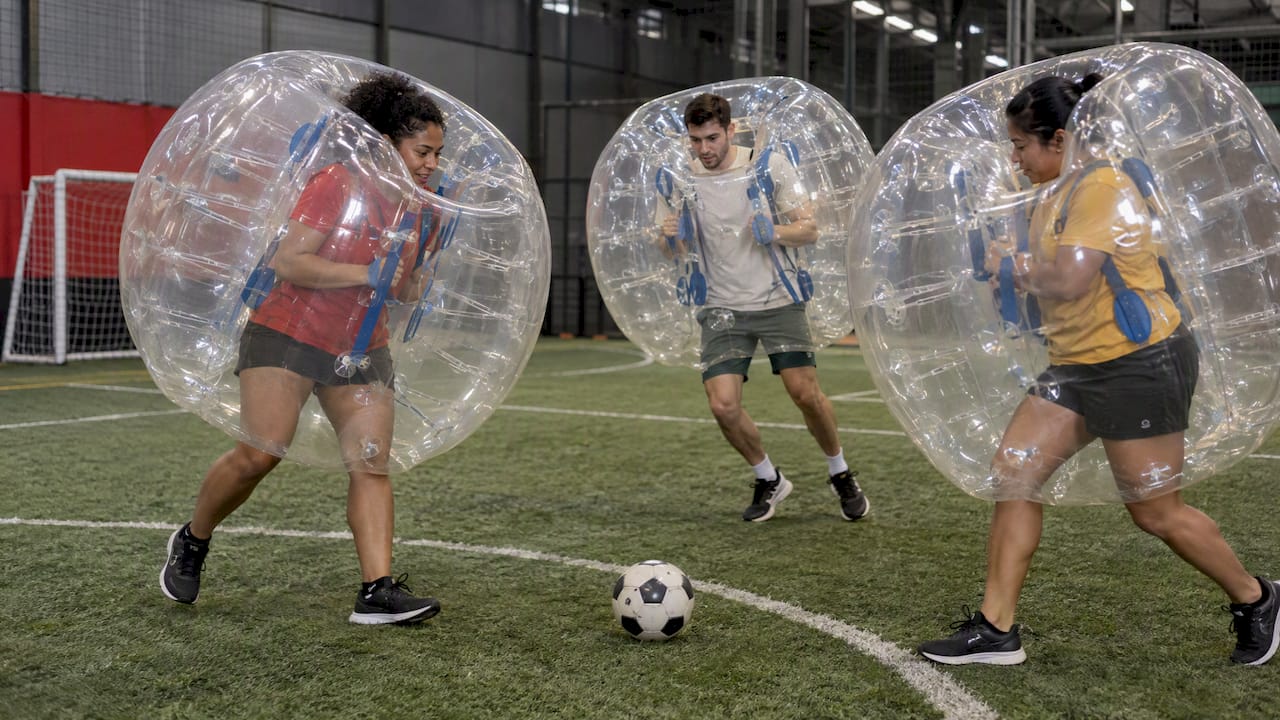
In Singapore, popular options include an app-based Amazing Race across the city, a bicycle scavenger hunt, laser tag and bubble soccer. Our laser tag corporate events and corporate bubble soccer formats are designed to be adjusted so teams must communicate and split roles to succeed, rather than just run around.
Pitch and persuasion challenges
An Office Shark Tank format has teams build an idea and pitch it to a panel. For sales teams it works well when the pitch brief uses a real or realistic product scenario, because reps practise structuring a message, handling questions and supporting each other under pressure. Role-playing selling scenarios such as objection handling is also something Brainshark recommends for sales kickoffs.
Style and communication workshops
A DISC profiling workshop gives reps a shared vocabulary for how colleagues prefer to communicate and decide. For a sales team that is useful in two places: internally (why does my manager frustrate me?) and externally (how do I adapt to this buyer?). Our guide on the benefits of DISC profiling explains the approach in more depth.
Cultural and experiential outings
For regional teams that fly into Singapore, a walking food immersion through Katong and Joo Chiat or other cultural team events create conversation that is not about quota. Mixed nationalities are common in regional sales meetings, and shared experiences help people connect before the working sessions begin.
What it costs in Singapore
These are our published per-person ranges, which vary with group size, venue and customisation. Check the linked pages for the details of each programme.
| Tier | Examples | Price per person |
|---|---|---|
| Budget-friendly | Kinball | $35-$45 |
| Bloop Bubble Soccer | $36-$43 | |
| Combat Skirmish Laser Tag | $37-$45 | |
| App-based Amazing Race | $40-$55 | |
| Bicycle Scavenger Hunt | $45-$55 | |
| Quality | Amazing Race | $65-$78 |
| Garden Odyssey | $68-$90 | |
| Laser Clay Shooting | from $69 | |
| Modified DISC Workshop | $70-$82 | |
| Running Man Challenge | $72-$82 | |
| Premium | Office Dynamics Workshop | $80-$90 |
| Katong/Joo Chiat Cultural Food Immersion | $82-$98 | |
| Office Shark Tank | from $92 | |
| Corporate Sailing Team Building | $125 | |
| DISC Personality Profiling | $150-$159 |
If you already have a venue and facilitators, event rentals are available too: bubble suits at $28 per hour per ball, laser tag guns at $25 to $33 per hour per gun, and portable tentage at $95 per day per tent.
A practical way to budget: put the sales team’s real goal first. A team that needs to reconnect after a hard quarter may be well served by a $40 half-day. A team that needs to fix how personalities collide may justify the profiling workshop. Mixing is common too, for example a competitive game in the afternoon after a workshop in the morning.
How to plan it step by step
- Name the goal in one sentence. For example: “SDRs and account executives agree how a qualified lead is handed over.” Goal setting and role clarification were the components with the largest effects in the team-building meta-analysis.
- Survey the team. Ask what they would enjoy, what they would avoid and any mobility, dietary or religious needs. Brainshark also suggests surveying salespeople and assigning pre-work.
- Mix the teams on purpose. Put new reps with veterans, one region with another, inside sales with field sales. Singapore’s Ministry of Manpower diversity guide says well-managed diverse teams can be more creative at problem solving, while poorly managed ones can see trust and communication break down.
- Choose the format and venue. Culture, practice and recognition work best in person, according to a sales kickoff planning guide, while pure information transfer can go virtual.
- Run a debrief. Ten minutes at the end: what did we do well as a team, where did we lose time, what will we do differently on Monday?
- Follow up. Pick one behaviour to carry into the next pipeline review or team meeting.
Time it around the sales calendar
Avoid the last two weeks of a quarter. Reps will be distracted and resentful. The week after a quarter closes, a sales kickoff or an offsite is usually easier to protect. Half-day formats fit around customer calls; full-day or overnight retreats suit leadership offsites and kickoffs.
Hybrid and remote reps
Some of your team may be abroad or remote. The same kickoff guide suggests shorter sessions, breakout-room practice and prerecorded content for virtual or hybrid events. Research from the University of Birmingham also found that trust in virtual sales-team relationships can be stronger than in co-located ones when leaders are member-centric and members talk about more than the agenda. If you can bring everyone to Singapore, do it. If not, have the leader set aside unstructured time on calls.
Logistics specific to Singapore
Most of this is handled by a good event planner, but know what to ask.
- Covered temporary structures. For covered temporary events lasting no more than 60 days, the SCDF requires a Temporary Change of Use permit (TCOUP) and compliance with fire-safety conditions, including unobstructed escape routes and passageways of at least 1.2 metres between booth rows. Ask your provider who applies for it if you plan tents or carnival-style setups.
- Workplace safety. The Workplace Safety and Health Act 2006 governs safety in workplaces across Singapore. Ask providers about risk assessments, briefings and first-aid arrangements for physical activities.
- Weather. Singapore afternoons bring sudden storms. Choose a covered or indoor backup, or portable tentage, for outdoor sessions.
- Group size. Large groups need more facilitators, more stations and tighter timing. Share your headcount early, including attendees flying in.
- Inclusivity. Offer roles for people who prefer not to run or take part in contact games: scorekeeper, navigator, strategist.
Ideas for large groups and CSR
Sales kickoffs and regional meetings often bring 100 or more people together. Formats that scale well include app-based city races, where many small teams play in parallel, and carnival-style stations. We also run CSR programmes where teams give back while they bond, which suits sales teams that want to build a connection around something other than targets. If families are involved, a family day carnival can reward a successful year.
Our perspective
We see the same pattern with sales teams. They are competitive, quick and often tired of generic team building. So we do not sell them entertainment. We design programmes around the behaviour the leader wants to change.
A race becomes a lesson in splitting tasks and sharing information. A pitch challenge becomes practice at structuring a message. A DISC workshop becomes a conversation about how to work with the colleague who irritates you.
We tailor each programme to the client’s objectives, group size and budget, and our facilitators run a debrief so the learning is not lost when the lanyards come off. That is the difference between a good afternoon and a team that works differently on Monday.
Joshua
Plan your sales team’s event with us
Tell us the goal, the headcount and the budget, and we will propose a programme that fits. Our team designs and runs events from budget-friendly games to premium facilitated retreats, and we customise them to the objectives of your sales team.
Browse the budget-friendly activities, compare premium programmes, or get in touch through our site to discuss your team. You can also read about what works in corporate team building in Singapore.
FAQ
What is the best team building activity for a sales team?
There is no single best one. Choose by goal: an Amazing Race or scavenger hunt for coordination, a pitch challenge for persuasion, a DISC workshop for communication styles, and laser tag or bubble soccer for energy. Competitive team-versus-team formats tend to suit sales people.
How much does sales team building cost in Singapore?
Our published ranges are about $35 to $55 per person for budget-friendly activities, $65 to $90 for quality programmes, and $82 to $159 for premium ones, with some starting prices. The final amount depends on group size, venue and customisation.
Does team building actually improve sales results?
Research shows moderate positive effects of team training on teamwork and performance outcomes, strongest on trust and process. A meta-analysis of team training also notes that content and team size matter. Treat it as support for collaboration, not a guaranteed revenue boost from one event.
How long should a sales team building session be?
Half a day suits most teams, because reps can still handle client commitments. Use a full day for kickoffs, leadership offsites or when you want a workshop plus a game. Always reserve time at the end for a debrief.
Sources
- Building effective inside-outside sales rep dyads (Journal of the Academy of Marketing Science, 2023)
- Does Team Building Work? (2009)
- Does team training improve team performance? A meta-analysis (2009)
- The Role of Consensus in Sales Team Performance (2010)
- Impacts of intra-team and inter-team social capital on adaptive selling
- Ministry of Manpower: speech at launch of Singapore Workplace Report 2026
- Ministry of Manpower: workplace diversity management guide
- Brainshark: sales kickoff readiness and planning
- How to plan a sales kickoff: timeline, agenda and budget
- University of Birmingham: trust development in virtual teams
- SCDF: Temporary Change of Use
- Workplace Safety and Health Act 2006
Recommended
- Team Building Event Ideas in Singapore
- Team Building Activities Singapore — Complete 2026 Guide
- Top 10 Classic Team Bonding Activities Ideas to Engage Employees
- Top Team Building Activities in Singapore for 2026
Made with BabyLoveGrowth to improve visibility in AI search