
The most reliable way to reduce workplace stress is to work on two levels at once. Individuals name their stress triggers, plan their workload, rest properly and speak up early. Employers fix the conditions behind the stress: workload, after-hours messages, manager support and how well colleagues know each other. This guide covers both, with Singapore sources, local helplines and team activities that HR leaders can put into a calendar.
TL;DR
- Stress usually comes from workload, lack of control, long hours, conflict and poor support, so list your own triggers before choosing a fix.
- Daily basics matter: about 7 hours of sleep, regular movement, proper meals, planned tasks and deliberate breaks.
- Talk to your manager early. If it feels heavy, Singapore has helplines such as Samaritans of Singapore (1767, 24 hours).
- Employers can set after-hours rules, build peer support, appoint a mental well-being champion and schedule time for bonding activities.
- Well-designed team activities help colleagues trust each other, which makes asking for help easier.
Table of Contents
- Why workplace stress is so common in Singapore
- Start by finding your own triggers
- Daily habits that lower stress
- Speak up early, and know where to get help
- What employers can do to reduce employee stress
- Team activities that ease pressure and build trust
- Our perspective
- Plan a stress-friendly team day with us
- FAQ
- Sources
Why workplace stress is so common in Singapore
Stress at work is not a personal failing. It is a predictable response to specific conditions, and those conditions are well documented.
The Institute of Mental Health (IMH) lists the usual stressors: unreasonable expectations, heavy workloads, lack of control or job security, long hours, conflict or lack of support, and poor work environments. It also includes habits such as skipping meals, sleeping too little, relying on caffeine or alcohol, and negative self-talk. Left for a long time, stress can raise the risk of anxiety, depression, heart disease and digestive problems. Burnout shows up as exhaustion, mental distance from work and lower efficiency.
The Tripartite Advisory on Mental Well-being at Workplaces, issued by MOM, NTUC and SNEF, groups the causes into work content (job scope, workload, pace, schedule, control) and work context (organisational culture, relationships, the home-work interface). That split is useful. Some of your stress comes from the job itself, and some from the way people around you work.
The numbers show how widespread this is:
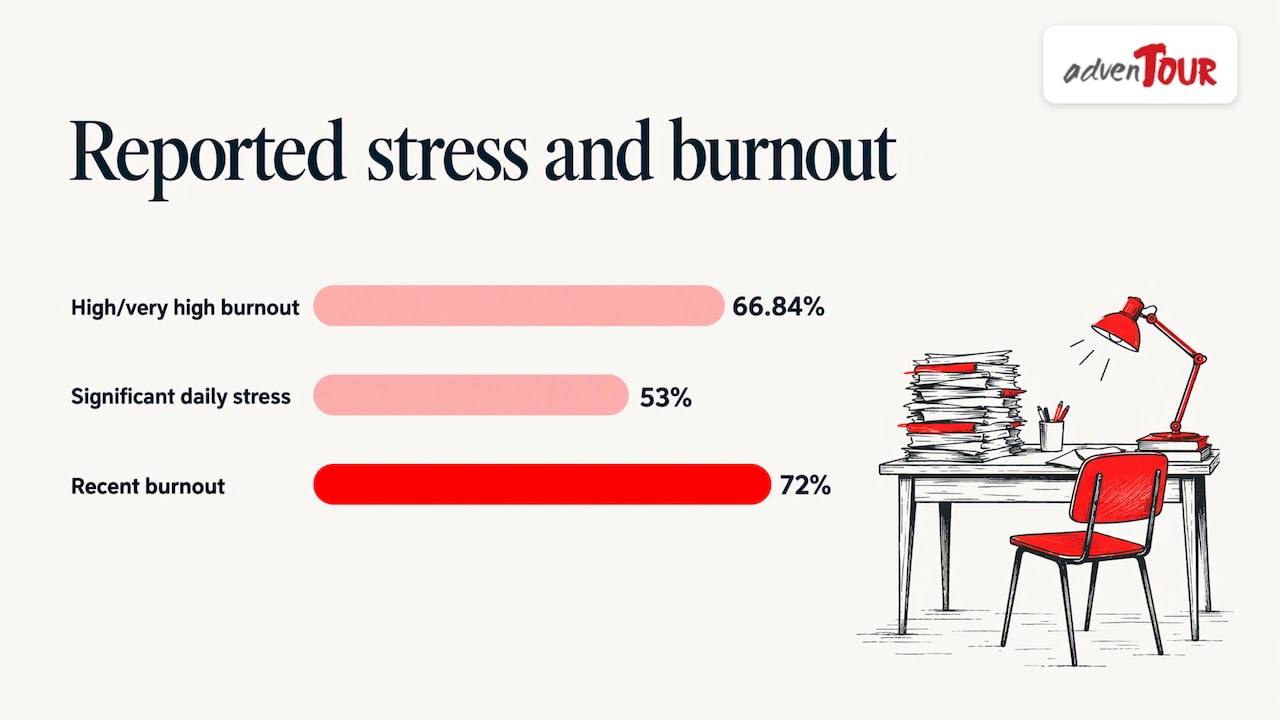
- A 2024 study of 4,338 full-time employees across four Southeast Asian countries found that 66.84% of Singapore respondents reported high or very high burnout, the second-highest of the four.
- ManpowerGroup’s January 2026 Singapore report found that 53% of employees felt significant daily stress and 72% had recently experienced burnout, with heavy workloads and job insecurity among the leading causes.
- A Duke-NUS and IMH study suggested that anxiety and depression symptoms could cost Singapore nearly $16 billion a year, about 2.9% of GDP, through absenteeism, lower productivity and healthcare use.
For an employer, that last figure is the business case. For an employee, the first two are a reminder that you are far from alone.
Start by finding your own triggers
Before you try any technique, find out what is actually causing the pressure. IMH suggests listing the tense situations you face and looking for patterns. Do this for a week. Each time you feel tight in the chest or irritable, write down:
- What was happening (a deadline, a meeting, a message from a certain person).
- What you needed (more time, clearer instructions, a pause).
- What you did.
Most people find that three or four triggers repeat. A few usually point to the job design: too many tasks, unclear priorities, no say in how work is done. Others point to relationships. This sorting tells you whether the fix is a personal habit, a conversation with your manager or a change your company needs to make.
Daily habits that lower stress
These are small and unglamorous, and they work because they protect the body that has to absorb the pressure.
Plan and prioritize
IMH recommends planning and prioritising tasks with a calendar and estimating how long each takes. Underestimating time is a quiet source of stress. If a task takes three hours, block three hours, not one. When the calendar is full, that is evidence for a conversation about what comes off the list.
Sleep enough
The Health Promotion Board advises adults to aim for about 7 hours of sleep a night, noting that sleep helps the mind organize thoughts and improves concentration and productivity. If you check email in bed, you are trading sleep for a few minutes of apparent progress.
Move and eat properly
MOM’s employee guide suggests brisk walking, taking the stairs and simple stretches, plus balanced meals, no skipped meals, water instead of sweetened drinks and more fruit and vegetables. On a crowded day, a ten-minute walk after lunch at a hawker centre or around your building is realistic. A packed desk lunch eaten while typing is not a break.
Pause before you react
When a message lands badly, the same guide advises taking a break with slow, deep breaths before reacting. It also suggests keeping a diary to express feelings and using positive self-talk such as “I can” and “I am able to”. IMH adds progressive muscle relaxation: tense and release each muscle group in turn, from your feet up to your shoulders. It takes about five minutes at your desk or in a quiet meeting room.
Protect your recovery time
Spend time with family and friends, do something you enjoy, and keep alcohol, tobacco and other substances out of your coping toolkit. IMH lists these as part of looking after yourself, and they matter most in the weeks when work is heaviest.
Look at your physical surroundings
Noise, poor ergonomics and a drab or cluttered desk all feed background strain, and IMH names the work environment as a stressor. Adjust your chair and screen height, reduce noise where you can, and consider how the space feels. Research on art in workspaces and well-being is one place to start if you want ideas for making an office feel calmer. Pair it with short movement breaks every hour to ease physical tension.
Speak up early, and know where to get help
Many employees wait until they are exhausted to say anything. Earlier is easier. Tell your manager which tasks are crowding you out, what you have already tried, and what would help: a deadline moved, a priority clarified, a task reassigned. Bring the triggers list from earlier so the conversation stays concrete.
If stress is affecting your sleep, mood or health, or talking at work does not feel possible, outside support exists. MOM’s guidance lists these contacts:
| Service | Number |
|---|---|
| Samaritans of Singapore (24 hours) | 1767 |
| Singapore Association for Mental Health (SAMH) | 1800 238 7019 |
| Singapore Counselling Centre | 6339 5411 |
| Silver Ribbon | 6386 1928 |
Migrant domestic workers can also call the MDW Helpline (1800 339 5505) or the Centre for Domestic Employees (1800 225 5233, 24 hours), as listed on MOM’s page on helpers’ mental well-being. If you feel you are in immediate danger or thinking of harming yourself, call 1767 or see a doctor or visit an emergency department right away.
What employers can do to reduce employee stress
Individual habits only go so far when the workload is the problem. The Tripartite Advisory is clear that its focus is what workplaces can do to support employees’ mental well-being. These are the practices it points to, and what they look like in a normal Singapore office.
Set an after-hours communication policy
The advisory suggests a policy stating that messages sent after work hours do not expect a reply until the next working day, except those marked “Urgent”, and giving time off to employees who must work after hours. With regional teams across time zones, this one rule removes a lot of low-level dread.
Build peer support and clear escalation
The same advisory recommends a peer support system with trained peer supporters, clear escalation protocols for referring colleagues to professional help, and time and resources for bonding activities that strengthen relationships. People ask a trusted colleague for help long before they fill in a form.
Appoint a mental well-being champion
It also recommends appointing workplace mental well-being champions who rally senior management, organise programmes, set up referral systems and review employees’ mental well-being regularly as part of workplace health risk assessment. In a smaller company this can be one HR lead with a clear mandate.
Use the free support that exists
MOM has said it does not currently mandate mental health training for employers and managers, but the WSH Council’s Total WSH Programme gives free access to qualified consultants and intervention programmes such as mental well-being workshops. The advisory also notes that upcoming Workplace Fairness Legislation will prohibit discrimination based on mental health conditions and require grievance handling procedures, so it is worth having these processes ready.
Teach managers the relationship basics
IMH’s guidance on healthy work relationships is practical: start with respect and friendliness, lead by example, practise active listening and kind responses, respect boundaries, and give and receive feedback constructively. It also encourages building connection beyond work through casual chats and team events. Interpersonal conflict is a named stressor, so improving how people talk to each other is stress reduction, not a soft extra.
Team activities that ease pressure and build trust

Support systems work only if people trust each other enough to use them. Shared, well-run activities give colleagues a different kind of contact from meetings and email: they solve problems together, laugh, see each other’s strengths and learn how teammates communicate. That is the thinking behind our programs, which are designed to build collaboration and communication rather than entertain passively.
The right format depends on your group, budget and what is causing the strain. Here is how we match them. Prices are per person, as published on our site.
| Need | Format | Published price |
|---|---|---|
| Release energy, quickly break the ice | Combat Skirmish Laser Tag | $37-45 |
| Light, active, laugh-out-loud bonding | Bloop Bubble Soccer | $36-43 |
| Working together under mild pressure | App-based Amazing Race | $40-55 |
| Understand how colleagues communicate | Modified DISC Workshop | $70-82 |
| Deeper insight into personalities and conflict | DISC Personality Profiling | $150-159 |
| Relaxed, social, away from the desk | Katong/Joo Chiat Cultural Food Immersion | $82-98 |
| A premium, memorable offsite | Corporate Sailing Team Building | $125 |
Match the activity to the stressor
- Friction between colleagues or departments: a profiling workshop such as DISC gives people a shared language for why they clash. It turns “they are difficult” into “they prefer a different pace”. The Office Dynamics Workshop ($80-90) is built along similar lines.
- Low morale after a heavy quarter: pick something active and light. Laser tag or bubble soccer gets people moving and laughing, and the budget-friendly range starts at $35 per person for Kinball.
- A new or merged team: an Amazing Race style challenge mixes people, gives them a shared goal and shows who takes initiative. Our Amazing Race ($65-78) suits mid-sized groups.
- Regional visitors or an MNC meeting: a cultural outing, such as the Katong/Joo Chiat food immersion, gives guests a relaxed way to connect with local colleagues.
- Giving back together: CSR programs let a team do something meaningful side by side. Contact us for details, as there is no published price.
If you are choosing between indoor and outdoor, our guide to indoor team building in Singapore covers options that work in Singapore’s wet weather, and our outdoor team building exercises page covers the open-air formats.
Make the day count
An activity helps only if it fits into how you run the team. Three rules we suggest:
- Do not schedule it on top of a deadline. A team building day squeezed between crunch periods feels like extra work.
- Set a purpose with the facilitator. Tell us whether the goal is trust, communication, cross-team ties or simply a break. We tailor the program to it.
- Follow up. Ask the team a week later what one thing they would do differently. Small agreed changes make the effect last.
Our perspective
We run team building for companies across Singapore, and we see the same pattern before many bookings: the team is not short of talent, but people have stopped talking to each other openly. Deadlines pile up, everyone works in their own corner, and small frictions turn into silent stress.
We believe a team activity should do more than fill an afternoon. That is why we customize programs to a client’s objectives, scale them to the group size and budget, and use experienced facilitators who steer the day toward communication and skill transfer. A laser tag session can end with a conversation about how the team handled pressure. A DISC workshop can end with two colleagues understanding each other for the first time.
Stress will not disappear because of one outing, and we would never claim that. What we aim for is a team that is a little more connected, so that asking for help, flagging overload or giving honest feedback feels less risky on Monday morning. Pair that with sensible workload, clear after-hours rules and good manager support, and a team day becomes part of a real plan.
Joshua
Plan a stress-friendly team day with us
If you are an HR leader or event planner looking for a team session that supports your well-being plans, we design and run programs for groups of all sizes, from budget-friendly formats to premium offsites and large executive retreats. Start with our budget-friendly activities, compare the quality programs and premium programs, or tell us your goal and we will propose a format.
If you need equipment only, our event rentals include bubble suits ($28 per hour per ball), laser tag guns ($25-33 per hour per gun) and portable tentage ($95 per day per tent). To discuss your team and your goals, visit AdvenTOUR.
FAQ
What is the fastest way to reduce stress at work?
Pause and take slow, deep breaths before you react, as MOM’s employee guide advises. Then step away for a short walk or stretch. These calm the body in minutes, but the lasting fix is addressing the trigger, such as an unclear priority or an overloaded calendar.
How do I tell my manager I am stressed?
Keep it specific and solution-focused. Name the tasks or situations that are causing strain, say what you have tried, and suggest what would help, such as moving a deadline or clarifying priorities. Early, concrete conversations are easier for both sides than waiting until you are exhausted.
What can companies do to reduce employee stress?
The Tripartite Advisory points to after-hours communication policies, peer support with clear escalation to professional help, a workplace mental well-being champion and regular reviews of employee well-being. It also recommends setting aside time and resources for bonding activities that strengthen relationships among employees.
Can team building really help with workplace stress?
It can support it, mainly by improving trust and communication between colleagues. We design our programs to build collaboration and communication, and they work best alongside sound workload management and manager support rather than as a substitute.
Who can I call if work stress feels overwhelming?
In Singapore you can call Samaritans of Singapore at 1767 (24 hours), the Singapore Association for Mental Health at 1800 238 7019 or the Singapore Counselling Centre at 6339 5411. If you are struggling to cope, also see your doctor.
Sources
- Workplace mental health: Tips for stress and burnout, IMH
- Tripartite Advisory on Mental Well-being at Workplaces, MOM
- Tripartite Advisory on Mental Health and Well-being at Workplaces (PDF), MOM
- Mental Well-being guide for employees, MOM
- Look out for your helper’s mental well-being, MOM
- Your Guide to Stress Management, HealthHub
- Written answer to PQ on mental health support for employers, MOM
- Prevalence and associated factors of burnout, Frontiers in Public Health
- Singapore workers and burnout, ManpowerGroup
- Anxiety, depression could be costing Singapore’s GDP almost $16b a year, The Straits Times
- Role of art in workspaces and well-being
Recommended
- How to Prevent Employee Burnout: A Singapore Guide for Employers
- How to Resolve Workplace Conflict: A Practical Guide
- How to Reduce Employee Turnover: A Singapore Employer’s Guide
- Corporate Wellness Team Building in Singapore