
An innovation workshop is a structured session that takes a team from one specific business challenge to ideas it has ranked and next steps with owners. It is not a brainstorm with sticky notes and pizza. The ones that work have a clear question, the right mix of people, a method that moves from many ideas to a few decisions, and a way to check afterwards whether anything changed. This guide covers formats, planning, large groups, Singapore costs and funding, and measurement, so you can brief a facilitator with confidence.
TL;DR
- A good innovation workshop starts with one defined challenge, not a general wish to “be more creative”.
- Keep the core group small and cross-functional. AI Singapore’s discovery approach suggests 4 to 7 participants per group.
- Formats range from design sprints to ideation games. Pick by the decision you need, and by how much time your people can give.
- Budget varies widely. Public design-thinking courses cost thousands of dollars per seat, while our facilitated team programs start at S$35 per person.
- Decide before the session how you will judge success: useful outputs, owned next steps, and better collaboration.
Table of Contents
- What an innovation workshop actually is
- Formats and activities worth knowing
- How to plan an innovation workshop in Singapore
- Running workshops for large groups and regional meetings
- Our perspective
- Budget or premium: how to choose
- Book an innovation-ready team session with us
- How to tell whether the workshop worked
- Common mistakes to avoid
- FAQ
- Sources
What an innovation workshop actually is
Strip away the jargon and an innovation workshop does three jobs in a condensed time. It frames a problem, it generates options, and it narrows those options to actions someone will own. The problem can be operational (a slow handover between two departments), commercial (a new service for an existing client base) or social (a CSR initiative your staff care about).
What separates a workshop from a meeting is method. Teams usually alternate between divergent thinking, where the aim is quantity and range, and convergent thinking, where the aim is choosing. Facilitator guides commonly list rapid brainstorming, brainwriting, SCAMPER, journey mapping and prototyping as standard tools for moving between those two modes.
What it is not: a lecture about innovation, a personality quiz, or a team-bonding afternoon with a loose link to the topic. Bonding matters, and we will come back to it, but a workshop that does not end with ranked ideas and named owners has not done its job.
Who asks for one
In our experience of Singapore clients, requests come from three groups:
- HR and learning leads who want teams to solve problems together instead of in silos.
- Heads of department with a defined challenge, such as onboarding, customer experience or internal process.
- Regional or global teams visiting Singapore for a meeting and wanting one session that produces more than slides.
Formats and activities worth knowing
There is no single best format. The right one depends on the decision you face and how much time you have.
Design sprint and design thinking
Design thinking moves through understanding users, defining the problem, ideating, prototyping and testing. Shopee Design describes how its Singapore design sprint used ideation, rapid prototyping and user testing to clarify goals, align teams around a shared vision and support faster launches. That is a product-team example, but the same logic works for service or process questions.
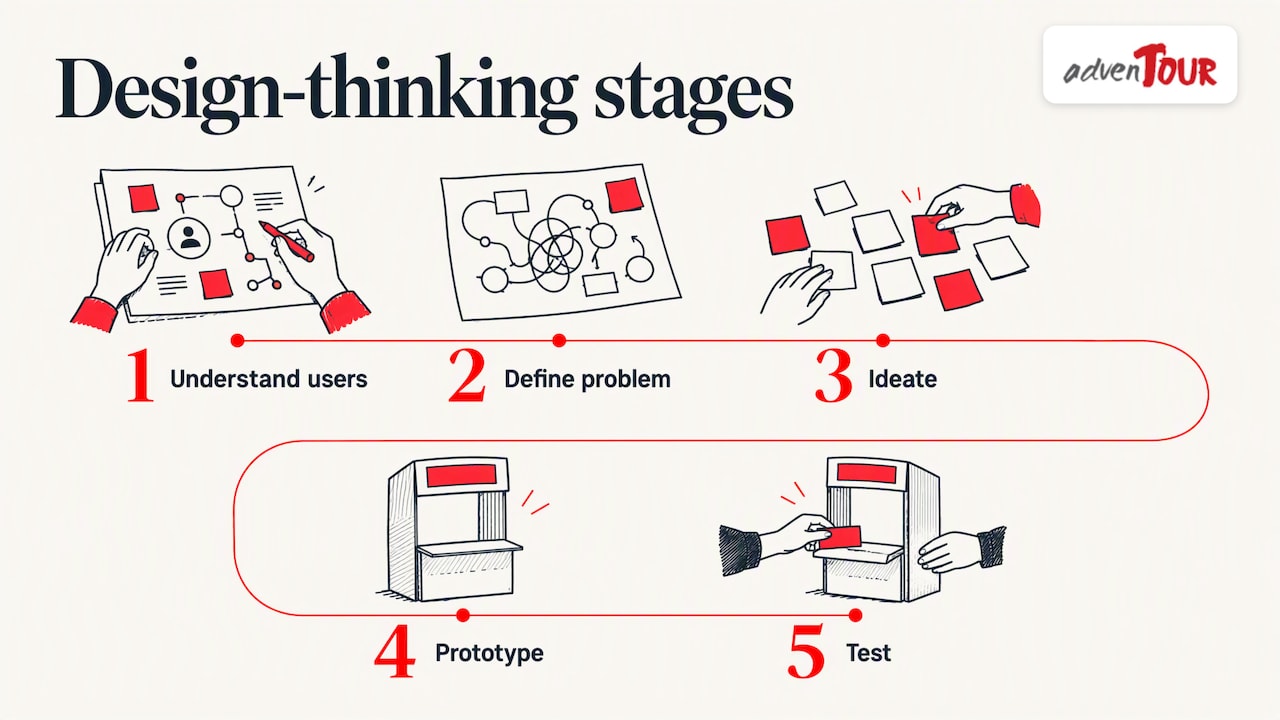
Singapore’s public sector uses the same cycle. The Community Hackathon has teams understand a community problem, refine the problem statement, ideate, build prototypes, test with users and iterate. The lesson for a company is useful: collaboration becomes meaningful when people go beyond ideas and test something against real needs.
Structured ideation sessions
When you do not need a prototype, a half-day ideation session is enough. AI Singapore’s discovery method has participants turn business challenges into “How might we” opportunity statements, cluster them, vote on priorities and agree a longer-term goal. You can borrow that sequence for almost any topic, not just AI.
Pitch-style and role-based formats
Some teams think better when there is a little pressure and a clear audience. A pitch format, where small teams present an idea to a panel of leaders, forces clarity and gives the convergent stage a natural ending. Our Office Shark Tank program is built around that kind of competitive, high-energy dynamic, and we can tailor it to your objectives.
Activity-led formats
Not every team is ready to start with a blank whiteboard. Active challenges can break habits first: a team building activity that makes people solve problems together in a different setting often loosens up communication that a meeting room does not. Many clients pair a short activity in the morning with an ideation block in the afternoon, so people arrive at the serious work already talking to each other.
How to plan an innovation workshop in Singapore
1. Write the challenge as a question
“How might we cut the time it takes to onboard a new regional client?” gives a facilitator something to work with. “Innovation” does not. If you cannot write the challenge in one sentence, spend your first hour on that before booking anything.
2. Choose the right people
AI Singapore’s approach recommends a defined theme and a cross-functional group of 4 to 7 participants. Larger events can run several such groups in parallel. Mix people who own the problem with people who feel its effects, and include at least one person who is not in your usual meetings. A decision-maker should be in the room or arrive for the final hour, or the output will stall.
3. Decide the time and place
Half a day suits a single focused question. A full day lets you add prototyping and a pitch round. Multi-stage programs make sense for large initiatives: the Lee Kuan Yew School’s Action Plan Singapore work describes sequences of scenario-building and strategy-building workshops that move from exploration to tangible outcomes. A company will rarely need that scale, but the principle holds: split a big topic into stages instead of cramming it into one afternoon.
Venue matters more than people expect. A room away from desks, with wall space and natural light, changes the energy. For groups that want an off-site feel, we run both indoor team building in Singapore and outdoor formats, and we can supply mobile portable tentage at S$95 per day per tent when you need shade for an outdoor session.
4. Agree the output before the session
Decide what “done” looks like. Typical outputs are a ranked shortlist of ideas, a one-page plan for the top two, and a named owner and next date for each. Write this on the agenda so participants know the day ends with decisions.
5. Plan the follow-up
Book the 30-day check-in before the workshop, not after. Ideas without a review date tend to fade by the following week.
Running workshops for large groups and regional meetings
MNCs holding regional meetings in Singapore often have 50, 100 or more people with only a day or two together. Plain plenary brainstorming fails at that size, so the answer is structure.
- Split into small tables. Each table of 4 to 7 works on the same challenge or on a different slice of it.
- Use rounds. Short timed rounds (ideate, cluster, vote) keep energy up and stop one voice dominating.
- Use a shared scoring method. When every table scores ideas the same way, you can compare results across the whole room.
- Mix teams across countries and functions. Visiting teams rarely get to work with each other’s colleagues, so seating plans are part of the design.
- Add movement. A competitive, outdoor or game-based block between thinking sessions resets attention. Our guide to outdoor team building for large corporate groups covers options that scale.
For visiting teams with limited time, a local-flavour format can double as a bonding element. Our Katong/Joo Chiat Cultural Food Immersion, listed at S$82 to S$98 per person, gives international colleagues a shared experience before or after a working session.
Our perspective
Most requests we receive for “innovation workshops” are really two requests: help us think better together, and help us trust each other enough to say what we think. Teams that skip the second one get polite, safe ideas.
That is why we build programs around experiential learning and skill transfer rather than passive entertainment. We treat the activity as the way people learn to collaborate, and the facilitated debrief as the place where they connect it to their own work. A laser tag round or an Amazing Race only matters if the team leaves able to name what they did differently under pressure and how that applies on Monday.
We also believe the format should fit the budget instead of the other way around. A team of 30 with a modest budget can get a lot from one of our budget-friendly activities followed by a focused conversation on a real challenge. A leadership group that needs a tougher session can move to a premium, tailored program. In both cases, we start from your objectives, then scale the design for group size and budget, and we aim for outcomes you can observe in engagement, collaboration and communication.
Joshua
Budget or premium: how to choose
The real question is what you are paying for: expert facilitation on your problem, a memorable shared experience, or both.
What formal training costs
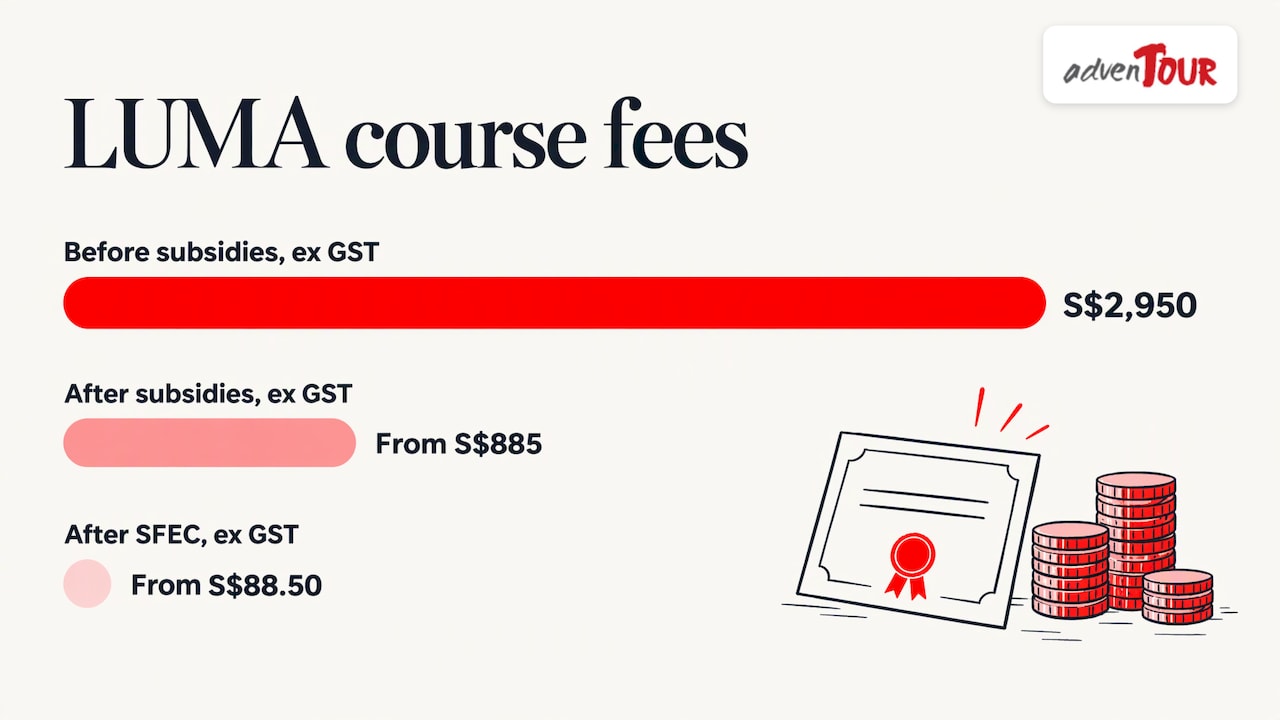
Public courses are the most visible price point. As one benchmark, the LUMA Certified Human-Centered Design Practitioner course at Ngee Ann Polytechnic is listed at S$2,950 before subsidies, from S$885 after subsidies and from S$88.50 after SFEC, excluding GST. That buys individual certification, not a team session on your own challenge, so the two are not interchangeable.
If your company is eligible, the Enterprise Workforce Transformation Package notes that the current SkillsFuture Enterprise Credit can defray out-of-pocket costs for specified enterprise and workforce transformation programmes and will be extended until the redesigned credit is ready. Check eligibility and which programmes qualify on the official page before you plan around it.
Our published per-person prices
Our programs are priced per participant, with a range that depends on group size and customisation. Prices below are as published on our site.
| Tier | Examples | Price per person |
|---|---|---|
| Budget-friendly | Kinball | S$35 to S$45 |
| Budget-friendly | Bloop Bubble Soccer | S$36 to S$43 |
| Budget-friendly | Combat Skirmish Laser Tag | S$37 to S$45 |
| Budget-friendly | App-based Amazing Race | S$40 to S$55 |
| Quality | Amazing Race | S$65 to S$78 |
| Quality | Modified DISC Workshop | S$70 to S$82 |
| Quality | Running Man Challenge | S$72 to S$82 |
| Premium | Office Dynamics Workshop | S$80 to S$90 |
| Premium | Corporate Sailing Team Building | S$125 |
| Premium | DISC Personality Profiling | S$150 to S$159 |
Office Shark Tank starts from S$92 per person. Browse the full lists on our budget-friendly, quality and premium pages.
A simple way to decide
- Is the main goal bonding or problem-solving? For bonding and energy, a budget-friendly active format is often enough. For working through a real challenge or understanding how people work together, look at the quality and premium workshop-style programs.
- How senior is the group? Executive offsites usually justify a more tailored design and a smaller, more intensive format.
- How many people? Per-person pricing makes large groups manageable when you pick formats that scale, such as an app-based race.
- Do you need a repeat? If you plan a series, put the heavier session first and lighter activities afterwards to keep momentum.
Workshops built on behavioural profiling are a useful middle path. Our Modified DISC Workshop and DISC profiling workshops help people understand how colleagues prefer to communicate, which is often the missing step before a group can ideate productively.
Book an innovation-ready team session with us
If you want a session that gets your team collaborating and thinking together, we design programs around your objectives, group size and budget, from S$35 per person for active formats to premium, fully tailored experiences. Tell us the challenge, and we will propose a format and facilitation plan. See the options on our premium programs page or start from our home page.
Our team also supports CSR programs, including SG60 CSR programs, if the challenge you want to explore is about giving back.
How to tell whether the workshop worked
Most companies stop at a satisfaction survey. Use that, but add three more checks.
Check the quality of the process
An academic observation guide for co-creation workshops suggests looking for useful outputs, reliable information, clear and transparent processes, impactful decisions, constructive conflict management and integration of diverse perspectives. Ask a neutral observer, or your facilitator, to note each during the session.
Ask participants the right questions
A 2023 Singapore-linked study of an asthma-care workshop built on design thinking asked participants to rate whether they understood the challenges, gained insights and could generate improvement ideas. It reported that 94.4% agreed or strongly agreed they could generate ideas and that the workshop helped drive innovation. That is a clinical setting, so do not expect the same number, but the question design transfers well: ask about understanding, insight, idea generation and intent to act.
Track what happens afterwards
The Singapore Productivity Association’s Team Excellence Assessment Guidelines, effective 1 January 2026, judge innovation work through project selection, root-cause analysis, solution development and validation, implementation, measurement and sustained results, stakeholder impact and team effectiveness. You can use those headings as a 90-day checklist for the ideas your workshop produced.
If the topic is CSR
When a workshop generates CSR ideas, ask whether they could become credible programmes. AmCham Singapore’s CARES framework looks at communications, measurement, strategy and sustainability, which gives a practical structure for that review. For a larger model of co-creation, JTC’s Decarbonisation Living Lab brings together companies, solution providers and public agencies to develop, test and implement carbon-saving solutions, with replication and commercial viability among the criteria.
Common mistakes to avoid
- Starting without a question. Vague themes produce vague ideas.
- Inviting only one department. You will get the answers you already had.
- Skipping the convergent stage. Fifty ideas on a wall are not a result.
- Leaving out the decision-maker. Ideas need someone who can say yes.
- Treating the activity as the outcome. Fun is useful, but connect it to the work in the debrief.
- No follow-up date. Put it in the diary before the session.
FAQ
How long should a corporate innovation workshop be?
Half a day is enough for one focused question with a small group. A full day gives you time to prototype and pitch. For large or complex topics, split the work into several shorter stages instead of one very long session.
How many people should be in each group?
AI Singapore’s structured discovery approach suggests a cross-functional group of 4 to 7 participants. For larger events, run several groups in parallel with the same method so you can compare outputs at the end.
How much does an innovation workshop cost in Singapore?
It depends on whether you want individual training or a facilitated team session. A public design course can run into thousands of dollars per seat before subsidies. Our team programs are priced per person, from S$35 to S$159 depending on the format, and we tailor the design to your group size and budget.
Can we get funding support?
Some Singapore companies can use the SkillsFuture Enterprise Credit for eligible programmes. Eligibility and qualifying courses change, so confirm the current rules on the official SkillsFuture for Business and MOM pages before you commit.
Is team building the same as an innovation workshop?
Not exactly. Team building develops trust and communication, while an innovation workshop targets a specific challenge and ends in decisions. They work well together: a short activity first, then a structured session on your real question.
Sources
- For Design Thinking Regional: facilitator guide
- Shopee Design Sprint
- About Community Hackathon
- A structured approach for ideating AI use cases, AI Singapore
- Year 2026: Doing Singapore Differently, LKYSPP
- Course details, SkillsFuture for Business
- Enterprise Workforce Transformation Package factsheet, MOM
- Observation Guide: Evaluating a Co-Creation Workshop
- Innovation workshop using design thinking framework, PMC
- Team Excellence Assessment Guidelines, Singapore Productivity Association
- AmCham Singapore CARES Awards 2024
- JTC Decarbonisation Living Lab
Recommended
- Interactive Corporate Workshops Singapore: Top Picks
- Shark Tank Experience: Fostering Innovation & Pitching Skills
- Corporate Team Building Solutions Singapore
- Team Building Event Ideas in Singapore