
Employees take part when they believe speaking up is safe, that someone listens and that something changes afterwards. Policies and surveys can set that up, but a well-run shared experience is where people first practise it. A facilitated team building session gives quieter colleagues a structured reason to contribute, and gives managers a chance to model the behaviour they want to see. Adventour designs and runs these programmes for companies in Singapore, from budget formats to premium offsites.
Key Takeaways
- Participation rises when feedback is visibly acted on: in a 2020 Singapore study, engagement scored 83% where feedback was turned into action well, against 34% where it was not.
- Psychological safety is built through team norms, such as senior people speaking last and everyone being invited to contribute.
- Involvement matters: a European study found 47% of employees in high-involvement organisations reported high engagement, against 24% in low-involvement ones.
- Facilitated activities give every person a defined role, which helps quieter colleagues contribute and gives teams a shared reference point afterwards.
- Measure participation with a few repeatable indicators, and read survey results alongside what people say in person.
Table of Contents
- What participation really means
- Make it safe to speak first
- Ask, listen, act
- Where team activities fit
- Include every role and personality
- Measure whether participation is rising
- Our perspective
- Plan a programme for your team
- FAQ
- Sources
What participation really means
Participation is more than attendance. It is people offering ideas in meetings, answering surveys honestly, volunteering for projects and joining company events by choice. When it is low, the usual causes are unclear purpose, a fear of looking foolish, and a belief that suggestions disappear.
The case for fixing it is well documented. A Eurofound study found that 47% of employees in high-involvement organisations reported high work engagement, almost double the 24% in low-involvement organisations. It also found that perceived fairness of management practices had the strongest effect on engagement, followed by supportive line management.
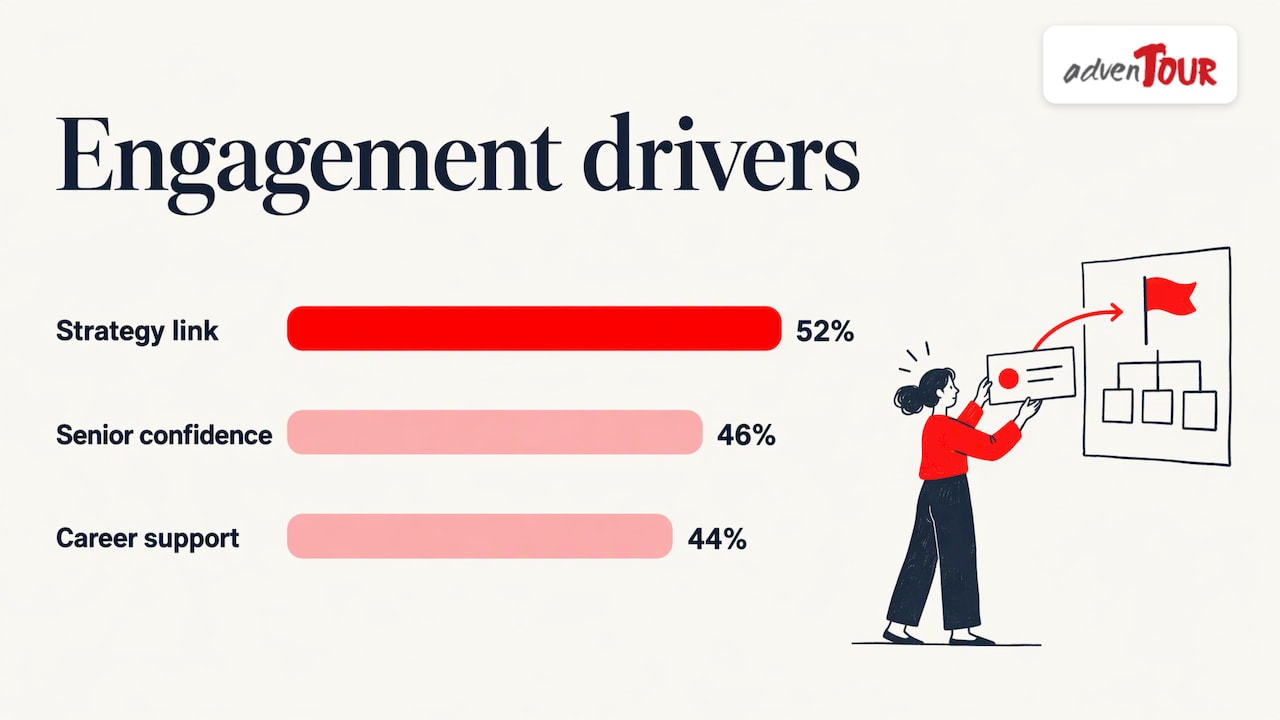
In Singapore, a 2020 Qualtrics study of 500 respondents put a clear link between daily work and company strategy at the top of engagement drivers (52% favourability), ahead of confidence in senior leadership (46%) and managers who help with career development (44%). People join in when they can see why their contribution matters.
Make it safe to speak first
Most silence in meetings is a safety problem, not a motivation problem. The Civil Service College’s inclusive workplace guidance recommends team norms that encourage open exchanges and broad participation in decisions. Leaders should give enough opportunity for all views to be shared and considered, not only the ones they agree with. It also suggests acknowledging opinions, returning the conversation to anyone who was interrupted, and crediting fresh ideas.
Several habits are easy to adopt this week:
- Let senior people speak last. DBS describes giving everyone a chance to contribute, with the most senior employees speaking last.
- Assign a devil’s advocate. The same DBS account says employees are asked to play this role, so disagreement becomes a task rather than a risk.
- Open with a check-in. CSC suggests using the start of each meeting to ask how each member is doing, and avoiding jargon or insider jokes that exclude people.
- Treat disagreement as debate. CSC frames healthy debate as distinct from interpersonal conflict, and makes sensitive communication a joint responsibility.
Peers matter too. A Singapore Public Service study cited by CSC found that colleagues significantly influence whether members feel a team is safe for divergent views. That is why one-to-one coaching of managers is rarely enough on its own.
Ask, listen, act
Singapore data is blunt on this point. In the Qualtrics report, 65% of respondents had an opportunity to give feedback, but only 25% said their company turns it into action very or extremely well. Engagement was 83% for those who felt feedback was acted on really well and 34% for those who did not. Asking alone lifted scores (55% against 33%), but acting moved them most.
Singapore employers already use a range of channels:
- MOM’s implementation guide lists satisfaction surveys, appraisals, exit interviews and informal tea sessions with management, and recommends engaging trusted opinion leaders at any level who can surface concerns early.
- St Luke’s Hospital trains leaders to acknowledge every suggestion and to tell staff what was done, or why change was not possible. Survey engagement there has stayed above 90%.
- DBS runs a quarterly town hall hosted by the CEO and an open channel where every question receives a personal reply. It reports nearly 97% survey completion.
- TAFEP’s Beyond 20/20 advises making follow-up on feedback more visible, to dispel the notion that giving feedback is futile.
A simple routine closes the loop: publish a short “you said, we did” note each quarter, listing what was adopted, what is in progress and what was declined with the reason. Declined ideas with reasons still build trust.
Where team activities fit
Meetings and surveys ask people to speak in settings where status is obvious. A facilitated activity changes the conditions. Roles are assigned, the task is shared, and a junior analyst may hold the map while a director follows. Debriefs then turn what happened into specific working habits: who was not heard, how decisions were made, what the team would repeat.
This is how Adventour approaches it: programmes that focus on experiential learning and skill transfer rather than passive entertainment, tailored to each client’s objectives and scalable for group size and budget. Match the format to the participation problem you actually have:
| Participation problem | Format to consider | Published price per person |
|---|---|---|
| Teams that rarely mix across departments | App-based Amazing Race | $40-55 |
| Large groups needing a high-energy start | Bloop Bubble Soccer or Kinball | $36-43 and $35-45 |
| People who stay quiet in meetings | Combat Skirmish Laser Tag, with team roles and debriefs | $37-45 |
| Teams that misread each other’s styles | Modified DISC Workshop | $70-82 |
| Leadership groups and senior offsites | DISC Personality Profiling | $150-159 |
| Pitching and decision-making practice | Office Shark Tank | from $92 |
Prices are those published on our site in October 2026 and can change, so confirm them on the programme pages. For a regional meeting, the same formats can be arranged around your agenda, and our outdoor team building and corporate sports days pages show how larger groups are handled.
Include every role and personality
Inclusion decides who participates. Extroverts volunteer; others wait to be asked. Design for both. Use written input before discussion, small groups before plenary, and rotating facilitation. For hybrid or regional teams, state the agenda in advance so those joining from other time zones can prepare. Our guides on building inclusive teams and staff wellness events go further on format and planning.
Personality profiling helps because it gives people neutral language. Saying “I need time to think before I answer” is easier when the team has a shared framework for working styles.
Measure whether participation is rising
Pick a few indicators and track them at the same interval:
- Survey completion rate. DBS reports nearly 97%; GIC runs surveys twice a year, tracks progress over time and holds managers accountable for acting on team results.
- Share of meeting contributions coming from outside the most senior people.
- Number of suggestions submitted and the share answered within an agreed time.
- Volunteer rates for projects and events.
Treat surveys with care. SHRI notes that in Asian contexts surveys can under-capture the truth, so pair them with skip-level conversations and tea sessions. Our engagement measurement guide covers this in more detail, and our piece on improving employee motivation covers the next step.
A 2026 study of allied health professionals at a Singapore hospital found that 95% reported meaningful work, yet 40.8% did not feel recognised by their organisation. Recognition is often the missing piece, so build it into the routine.
Our perspective
Participation is a habit, and habits form through repetition in low-risk settings. We have found the most useful programmes are the ones with a clear objective set before the day, such as cross-team mixing, clearer communication or decision-making under time pressure.
Our programmes are designed for experiential learning and skill transfer, with experienced facilitators and measurable outcomes in engagement, collaboration and communication. We tailor each one to the client’s goals, group size and budget, from budget-friendly formats to premium experiences.
The activity opens the door. What follows at work, such as senior people speaking last and feedback being answered, keeps it open. We would rather help you plan both together.
Joshua
Plan a programme for your team
Adventour plans and runs team building, retreats, wellness events and CSR programmes for companies in Singapore and those visiting for regional meetings. Programmes are priced per participant or per event, with budget, quality and premium tiers. Browse the budget-friendly activities, quality programmes or premium programmes, or tell us your participation goal through our website and we will shape the format around it.
FAQ
How do I encourage quiet employees to participate?
Give them structure instead of pressure: share questions in advance, collect written input first, and use small groups before open discussion. Activities with defined roles also give quieter colleagues a clear way to contribute.
How quickly can participation improve?
Visible follow-through tends to be the fastest lever, because it answers the question “will anything happen?”. Start with a quarterly “you said, we did” update and track completion and suggestion rates over several cycles.
Do incentives increase participation?
Recognition matters more than rewards in the evidence available. In the Singapore hospital study, 40.8% of staff did not feel recognised, so crediting ideas by name in meetings is a sound first step.
What group sizes can team building cover?
Our formats scale for group size and budget, including large group sessions. Share your headcount and objective when you enquire so the programme can be shaped to fit.
Sources
- How does employee involvement in decision-making benefit organisations (Eurofound)
- Qualtrics Singapore Employee Experience Trends report
- Civil Service College: Making the Most of Diversity through Inclusive Workplace Practices
- McKinsey: How DBS embraces change
- MOM CEP implementation guide
- Great Place to Work: St Luke’s Hospital case study
- TAFEP: Beyond 20/20
- GIC ThinkSpace: Moving Beyond Equality to Inclusion
- SHRI: Singapore’s Leadership Judgment Problem
- MDPI: Staff Wellbeing and Engagement at a Singapore hospital
Recommended
- How to Improve Employee Motivation: What Works and How to Start
- Outdoor Team Building: Boost Morale & Collaboration
- Employee Engagement & Team Bonding Guide
- Employee Engagement Measurement: A Practical Guide for Singapore Teams