
To measure employee engagement well, combine a short, validated survey with a few hard business indicators (retention, productivity, participation) and follow both with team-level conversations. Then report the results back and act on them. The survey on its own tells you very little. What changes behavior is the loop around it: ask, share, decide, repeat. This guide covers the models behind the measures, the metrics worth tracking, how often to measure, and how to read team performance alongside engagement. It is written for HR leaders and managers in Singapore.
TL;DR
- Engagement is a psychological state of commitment, shown in vigor, dedication and absorption. Measure that state, not just satisfaction.
- Use three layers: a short survey, outcome metrics such as retention and productivity, and qualitative conversations.
- Measure at team level. Engagement is mostly created in teams, so company-wide averages hide the story.
- Move from one big annual survey toward shorter, more frequent pulses, and always share the results, even uncomfortable ones.
- Test your actions in the field. A facilitated team session is one way to see if a low-scoring team’s collaboration improves before the next pulse.
Table of Contents
- What engagement measurement actually tells you
- Employee engagement models and theories that guide what you measure
- Employee engagement metrics worth tracking
- How to measure employee engagement, step by step
- How often to measure: annual survey, pulses and conversations
- Measuring team performance alongside engagement
- Turning scores into action
- Perspective: why we pair measurement with shared experience
- Matching a session to what your measurement found
- Work with us on the follow-through
- FAQ
- Sources
What engagement measurement actually tells you
The CIPD’s evidence review describes engagement as a psychological state of emotional commitment to the organization and its goals, characterized by vigor, dedication and absorption. That definition matters because it separates engagement from three things it is often confused with: job satisfaction, happiness and loyalty. A person can be content and still do the minimum.
A good measurement program shows you where communication, recognition and trust are working and where they are not. It also links those findings to outcomes such as retention and productivity.
The local picture explains why this deserves attention. At the launch of the Singapore Workplace Report 2026, the Minister of State for Manpower cited a figure of 14% of employees reporting that they are engaged at work. The same speech frames an engaged workplace as a deliberate, tripartite effort in which firms use engagement surveys to find ways to bring out the best in workers. Measurement is the starting point of that effort, not the effort itself.
Employee engagement models and theories that guide what you measure
You do not need to be an academic to choose a measure. You do need to know what a model assumes, because it decides which questions you ask.
The vigor, dedication and absorption view
This is the definition above. It treats engagement as a work-related state of mind. Questions under this view ask about energy at work, pride in the job and how easily people get absorbed in tasks. It suits organizations that want to understand the individual’s experience.
The job demands and resources view
Here engagement depends on the balance between what a job demands and what it gives back: control, support, recognition. Singapore has a locally validated instrument built on similar ideas. The iWorkHealth study published in PLOS One in 2019 validated a tool for the Singaporean workforce that assesses five psychosocial factors: job demand, job control, employee and management engagement, supervisor support and colleague support.
The Tripartite Advisory on Mental Health and Well-Being at Workplaces points employers to iWorkHealth as a confidential, self-administered online tool for surveying employees’ mental well-being and work stressors. It is not a pure engagement survey. It is a useful companion when you want to understand the pressures behind a low score.
The local cultural lens
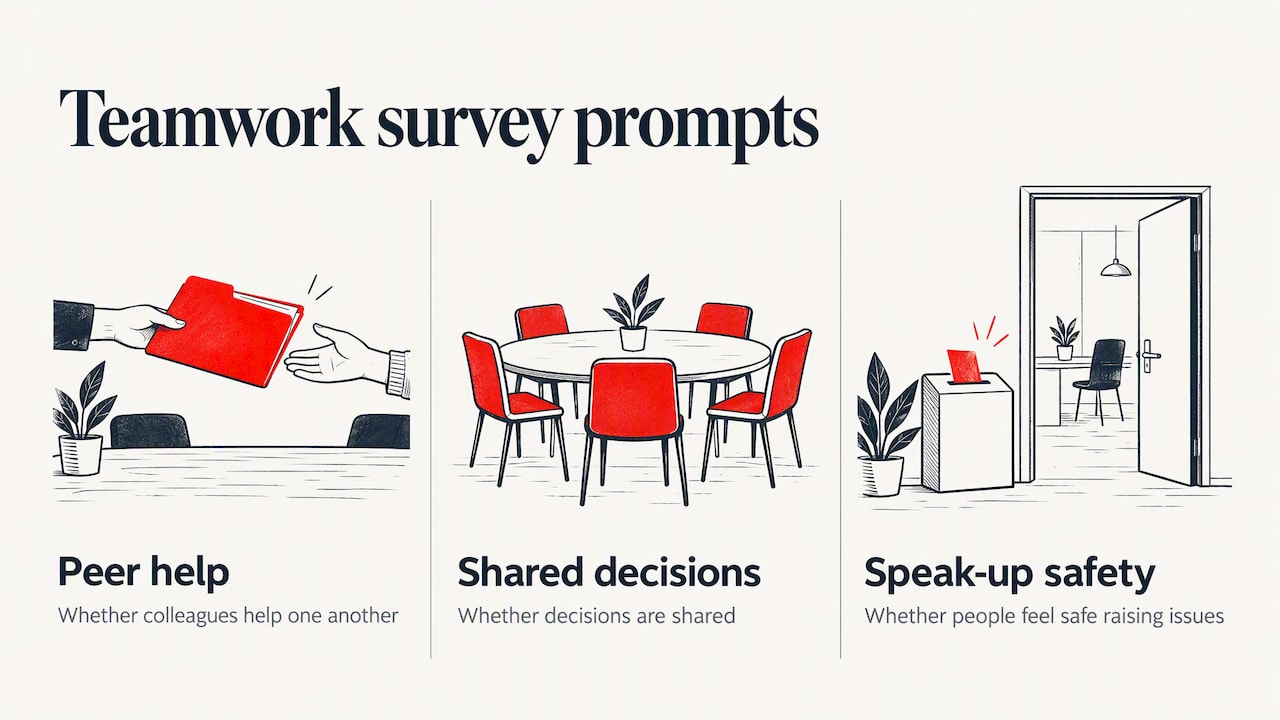
Singapore research suggests that models imported from elsewhere may miss something. A study of a Singapore engineering firm found that teamwork is a key, and potentially idiosyncratic, component of engagement in the local context. In practice, add questions about how people experience their immediate team: whether colleagues help one another, whether decisions are shared and whether people feel safe raising issues.
Choosing a model
| If your main question is… | Lean on… | Typical items |
|---|---|---|
| Are people energized and committed? | Vigor, dedication, absorption | Energy, pride, focus |
| Why are people stressed or disengaged? | Demands and resources, e.g. iWorkHealth factors | Workload, control, supervisor and colleague support |
| Is our team culture helping? | Team-centered items | Collaboration, trust, peer support |
Most companies end up blending the three. Keep the total short.
Employee engagement metrics worth tracking
Survey scores are one metric among several. A sound set has three groups.
Survey-based metrics
- An engagement index. A handful of questions averaged into one score you can trend over time.
- Driver scores. Manager support, recognition, growth, communication and teamwork. These tell you what to fix.
- Participation rate. A falling response rate is itself a signal of low trust.
Outcome metrics
A 2020 global study from NTU lists complements to engagement surveys: retention, productivity gains, revenue per employee, proactivity and willingness to participate in or initiate activities. Pick two or three that fit your business, not all of them.
- Voluntary turnover, ideally split by team and tenure.
- Productivity or output per person, defined consistently.
- Voluntary participation in initiatives, such as volunteering, mentoring or internal projects.
One Singapore employer shows how this can work in practice. Wildlife Reserves Singapore’s CHRO reported that biannual engagement surveys showed alignment with the organization’s mission, vision and values, and that appraisal-form completion was tracked digitally. Both a survey signal and an operational signal.
Metrics for inclusion
Averages can hide uneven experiences. Include Consulting’s 2026 note on diversity metrics says that reporting engagement scores by gender, age and nationality can reveal inclusion issues that headcount figures alone do not show. In a workforce as mixed as Singapore’s, the cut by nationality and tenure is worth the effort, provided groups are large enough to protect anonymity.
Check that the measure is sound
The CIPD advises evaluating any engagement measure for reliability (does it give consistent results?) and validity (does it predict outcomes such as performance?). If a vendor or an internal survey cannot answer those two questions, treat its scores as conversation starters, not as targets.
How to measure employee engagement, step by step
- Define the decision first. Write down what you will do differently depending on the result. If nothing would change, do not run the survey.
- Pick a short instrument. Eight to twelve questions covering commitment plus the drivers that matter to your teams. Add one or two open-text questions.
- Guarantee confidentiality. Set a minimum group size for reporting and say what it is.
- Collect baseline outcome data. Pull the last 12 months of turnover, absence and productivity data by team, so survey results have context.
- Run the survey and report quickly. Share results with managers within weeks, not months.
- Hold team conversations. Each manager reviews the team result, asks what is behind it and agrees one or two actions.
- Track the actions. Put owners and dates on them and review progress at the next pulse.
Gallup’s Singapore Workplace Report makes a related point: engagement measurement must be linked to decision-making and accountability if surveys are to lead to tangible improvements. A survey without owners for the follow-up is a cost, not an investment.
How often to measure: annual survey, pulses and conversations
The NTU interview study found some companies moving from annual mega-surveys to continuous feedback models. You do not have to abandon the annual survey, but you can supplement it.
| Method | Rhythm | Best for |
|---|---|---|
| Full engagement survey | Once or twice a year | Trends, drivers, company-wide benchmarks |
| Pulse check | Monthly or quarterly, a few questions | Spotting change in a team early |
| Stay interviews and one-to-ones | Ongoing | Understanding the why behind a number |
| Focus groups | After a survey | Digging into one issue with a small group |
The CIPD cautions that running a survey is not the same as “doing” engagement. It sees surveys as indicators that need qualitative discussion to give a rich understanding. The NTU researchers add that leaders should communicate results openly, even when they are less than desirable. People answer honestly the second time only if the first time led somewhere.
Measuring team performance alongside engagement
Engagement and performance are related, but not identical. Looking at them together stops you from treating a high score as proof that work is going well, or a low score as proof that it is going badly.
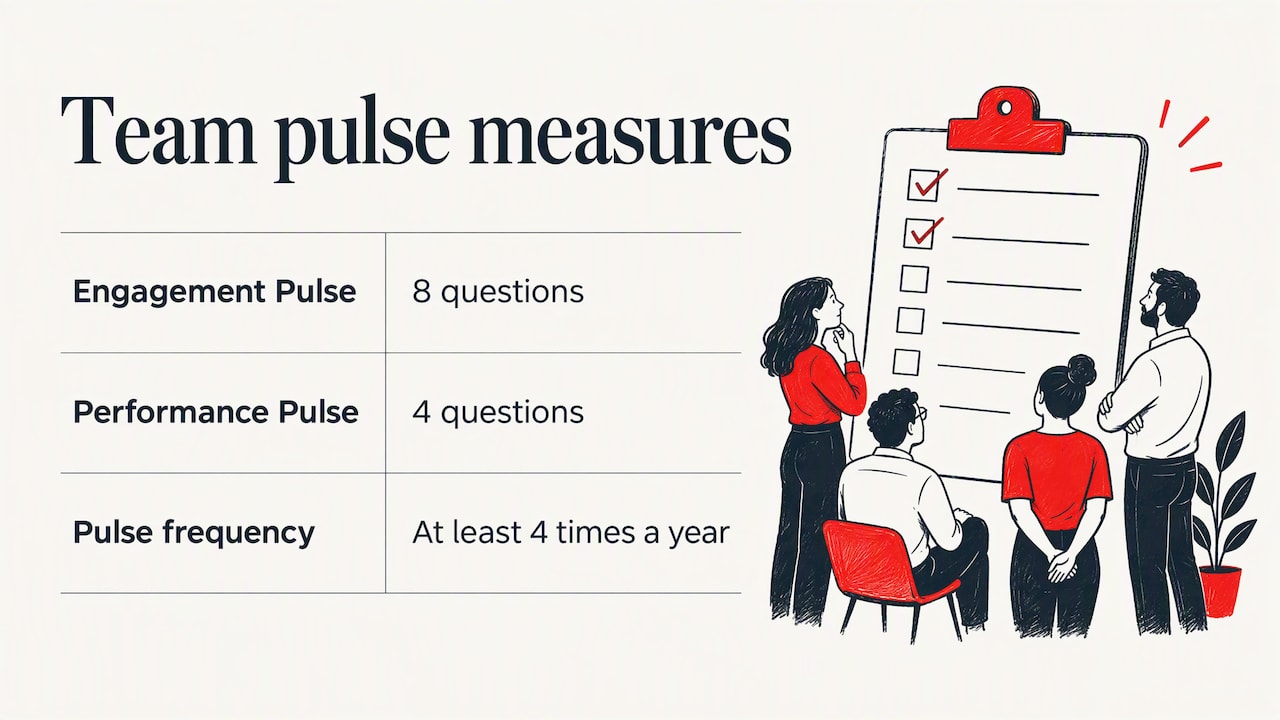
ADP’s research argues that engagement is primarily created at the team level. That makes centralized surveys potentially ineffective when they do not deliver actionable, team-specific insight. The same paper describes an “Engagement Pulse” of eight questions and a “Performance Pulse” of four, collected at least four times a year to give reliable team-level data. You can copy the principle without buying a platform: keep the questions few, keep them regular and report by team.
Team performance indicators that pair well with engagement
- Delivery: on-time completion of agreed work, rework rates, quality checks passed.
- Collaboration: how quickly cross-team requests are resolved, how often handovers fail.
- Customer outcomes: satisfaction or complaint trends tied to that team.
- Team health: pulse scores on trust, clarity of goals and peer support.
- Stability: voluntary turnover and internal transfers.
Reading the two together
| Engagement | Performance | What it often suggests |
|---|---|---|
| High | High | Protect what works and share the practices |
| High | Low | Check clarity of goals, skills and resources |
| Low | High | Risk of burnout or attrition, look at workload and recognition |
| Low | Low | Start with manager support and team trust |
These are hypotheses to test in a team conversation, not diagnoses.
Turning scores into action
Most of the value arrives after the report. Pick the lowest-scoring driver for each team and choose one action you can finish within a quarter.
- Low recognition scores: build in routine, specific recognition and mark milestones. Our ideas for employee appreciation events and for celebrating employee achievements are a starting point.
- Low communication or trust scores within a team: a facilitated session can surface working-style differences. Profiling such as our DISC profiling workshops gives people a shared language for it.
- Low well-being scores: look at workload first, then at corporate wellness programs as one support.
- Low connection to purpose: consider CSR team building so teams contribute to something beyond their targets.
- Weak leadership support: invest in manager capability through leadership training.
If you are weighing a session against formal training, our comparison of team building and training ROI covers how to judge which suits the gap you found. Whatever you choose, re-measure the same team on the same items afterward, so you can see whether the action moved the number.
Perspective: why we pair measurement with shared experience
We run team building for Singapore companies, and the same pattern shows up in briefings. A client shares a survey result, often low scores on communication or collaboration, and asks for an event. The best outcomes come when the event is designed around that result, not around a generic fun day.
That is why we start with the objective. If the number to move is cross-team collaboration, we lean toward formats such as an Amazing Race or a problem-solving challenge that force teams to coordinate. If the issue is how colleagues work with each other, a DISC-based workshop gives people vocabulary for differences they already feel. Our programs are customized to organizational goals and scaled for group size and budget, and we aim for experiential learning and skill transfer rather than passive entertainment.
Our advice: measure before, agree on one or two indicators, run the session, then measure the same team again at the next pulse. Events do not replace manager conversations, but they give those conversations something real to talk about.
Joshua
Matching a session to what your measurement found
Once you know which driver is weakest, you can pick a format and a budget. Our published per-person ranges, which can be tailored to your group, are below. Confirm current rates on each page.
| Finding | Format to consider | Published price | Page |
|---|---|---|---|
| Low team energy, need a quick reset | Kinball | $35-45 per person | Budget-friendly activities |
| Weak cross-team coordination | App-based Amazing Race | $40-55 per person | Budget-friendly activities |
| Collaboration across a larger group | Amazing Race | $65-78 per person | Quality programs |
| Communication and working styles | Modified DISC Workshop | $70-82 per person | Quality programs |
| Team dynamics at leadership level | Office Dynamics Workshop | $80-90 per person | Premium programs |
| Deep personality insight | DISC Personality Profiling | $150-159 per person | Premium programs |
For a larger sequence, our guide to planning a corporate team building event in Singapore walks through timing, venue and logistics.
Work with us on the follow-through
If your latest pulse has pointed to a team that needs better collaboration or communication, we can design a program around that finding. We build and facilitate corporate team building solutions in Singapore, from budget-friendly games to premium offsites and CSR programs, and we customize each to your objectives.
Bring us your survey themes and group size, and we will suggest a format and a way to check afterward whether it helped. Start from our team building programs or contact us through our home page.
FAQ
What is the simplest way to measure employee engagement?
Start with a short survey of eight to twelve questions on commitment and the main drivers, plus one open-text question. Pair it with two outcome metrics, such as voluntary turnover and survey participation. Then hold a team conversation on the results, because the number alone does not tell you what to change.
How often should we measure engagement?
Many organizations keep one fuller survey a year and add short pulses in between, for example quarterly. Some companies in global research have moved from annual surveys toward continuous feedback. Choose a rhythm you can act on, since each round must be followed by visible action.
Which engagement metrics matter most?
An engagement index, driver scores such as manager support and recognition, and participation rate cover the survey side. For outcomes, retention and productivity are the most common choices. Check that any survey you use is reliable and predicts outcomes you care about.
How do I measure team performance and engagement together?
Use the same team cut for both. Pair a few pulse questions on engagement with delivery, quality and collaboration indicators for that team, then compare the pattern. A mismatch, such as high output with low engagement, is a prompt for a conversation about workload and recognition.
Do team building events improve engagement scores?
They can help when they are designed around a specific finding, such as weak collaboration, and followed by manager conversations. We design our programs around client objectives, and we suggest re-measuring the same team at the next pulse so you can judge the effect yourself.
Sources
- Employee engagement: definitions, measures and outcomes (CIPD)
- Speech at the launch of the Singapore Workplace Report 2026 (Ministry of Manpower)
- iWorkHealth: An instrument to identify workplace psychosocial factors (PLOS One)
- Tripartite Advisory on Mental Health and Well-Being at Workplaces
- Defining Employee Engagement in the Singaporean Context
- Recharging Employee Engagement (NTU, 2020)
- Q&A with the CHRO of Wildlife Reserves Singapore (Human Resources Online)
- The 12 DEI Metrics Singapore Companies Should Track in 2026 (Include Consulting)
- Singapore Workplace Report 2026 (Gallup)
- StandOut white paper (ADP)
Recommended
- Employee Appreciation Event Ideas Singapore
- Team Building Activities Singapore — Complete 2026 Guide
- How to Plan Corporate Team Building Events in Singapore: A Step-by-Step Guide
- How to Choose Team Building Activities
Made with BabyLoveGrowth to strengthen website authority