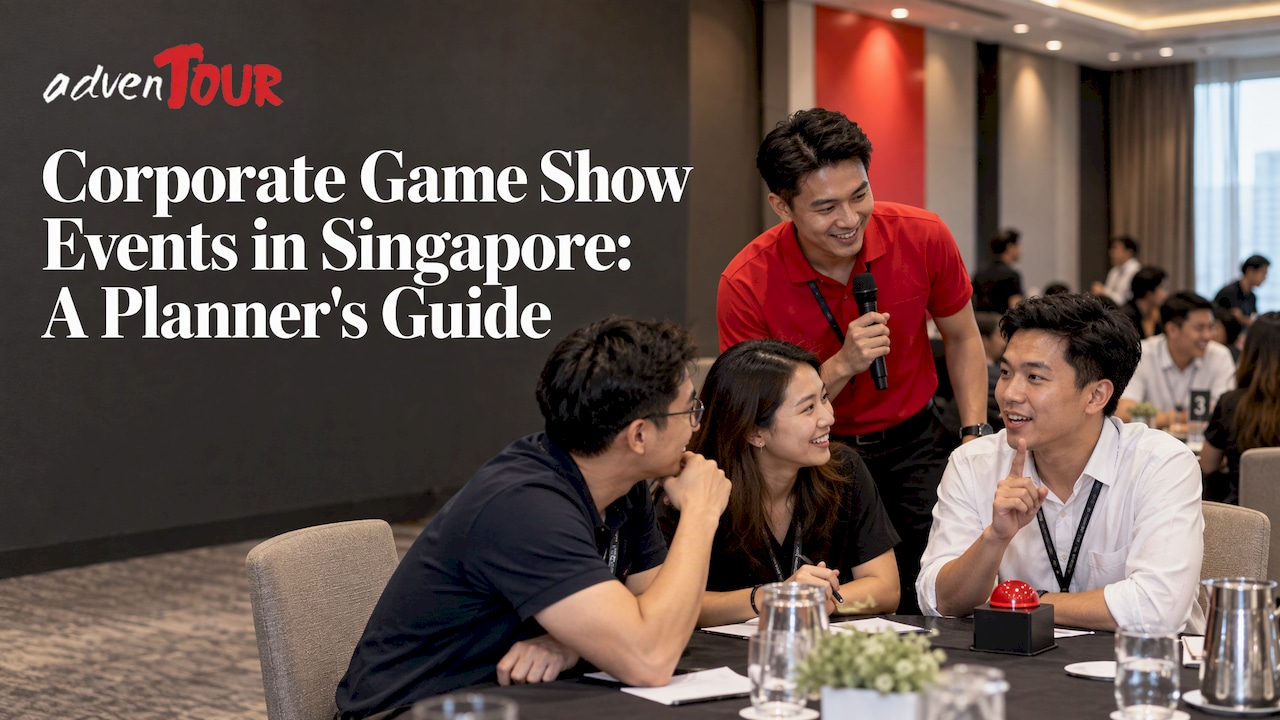
A corporate game show event turns your team into contestants: mixed-department teams, a host, scored rounds and a leaderboard, with a purpose behind the fun. Done well, it gets people who rarely talk to solve problems together. The format you choose matters less than what you design around it: the objective, the group size and how teams are mixed. Below is how we would plan one in Singapore, and which of our programs deliver the game show feel, from S$35 per person.
Key Takeaways
- A game show works as team building when teams are mixed across departments and every round rewards cooperation, not just trivia recall.
- Pick the format by headcount and venue first: quiz-style rounds suit a hall or meeting room, while race and challenge formats suit larger or outdoor groups.
- Our game show style programs run from S$35 to S$159 per person, depending on format and depth of facilitation.
- Tie the event to one measurable goal, such as cross-team communication, before you choose rounds and prizes.
- Regional meetings and conferences can fit a game show into an agenda slot of 60 to 90 minutes, or stretch it to a half day.
Table of Contents
- What a corporate game show event actually is
- Game show formats that work for companies
- Program options that deliver the game show feel
- Planning a corporate game show event step by step
- Game shows for regional meetings and conferences
- Budgeting a game show event
- How to tell if it worked
- Our perspective
- Plan your event with us
- FAQ
- Sources
What a corporate game show event actually is
A corporate game show event borrows the structure of a TV competition: a host, teams, timed rounds, points, a final showdown. The content is built for your company. Questions can cover your products, your history or your values, and challenges can mirror skills your teams use at work.
The search term “game show team building” points at the real purpose. Entertainment alone gives a good evening. Team building asks more: that people leave knowing how colleagues think, decide and communicate under light pressure. That is why a facilitator, not just an emcee, makes the difference.
Why the format works for engagement
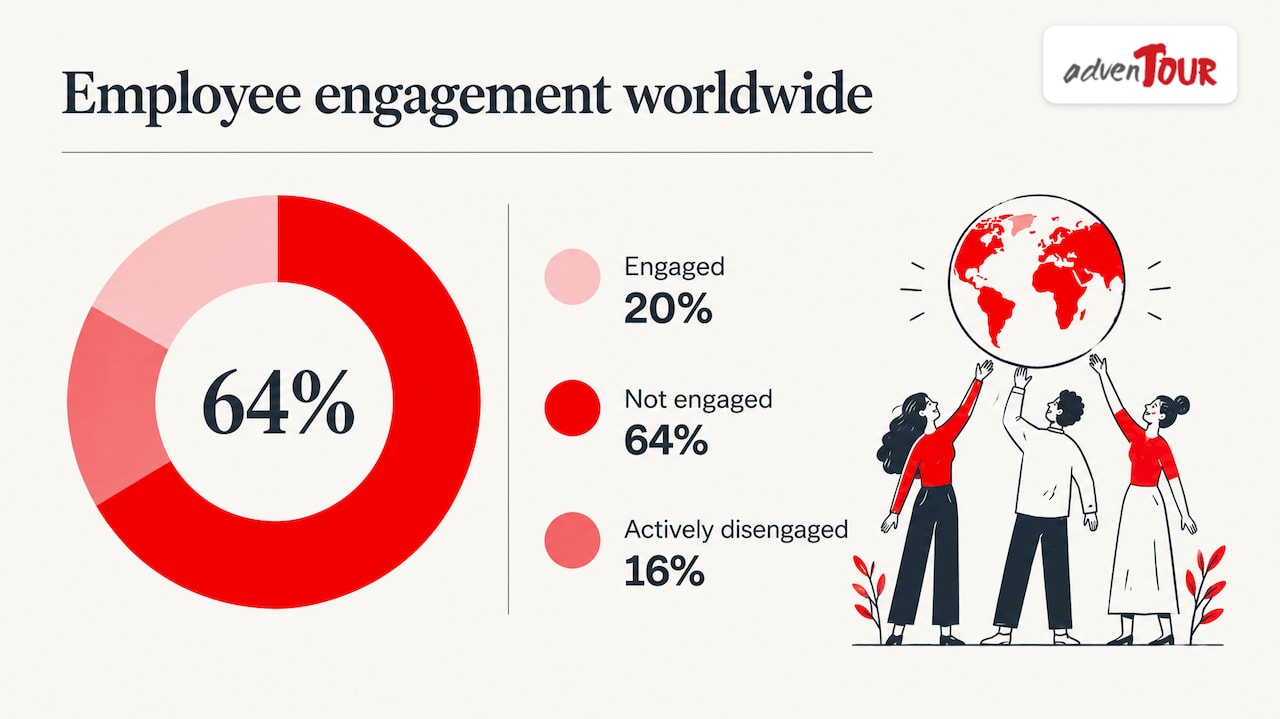
Engagement is a live problem. Gallup’s global research found that 20% of employees worldwide were engaged at work in 2025, with 64% not engaged and 16% actively disengaged. Gallup’s figure comes from a global survey, not Singapore alone, but it shows why many HR teams look for shared experiences that give people a reason to connect.
Game formats help for three practical reasons:
- Low stakes, real interaction. Points and prizes lower the social barrier, so a finance analyst and a sales lead will argue over an answer together.
- Visible roles. Teams quickly sort out who leads, who checks, who keeps time. Those patterns are the material for a debrief.
- Shared story. A last-second win or a spectacular miss gives colleagues something to talk about back at the office.
Game show formats that work for companies
There is no single “game show.” These are the building blocks we use when we design a program.
| Format | How it plays | Best for |
|---|---|---|
| Quiz rounds | Teams answer buzzer or device questions on company knowledge, general topics or pop culture | Conferences, town halls, product training |
| Challenge rounds | Teams complete physical or puzzle tasks against the clock | Mid-size teams, indoor or outdoor venues |
| Pitch rounds | Teams build and present an idea to a panel | Leadership, sales and innovation teams |
| Race formats | Teams move between stations or locations, solving clues | Large groups, offsites, outdoor spaces |
| Head-to-heads | Representatives from each team face off in a final | Finales and awards-style closings |
Most strong events combine two or three of these. A quiz warm-up, a challenge middle and a head-to-head finale gives energy a clear arc.
Program options that deliver the game show feel
We do not run a single off-the-shelf quiz. Our programs are customised to each client’s objectives and scalable for group size and budget, and several carry the competitive, round-based structure of a game show. Prices below are the per-person ranges published on our site.
Budget-friendly: high energy, simple logistics
These suit large groups and tight budgets. See the full budget-friendly activities.
- App-based Amazing Race: S$40 to S$55 per person. Teams work through challenges and clues on a mobile app, which gives you a live scoreboard much like a game show leaderboard.
- Combat Skirmish Laser Tag: S$37 to S$45 per person. Team versus team rounds with scoring.
- Bloop Bubble Soccer: S$36 to S$43 per person.
- Kinball: S$35 to S$45 per person.
- Bicycle Scavenger Hunt: S$45 to S$55 per person.
Quality: more facilitation, more learning
Our quality team building programs add depth for teams that want a takeaway beyond the day.
- Amazing Race: S$65 to S$78 per person.
- Running Man Challenge: S$72 to S$82 per person, a mission-based format named after a popular TV show.
- Modified DISC Workshop: S$70 to S$82 per person, pairing activity with an understanding of working styles.
- Garden Odyssey: S$68 to S$90 per person.
- Laser Clay Shooting: from S$69 per person.
Premium: leadership and senior teams
For executives, regional leaders and clients, the premium team building programs give a more polished format.
- Office Shark Tank: from S$92 per person. Named after the TV pitch show, it suits teams who want a pitch-and-judge dynamic.
- Office Dynamics Workshop: S$80 to S$90 per person.
- DISC Personality Profiling: S$150 to S$159 per person.
- Katong/Joo Chiat Cultural Food Immersion: S$82 to S$98 per person.
- Corporate Sailing Team Building: S$125 per person.
Every figure above is a published per-person range. Your final quote depends on headcount, venue, date and how much customisation you want.
Planning a corporate game show event step by step
1. Start with one goal
Write one sentence: what should be different after the event? Examples: sales and operations understand each other’s constraints; a newly merged team has met; regional delegates leave the conference more connected. The goal decides the rounds. Cross-team communication calls for rounds where information is split between members. A morale lift calls for faster, lighter rounds.
2. Count heads and mix the teams
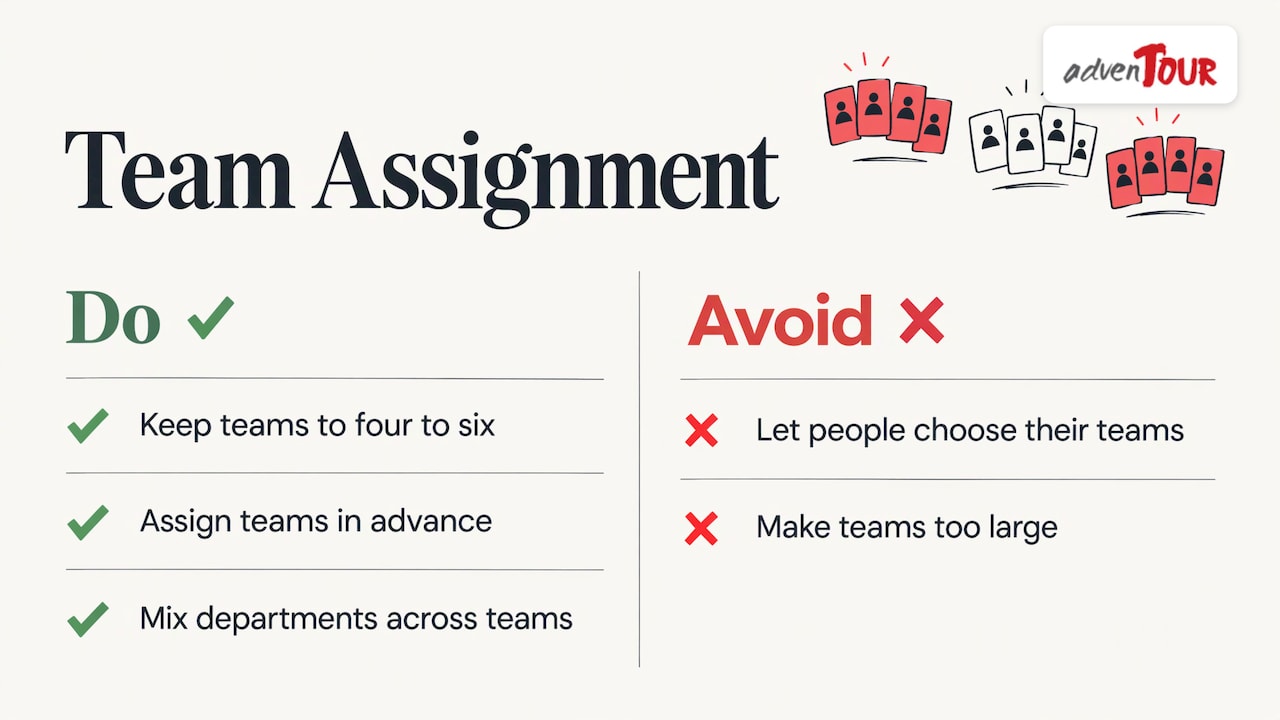
Teams of four to six keep everyone involved, because in bigger teams quieter people stop contributing. Divide a 60-person group into ten teams of six, and assign teams in advance so departments are mixed. Self-selected teams usually sit with friends, which defeats the purpose.
For a large group, the format matters as much as the count. Quiz formats work well in a single room. Race and field formats such as the Amazing Race spread teams across a venue and scale to big numbers with more facilitators, which is why they are our usual answer for organisations planning large group sessions. For ideas on big groups outdoors, our guide to the best outdoor team building activities for large corporate groups shows what fits.
3. Choose the venue and the weather plan
Singapore weather changes the plan. Indoor options, from meeting rooms to ballrooms, remove the risk. Our indoor team building page covers formats that run in a conference or office setting. If you prefer an outdoor or semi-outdoor event, confirm a covered or indoor backup before you book. Our Mobile Portable Tentage is S$95 per day per tent, listed with our event rentals.
4. Fit the schedule
A game show round works in blocks:
- Welcome and rules: 10 minutes.
- Warm-up round: 15 minutes.
- Main rounds: 30 to 45 minutes.
- Finale: 10 to 15 minutes.
- Debrief and awards: 10 to 15 minutes.
That is about 75 to 100 minutes. For a conference, it slots in as an afternoon energiser or an evening networking session. For a retreat, race and workshop formats can fill a half day or full day.
Keep the debrief. It is where the experience becomes learning: what did your team do when time ran short, who spoke up, what would you change? Skipping it turns team building into a pure party.
5. Plan prizes, food and the finishing touches
Prizes can be small. Bragging rights, a trophy and a team photo often do more than expensive vouchers. For refreshments, plan food that people can eat standing or between rounds. If you want sweet touches for the closing, these corporate event dessert ideas show how different event formats suit different options.
6. Build in inclusivity
Check the group for mobility, dietary and comfort needs before choosing physical rounds. A good program lets everyone score points: pair knowledge rounds with logic and creative rounds so no one is sidelined. If you are mixing in physical formats such as laser tag or bubble soccer, share the activity description with participants in advance so they can dress and prepare.
Game shows for regional meetings and conferences
Global MNCs hosting regional meetings in Singapore have a different challenge: delegates from many offices, limited free time and mixed English fluency. Keep these points in mind:
- Use visual and quick rounds. Short, clear instructions make for fewer mistakes across language backgrounds.
- Mix by office and function. Place each team’s members from different countries together to speed up bridge-building.
- Use local flavour. A food immersion such as our Katong/Joo Chiat Cultural Food Immersion (S$82 to S$98 per person) gives visitors a real taste of Singapore and works as a competitive trail.
- Plan for the agenda. A conference day is full, so a 60 to 90 minute session is more realistic than a full afternoon.
If your meeting has a corporate social responsibility side, our CSR programs combine bonding with giving back, including the SG60 CSR program, for teams visiting or based in Singapore.
Budgeting a game show event
Per-person pricing makes the maths simple. Multiply your headcount by the range, then add venue, food, prizes and any rental needs.
A worked example: 80 staff on an app-based Amazing Race at S$40 to S$55 per person comes to S$3,200 to S$4,400 for the program. The same 80 people on our Amazing Race at S$65 to S$78 would be S$5,200 to S$6,240. Premium formats scale from there. These are illustrations of the published per-person ranges, not a quote.
What moves the price:
- Format and facilitation depth. A workshop with profiling and debrief costs more than a pure activity.
- Group size. Larger groups need more facilitators and equipment.
- Customisation. Content built around your goals, products or culture takes more design time.
- Venue and equipment. If you already have a venue, you may only need equipment. We rent laser tag guns at S$25 to S$33 per hour per gun and Bloop bubble suits at S$28 per hour per ball.
How to tell if it worked
Decide on the measures before the event. Simple options:
- A short pulse survey a week later: do you know someone in another team better than before?
- Observed behaviours: more cross-team messages, joint projects started.
- Participation: how many attended and stayed to the end.
Our programs are designed around measurable outcomes in engagement, collaboration and communication, and the debrief is where we capture what teams learned. You can see how past clients described their results in our reviews and case studies.
Our perspective
Many companies ask us for a game show because they want energy in the room. We understand that, and we deliver it. What we add is the reason behind each round.
We design every program around your objective, then size it for your headcount and budget. A budget-friendly race can be as strong as a premium workshop when the goals are clear and the debrief is honest. Experiential learning, not passive entertainment, is what we aim for, so people leave with skills they can use on Monday.
We were named one of Asia’s Top 10 Corporate Team Building Companies in 2023, and the reason we care about that is simple: it came from running programs that teams remembered. Tell us what you want your people to feel and do differently, and we will build the format around it.
Joshua
Plan your event with us
We plan and run team building programs in Singapore for HR leaders, event planners and management teams, from S$35 per person for energetic competitive formats to premium leadership experiences. Tell us your headcount, goal and venue, and we will shape a program to fit.
Browse our budget-friendly activities for lively formats at an accessible price, or visit AdvenTOUR to speak with our team about a custom program. Our top team bonding games guide is also a good place to compare ideas.
FAQ
How long should a corporate game show event last?
Most run 60 to 100 minutes, including rules, rounds, finale and a short debrief. For retreats, race or workshop formats can fill a half or full day. Match the length to the agenda slot and keep the debrief.
How many people can take part?
Quiz-style formats work in one room for dozens of people, and race or field formats scale to larger groups with more facilitators. Teams of four to six work best. Tell us your headcount and we will recommend a format that keeps everyone involved.
How much does a corporate game show style event cost in Singapore?
Our published per-person ranges run from S$35 to S$45 for Kinball up to S$150 to S$159 for DISC Personality Profiling. For example, the app-based Amazing Race is S$40 to S$55 per person. Final cost depends on group size, venue and customisation.
Can we run it indoors?
Yes. Indoor formats work in meeting rooms, ballrooms and function spaces, and they remove weather risk. If you want an outdoor event, we recommend planning an indoor or covered backup.
Can the event be customised to our goals?
Yes. We tailor programs to each client’s objectives, whether that is cross-team communication, leadership development, a regional meeting icebreaker or a CSR element. Share your goal when you enquire.
Sources
- State of the Global Workplace, Global Data Summary (Gallup)
- The Best Corporate Event Dessert Ideas for Every Format (Dudley’s Toffee)
Recommended
- The Complete Guide to Planning a Corporate Event in Singapore
- End-to-End Corporate Event Planning: Expert Strategies for Success
- Corporate Activity Days in Singapore: Formats, Costs, Planning
- Top Team Bonding Games for Corporate Groups in Singapore (2026 Guide)