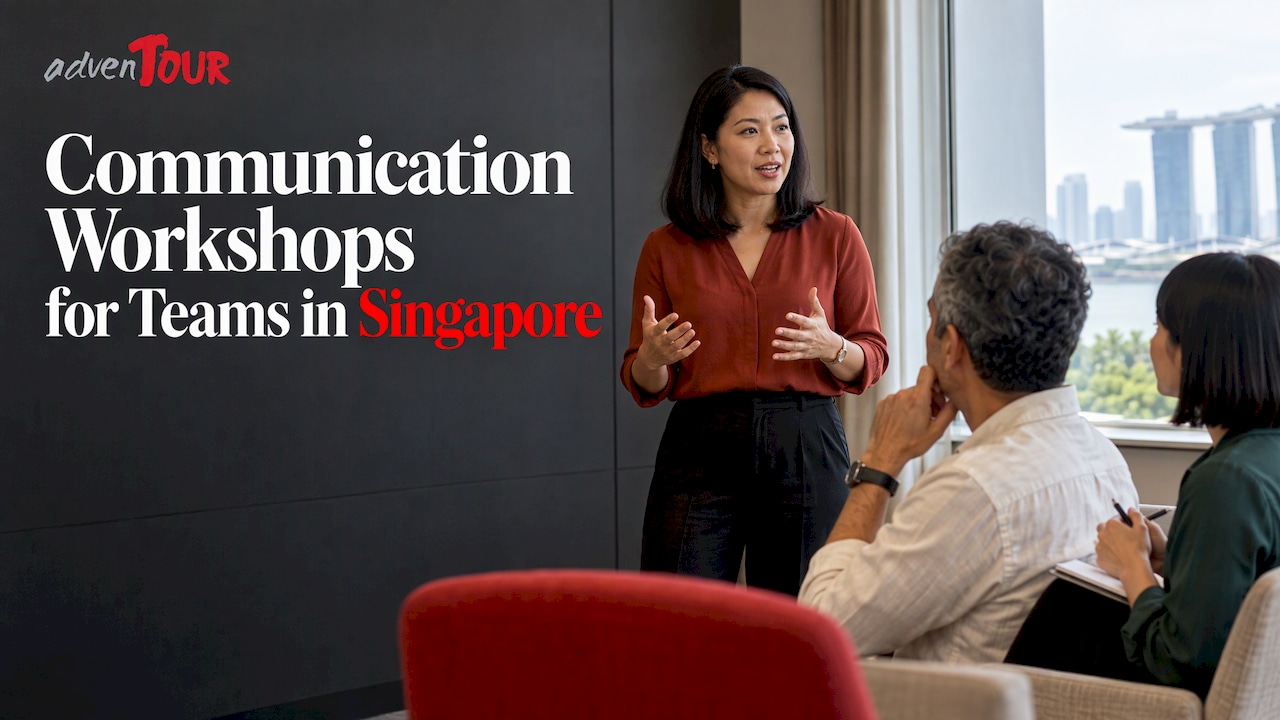
A good communication workshop gets your people practising real conversations, not listening to theory. In Singapore, the strongest ones are tailored to your team’s actual friction points (feedback, handovers, cross-department work), run by a facilitator who gives live feedback, and end with behaviors people can use on Monday morning. This guide shows what to look for, which formats suit which goals, what they cost with us, and which funding rules to check first.
TL;DR
- A workshop is built around practice and feedback. Pick one where participants spend most of the time doing, not sitting through slides.
- Match the format to the goal: personality-based workshops (DISC) for communication styles, game-based programs for collaboration under pressure, and food or wellness formats for bonding.
- Our published per-person ranges run from S$35-45 for budget activities to S$150-159 for premium DISC profiling.
- Wellness activities work best when they are varied and open to every profile of employee, as Singapore’s Ministry of Manpower advises.
- Check SkillsFuture rules before you assume funding: subsidies depend on the course, the employer and the trainee.
Table of Contents
- What a communication workshop is, and how it differs from a course
- What a strong workplace communication workshop covers
- Formats that work, and when to use each
- What it costs: our published price ranges per person
- Workplace wellness activities that support communication
- How to plan an inclusive session
- Funding and training rules to check
- Choosing between a workshop, a game-based program and a mix
- Plan your team’s communication session with us
- FAQ
- Sources
What a communication workshop is, and how it differs from a course
A communication course usually moves through a syllabus: concepts, assessments, a certificate. A workshop is shorter and more hands-on. The group works through scenarios drawn from their own workplace, tries a technique, gets feedback, and tries again.
That difference matters because communication is a behavior, not a body of knowledge. Knowing that you should listen actively is easy. Doing it when a deadline is slipping and a colleague is irritated is the skill. A workshop gives people a safe place to rehearse that moment.
For HR leaders and event planners, the practical consequences are these:
- Group-based, not individual. The whole team (or a cross-section of it) learns the same shared language at the same time.
- Tailored content. Scenarios come from your workplace, not a generic case study.
- Observable change. You can agree in advance what you want to see differently: fewer misunderstandings in handovers, faster decisions in meetings, more honest upward feedback.
What a strong workplace communication workshop covers
Whatever the format, look for four building blocks.
1. Understanding communication styles
People misread each other mostly because they communicate differently: one wants the bottom line, another wants context, another wants to check how everyone feels. A style framework such as DISC gives the team neutral vocabulary for those differences, so a blunt message is read as “direct” instead of “rude”. Our DISC Personality Profiling workshop and our Modified DISC Workshop are built around this idea.
2. Listening and clarity
The basics are still the highest-value skills: structuring a message so it is short and clear, asking better questions, and checking that the other person understood what you meant. Exercises where one person briefs and another executes (and the gaps become visible) teach this faster than any lecture.
3. Difficult conversations and feedback
Saying no, disagreeing without friction, giving feedback and handling pushback are where teams stall. Role-play and simulated business decisions let people practise these in a low-stakes setting.
4. Collaboration under pressure
Some of the best communication lessons come when a team has to solve a problem together against a clock. Who speaks first? Who gets ignored? Does anyone check the plan? A debrief that links those moments to the office is what turns a fun activity into skill transfer.
Formats that work, and when to use each
There is no single best workshop. The right one depends on your goal, group size and how much appetite the team has for being put on the spot.
Style-focused workshops
Best for: new teams, merged teams, managers who want to adapt how they lead, and teams where tension keeps resurfacing between the same personality types.
These run as facilitated sessions in which participants complete a profile, see the team’s pattern and practise adapting. Our Office Dynamics Workshop also looks at how people interact day to day in the office.
Game-based programs with a debrief
Best for: larger groups, cross-department mixing, and teams that learn better by doing than by talking.
An Amazing Race, Garden Odyssey or Running Man Challenge puts teams through tasks that need division of labor, clear instructions and quick decisions. The facilitator’s debrief is the point: what did you notice about how you communicated? Read more about how our Amazing Race programs work.
Decision and pitch simulations
Best for: leadership teams, cross-functional groups and sales or product teams. In Office Shark Tank, teams build and pitch ideas, which exercises persuasion, structured messaging and responding to tough questions.
Bonding-first formats
Best for: teams that need trust before skills. A guided food immersion in Katong/Joo Chiat, a sailing day or a bubble soccer match gets people talking without a whiteboard in sight. Conversation in these settings is relaxed, and that is exactly why they help remote or hybrid colleagues who rarely see each other.
What it costs: our published price ranges per person
Below are the programs most relevant to communication goals, as published on our site. All prices are per participant, one-off.
| Program | Price per pax | Best for |
|---|---|---|
| Kinball | S$35-45 | Large, casual groups, quick bonding |
| Bloop Bubble Soccer | S$36-43 | High-energy team bonding |
| App-based Amazing Race | S$40-55 | Budget-friendly collaboration challenge |
| Bicycle Scavenger Hunt | S$45-55 | Outdoor problem solving |
| Amazing Race | S$65-78 | Cross-team collaboration with debrief |
| Garden Odyssey | S$68-90 | Mixed-skill team challenges |
| Modified DISC Workshop | S$70-82 | Communication styles |
| Running Man Challenge | S$72-82 | Fast-paced team tasks |
| Office Dynamics Workshop | S$80-90 | Day-to-day working relationships |
| Katong/Joo Chiat Cultural Food Immersion | S$82-98 | Relaxed bonding |
| Office Shark Tank | from S$92 | Pitching and persuasion |
| Corporate Sailing Team Building | S$125 | Executive teams, leadership offsites |
| DISC Personality Profiling | S$150-159 | In-depth style insight |
You can see the full lists on our budget-friendly activities, quality programs and premium programs pages. Where a range is shown, group size and customization affect where you land.
Workplace wellness activities that support communication
Communication and wellbeing are linked in practice. A team that is stretched, isolated or anxious communicates worse, and a team that feels connected communicates more openly. If your brief is “improve wellness at work” as well as communication, the activity mix matters.
Singapore organizations tend to combine a few types:
- Physical activity. Exercise and yoga sessions are common ways to encourage movement; one NUS public health interview describes health talks, regular exercise and yoga for physical activity, and mindfulness sessions for mental wellbeing as part of a workplace approach.
- Interest-based bonding. The Ministry of Manpower’s workplace diversity toolkit suggests picking common-interest themes for workplace activities, with examples such as sports clubs and competitions, family days and excursions, and culinary tours.
- Crafts, tours and clubs. Marina Bay Sands reports offering team member activities that range from yoga and gym classes to leather-making and sun-catcher workshops and educational tours, and has reinstated sports clubs such as soccer, badminton and running.
- Manager capability. Oracle’s APAC team describes managers joining workplace mental health training and creating a safe space for employees to voice concerns. Communication skill sits right at the center of that.
For a one-off corporate event, our formats map neatly onto this list. Bubble soccer, Kinball and laser tag cover active play. The Katong/Joo Chiat food immersion covers the culinary-tour idea. A style workshop covers the manager and peer communication piece. See corporate sports days if you want a bigger wellness-and-engagement format, or our Family Day Carnival for events that include employees’ families.
Our perspective: communication is learned by doing
We have run enough team sessions to see the same pattern repeat. Teams rarely lack knowledge about good communication. They lack a safe, structured place to try it with the people they actually work with.
That is why we design programs around experiential learning and skill transfer rather than passive entertainment. A game or workshop is the vehicle. The debrief, where a facilitator helps the team connect what happened in the activity to how they work on a Tuesday afternoon, is what makes it stick.
It is also why we customize. A regional team meeting in Singapore for the first time has different needs from a department that has worked together for ten years and keeps clashing over handovers. We scale the format to group size and budget, from our budget-friendly activities up to premium programs, and we set objectives with you first so that engagement, collaboration and communication outcomes can be measured afterwards.
Our advice: choose the style framework or activity that suits your people, make sure the facilitation is experienced, and agree on what “better” looks like before the day.
Joshua
How to plan an inclusive session
A communication workshop only works if everyone can take part. Some practical points for planners:
- Mix profiles on purpose. The Ministry of Manpower’s toolkit advises organizing formal and informal activities that help employees of different profiles and departments interact. Build teams across departments and seniority, not by default seating.
- Check accessibility. The same toolkit highlights sensitivity to different employee populations, for example access needs and ergonomics for older workers. Ask for a venue and activity plan that suits wheelchair users, older colleagues and anyone with a health condition, and offer a meaningful alternative role (scorekeeper, navigator, strategist) when a physical task is unsuitable.
- Set the objective in one sentence. For example: “Our finance and operations teams should hand over month-end tasks without rework.” Everything else flows from that.
- Match the activity to the group’s comfort. Role-play heavy sessions can feel exposing for quieter teams. Game-based formats let people ease into collaboration before the debrief gets more personal.
- Plan for size. Large groups need more facilitators and clear team structures. We run large group packages for companies of every size.
- Close the loop. Ask participants for one commitment each, and have managers revisit it a few weeks later.
Funding and training rules to check
If you are comparing a formal communication course with a workshop-style team event, check the funding position early, because the two can be treated differently.
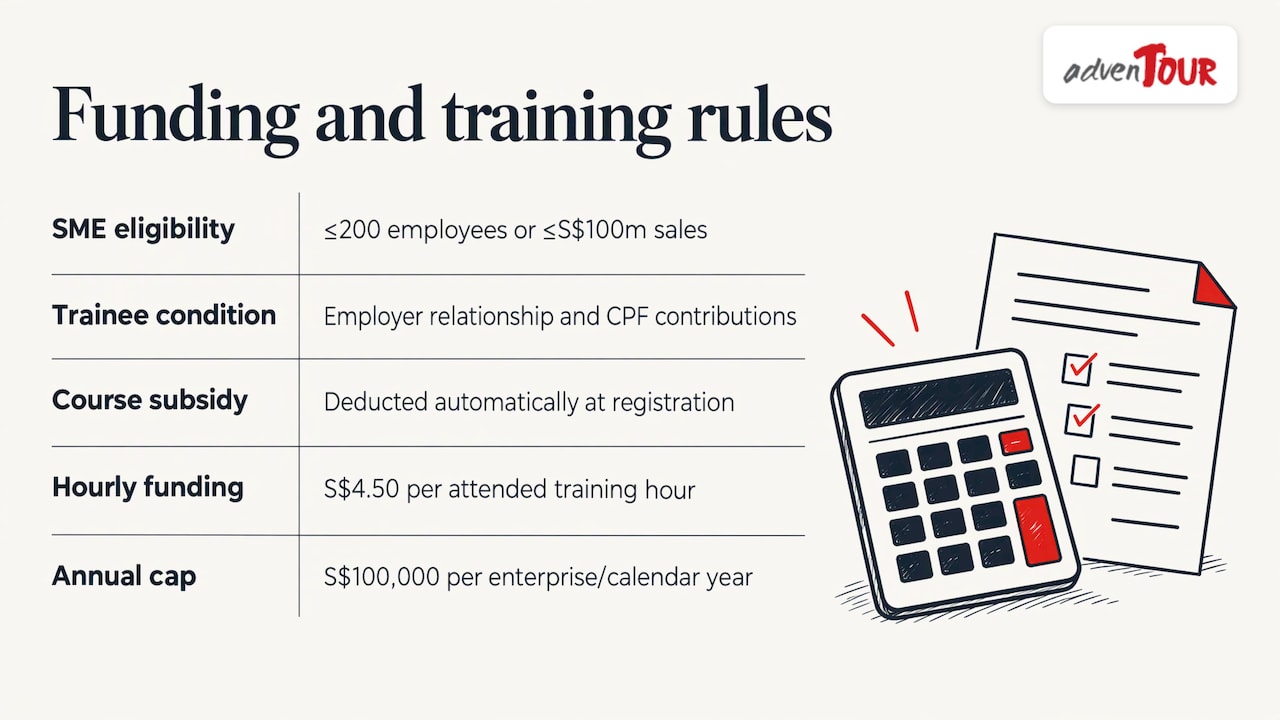
The SkillsFuture for Business page explains that SMEs registered with ACRA and meeting the criteria (employment size of no more than 200, or annual sales turnover of no more than S$100 million) can receive Enhanced Training Support for SMEs on top of baseline course subsidies. For employer-sponsored trainees, there must be an employer-employee relationship and CPF contributions. Applicable course subsidies are deducted automatically at registration. The same page says Absentee Payroll Funding reimburses S$4.50 per hour of attended training, capped at S$100,000 per enterprise per calendar year.
Those schemes apply to eligible funded courses, so ask your finance or HR team to confirm whether a given program qualifies before you budget around a subsidy. Our team-building programs are quoted at the per-person prices above, and we are happy to talk through your plans so that you can budget accurately.
Choosing between a workshop, a game-based program and a mix
A simple way to decide:
- Your problem is misunderstanding between types of people. Start with a style workshop (Modified DISC for a shorter, lighter session; DISC Personality Profiling for a deeper one).
- Your problem is silos or a new team. A game-based program such as Amazing Race, Garden Odyssey or the Running Man Challenge, with a facilitated debrief.
- Your problem is leadership alignment. Office Shark Tank, or corporate sailing for an executive offsite.
- Your budget is tight. App-based Amazing Race, Kinball or bubble soccer give you a strong shared experience at the lower end of our ranges.
- You need both skills and bonding. Combine a morning workshop with an afternoon activity. The workshop gives the vocabulary, and the activity lets the team use it under light pressure.
If you want to see how this plays out, read our client reviews and case studies and the story of how one team strengthened communication.
Plan your team’s communication session with us
We design and facilitate team building programs in Singapore for HR leaders, event planners and management teams, from budget-friendly activities to premium offsites, including large-group sessions, regional meetings and CSR programs. We were recognized as one of Asia’s Top 10 Corporate Team Building Companies in 2023.
Tell us your objective, group size and budget, and we will propose a program tailored to it. Start on our corporate team building solutions page or browse the Modified DISC Workshop and other quality programs.
For events with a giving-back angle, our CSR programs bring teams together around a shared cause.
FAQ
How long should a corporate communication workshop be?
It depends on the goal. A focused style session can fit into a half day, while a program that combines learning with an activity and a debrief usually needs more time. Tell us your group size and objective and we will recommend a duration that leaves enough time for practice and feedback.
What is the difference between a communication workshop and a team building activity?
A workshop teaches and rehearses specific skills with a facilitator. A team building activity creates a shared experience that builds trust and reveals how a team behaves. The most effective programs combine both: an activity followed by a facilitated debrief that links it to daily work.
Can a communication workshop be combined with wellness activities?
Yes. Many organizations pair a workshop with active or relaxed formats, such as a food immersion, a sports-style activity or a sailing day. This supports bonding and wellbeing while the workshop covers the communication skills. Choose activities that everyone in the group can join.
Are communication workshops eligible for SkillsFuture funding?
Some formal courses are, depending on the course, the employer and the trainee. Check the SkillsFuture for Business page or ask your finance team to confirm eligibility for the specific program you are considering.
How much does a team communication workshop cost per person with AdvenTOUR?
Our Modified DISC Workshop is S$70-82 per pax, the Office Dynamics Workshop is S$80-90 and DISC Personality Profiling is S$150-159. Game-based options start at S$35-45 per pax.
Sources
- SkillsFuture for Business: training subsidies for employers
- Ministry of Manpower: workplace diversity management toolkit
- NUS Saw Swee Hock School of Public Health: interview with Dr Melvin Seng
- Sands: team member well-being initiatives
- Oracle: busting stress and embracing wellness
Recommended
- Innovation Workshops for Corporate Teams in Singapore
- Interactive Corporate Workshops Singapore: Top Picks
- Corporate Team Building Activities: What Works
- Sales Team Building in Singapore: Activities That Work