
Workplace gamification means borrowing the design principles of games, such as progress, feedback, challenges and recognition, and applying them to ordinary work like learning, wellbeing and collaboration. It is not playing video games on company time. Research on gamified workplaces describes it as adapting game-design principles and interaction elements to everyday work processes and behaviors. Done well, it makes routine effort feel visible and shared. Done badly, it feels like surveillance with a trophy attached. This guide shows what works, with Singapore examples, and how to start.
TL;DR
- Gamification at work is game design (points, badges, challenges, feedback, leaderboards) applied to real tasks such as training, wellness and system adoption.
- Learning and development is the most common use, and Singapore’s National Steps Challenge shows the model at national scale.
- A 2026 study that included Singapore employees found that excessive competition can undermine relatedness and meaningfulness, so balance rivalry with team goals.
- Make participation a choice, explain what data you collect, and keep leaderboards optional or team-based.
- Live, facilitated team activities are a low-risk way to give your team a gamified experience and test what motivates them.
Table of Contents
- What gamification at work actually involves
- The game elements and how each one behaves
- Workplace gamification examples that work
- What the evidence says about benefits
- Designing it so it motivates everyone
- How to start in Singapore: a five-step plan
- Our perspective
- Bring gamification to life with your team
- FAQ
- Sources
What gamification at work actually involves
The core idea is simple: take something people already need to do and wrap it in the mechanics that make games engaging. A new software rollout becomes a set of missions. A compliance course becomes a series of levels. A fitness push becomes a team challenge.
The framework published in PMC says these mechanics can involve progress, feedback, challenges, rewards, recognition, social interaction and carefully chosen competition. It also states the long-term aim of a gamified workplace: better organizational wellbeing, including productivity, and better personal wellbeing, including work satisfaction. Notice that the goal is not simply more output. The best programs are built around how people feel about their work.
What it is not
It is not a ping-pong table, and it is not a one-off party. Those are fine perks. Gamification is a designed system with a goal, a behavior it wants to encourage, and a way to measure whether it worked.
The game elements and how each one behaves
Most workplace programs are built from a handful of parts. Professional guidance on team engagement describes them along these lines, and the table adds practical notes on when to use each.
| Element | What it does | Best used for | Watch out for |
|---|---|---|---|
| Points | Show progress and reward completion | Training modules, onboarding, habit building | Points that lose meaning once novelty fades |
| Badges | Signal milestones or skill levels | Certifications, learning paths | Badges nobody values or understands |
| Challenges and quests | Define a clear goal and a path to it | Cross-team projects, adoption of new tools | Goals set so high that people give up |
| Progress bars | Show how far along someone is | Long programs, onboarding | Making slow progress feel like failure |
| Feedback | Tells people how they are doing, quickly | Almost everything | Feedback that feels like monitoring |
| Leaderboards | Display rankings | Short, opt-in sprints | Visible ranking can motivate some people and discourage or stress others |
The same guidance advises using leaderboards cautiously. If you remember one line from this table, make it that one.
Workplace gamification examples that work
Learning and development
HRM Asia reported that learning and development is the most common use case. It also cited 2019 Harvard Business School research finding that gamification increased people’s willingness to engage with learning and to complete programs consistently. Typical formats are quizzes, short levels, streaks and team knowledge battles.
Feedback and recognition
Peer shout-outs, milestone badges and visible thank-yous turn recognition from an annual event into a daily habit. The same HRM Asia piece covers gamification for employee feedback, where staff earn points for sharing input, which helps leaders hear from quieter people.
Adopting a new system
Rolling out new software is where many teams stall. An industry perspective published in Singapore points to frequent feedback, leaderboards, wellness step challenges and team collaboration missions as ways to support adoption. A team mission such as “get every person in your department through the first three workflows this week” rewards the group, not the fastest individual.
Wellbeing challenges: the Singapore benchmark
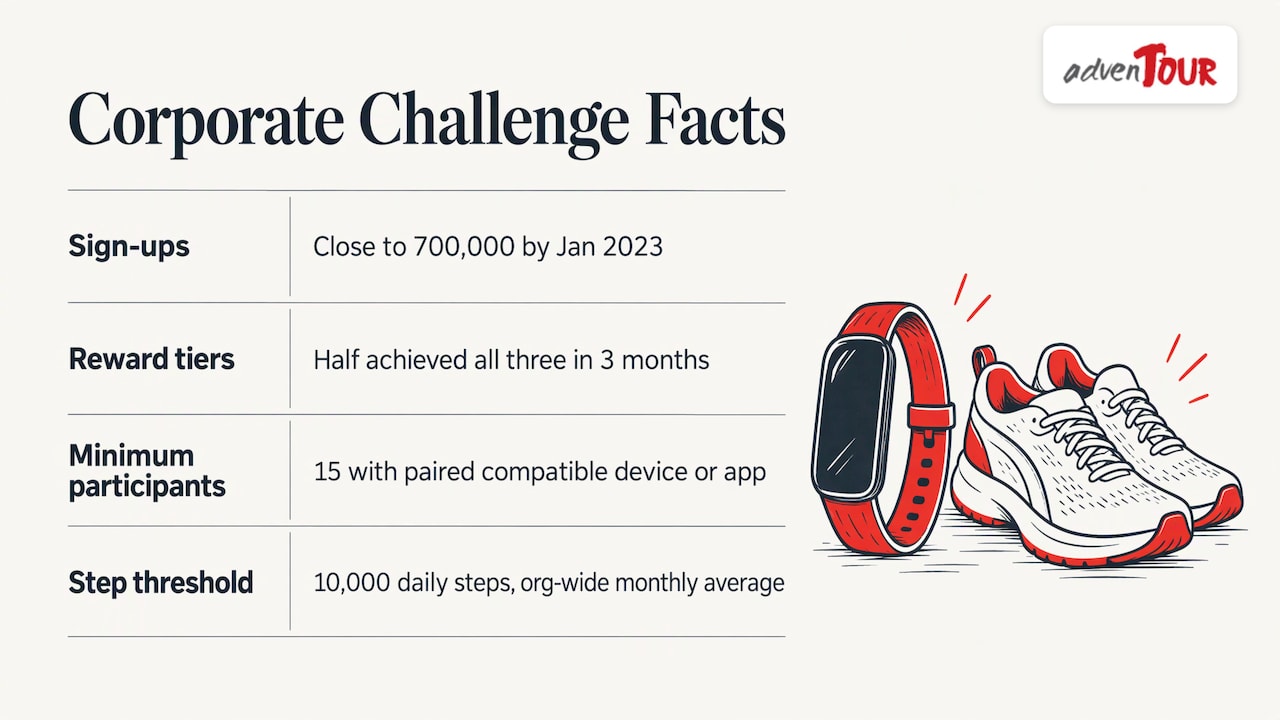
Singapore has the clearest local example. The Health Promotion Board describes the National Steps Challenge as using gamification and technology to encourage physical activity, and its 2022-2023 refresh had close to 700,000 sign-ups as of January 2023.
The corporate version is more relevant to HR teams. HPB’s Corporate Challenge lets employees compete between organizations and, optionally, between departments or teams within one. In Season One, HPB reported, half of participants achieved all three sure-win reward tiers within three months. The published terms set conditions for corporate rewards: at least 15 participants who have paired a compatible device or app, and an organization-wide average of 10,000 daily steps for that month. Check the current terms before you sign up, because they are updated by season.
A small touch makes these challenges feel like a team effort: shared kit. If you run a department step challenge, custom team T-shirts for challenges give each team an identity and a reason to cheer each other on.
Live, facilitated gamification
Not all gamification is an app. A well-run physical activity uses the same ingredients: clear goals, quick feedback, shared challenges and recognition. Our own formats work this way. An app-based Amazing Race gives teams missions and points. A bicycle scavenger hunt turns problem-solving into a route. Laser tag and bubble soccer put strategy and communication under light pressure. These are designed to show how your team collaborates, and the debrief connects what happened on the field to daily work.
What the evidence says about benefits
The benefits reported across sources are consistent, though they depend on design:
- ADP reports that strategic gamification may increase motivation and engagement, productivity through positive competition or collaboration, retention, program adoption and willingness to try new things or tackle repetitive tasks.
- HRM Asia lists engagement, skill development, collaboration, control, immediate feedback and recognition as potential benefits, with achievement badges and leaderboards as the common mechanics.
- A 2026 study of employees in China and Singapore found that autonomy was positively related to meaningful work in Singapore, while competence and relatedness were strong predictors across both contexts.
That last finding matters for design. People want to feel they have a choice, that they are getting better at something, and that they belong. Gamification that delivers those three feelings tends to work.
Designing it so it motivates everyone
The research on risks is not a reason to avoid gamification. It is a design brief. Here are the lessons.
Balance competition with collaboration
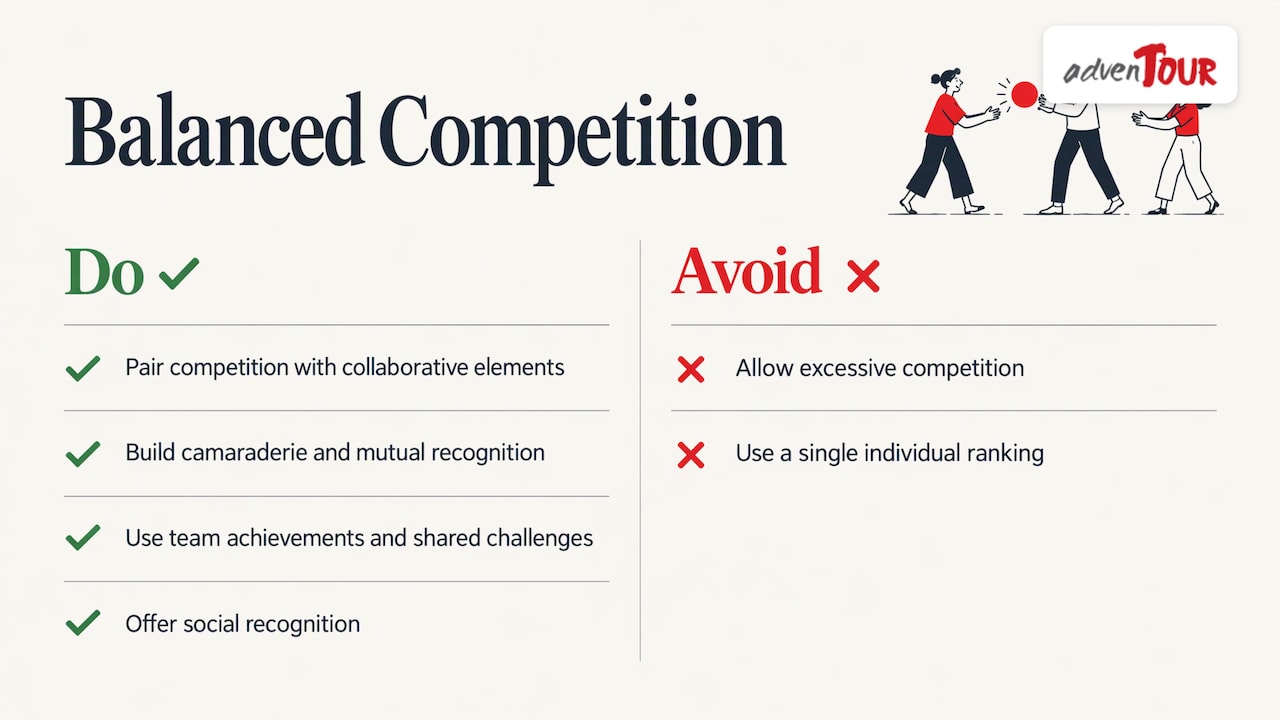
The Tan et al. study, published in 2026, found that gamification works through three features: visibility, comparability and immediacy. It also found that in collectivist or hierarchical cultures like Singapore, excessive competition can undermine relatedness and meaningfulness. The recommendation for managers is to pair competitive elements with collaborative ones that build camaraderie and mutual recognition. In practice: team achievements, collaborative challenges and social recognition rather than a single individual ranking.
Keep it supportive, not controlling
A Concordia University research summary reports that employees are sensitive to whether gamification feels supportive or controlling. Programs that looked focused on monitoring or competition often met resistance, especially when people felt they had little choice. It also notes that a leaderboard that energizes one team may create anxiety for another. The researchers stress that the key is creating experiences that make people feel valued, supported and connected to what they do.
Design against known pitfalls
A peer-reviewed taxonomy of gamification risks found that problems arise mainly when staff see the system as an appraisal and performance-monitoring tool. It names free-riding, work intimidation, weaker group cohesion and social loafing as risks, and recommends practical fixes:
- Use anonymity for names or performance data where you can.
- Reward helping behavior, not only individual results.
- Rotate teams randomly so groups do not harden into rivals.
Other studies add that rewards can lose novelty, so refresh the program on a schedule. Field research on frontline staff found that willingness to participate moderated negative effects on engagement, which is another argument for opt-in design. A study of a slot-machine style reward game found the effect was short-term and limited to those who chose to play, so make sure people who sit out are not penalized.
Respect the ethics
Academics have also raised concerns about manipulation and coercion. A Journal of Business Ethics article argues that workplace gamification can use data-driven persuasion against users’ interests. The practical answer is transparency: tell people what the program is for, what is measured and who sees it.
How to start in Singapore: a five-step plan
- Pick one behavior. Choose a single outcome, such as finishing onboarding, using a new tool or taking part in wellness activity. Programs that try to change everything change nothing.
- Start with team goals. Build in a shared target first, then add individual recognition. The framework in PMC recommends balanced competition and collaboration, predictable achievement-based rewards, a learning orientation and a wellbeing orientation.
- Make it opt-in and low stakes. Offer a way to take part without being ranked. Rewards should feel supportive rather than controlling.
- Check your data practices. Under Singapore’s Personal Data Protection Act 2012, an academic analysis of employee monitoring explains that organizations must generally obtain consent to collect, use or disclose personal data, with an employment relationship exception for data reasonable to manage the employment relationship. It also notes that unaddressed data concerns can cost employee trust. A 2026 guide for HR teams adds that employers should collect only data that is reasonable and related to employment, and remain responsible for data handled by an HR software vendor on their behalf. If your program tracks individuals, speak with your data protection officer or legal counsel first.
- Measure and refresh. Compare engagement before and after, ask participants how it felt, and rotate the mechanics so novelty does not wear off.
Our perspective
We run team building for Singapore companies every week, and the pattern is clear: people do not remember the points, they remember how the day felt. A good gamified activity gives a mixed group a shared problem, a short feedback loop and a reason to lean on colleagues they rarely talk to.
That is why we design around objectives, not around novelty. Our programs are built to be customized to your goals and scaled to your group size and budget, with experienced facilitators who link what happened in the game to how the team works on Monday. We aim for experiential learning and skill transfer rather than passive entertainment.
Our advice is to start live. A facilitated session shows you in a few hours which people thrive on competition, which prefer collaboration, and where communication breaks down. Those insights then shape any app or ongoing program you build later. Keep teams mixed, keep the goal shared, and keep the debrief honest.
Joshua
Bring gamification to life with your team
If you want to see gamification work before committing to a long-term system, a facilitated team event is a fast start. Published prices per person are below, and we can tailor each format to your goals.
- Budget-friendly: App-based Amazing Race at $40 to $55, Bloop Bubble Soccer at $36 to $43, Kinball at $35 to $45 and Combat Skirmish Laser Tag at $37 to $45. See the budget-friendly activities.
- Quality: Amazing Race at $65 to $78 and the Modified DISC Workshop at $70 to $82. See the quality team building programs.
- Premium: Office Shark Tank from $92 and Corporate Sailing at $125. See the premium programs.
For a wellbeing angle, such as a step-style challenge turned into a team day, read about our corporate wellness team building, or talk to us through our main site about a custom program.
FAQ
What is gamification in the workplace?
It is the use of game-design elements such as points, badges, challenges, feedback and leaderboards in everyday work activities like training, wellness or collaboration. It is not the same as playing games at work. The aim is to make real tasks more engaging and to support wellbeing and productivity.
What are good examples of workplace gamification?
Common examples are quiz-based learning with streaks, peer recognition badges, team missions for adopting new software and wellness step challenges. In Singapore, the National Steps Challenge and its Corporate Challenge are well-known examples. Live formats such as an app-based Amazing Race or a scavenger hunt apply the same principles in person.
Does gamification always improve motivation?
No. Studies report that effects can fade when rewards lose novelty, and that competition can stress lower performers or feel controlling. Results are better when participation is a choice, goals are shared, and recognition supports people rather than ranking them.
How do I avoid unhealthy competition?
Combine competitive elements with team achievements, reward helping behavior, rotate teams and keep individual rankings optional or anonymous. Research on Singapore employees suggests that collaboration and mutual recognition protect the sense of belonging and meaningful work.
Do Singapore employers need to think about data protection?
Yes, if your program collects personal data. The PDPA generally requires consent, with an exception for data reasonable to manage the employment relationship. Collect only what you need, explain it clearly, and consult your data protection officer or legal counsel for your specific setup.
Sources
- I PLAY AT WORK: ten principles for transforming work processes through gamification (PMC)
- Game on: How to engage employees using gamification (HRM Asia)
- Discover how workplace gamification boosts team engagement
- How Businesses Can Harness Gamification for Growth
- HPB: National Steps Challenge refresh
- HPB: National Steps Challenge expands to include corporates
- National Steps Challenge Corporate Challenge terms
- ADP: Gamification in the workplace
- Tan et al. (2026), From gamification to work performance, Emerald
- Self-determination study of employees in China and Singapore (JCU)
- Concordia University: Workplace gamification can boost engagement and performance
- Gamification Risks to Enterprise Teamwork (MDPI Systems)
- Uncovering the dark side of gamification at work (Journal of Business Research)
- Behavioral implications of using an online slot machine (Accounting and Society)
- Redemption Through Play? Ethics of Workplace Gamification (Journal of Business Ethics)
- Data protection implications of modern employee monitoring (Singapore Academy of Law Journal)
- PDPA for Employers in Singapore (Glints TalentHub)
- Corporate T-shirt printing in Singapore for team building
Recommended
- Adventour’s Squid Game: The Ultimate Corporate Event
- Employee Engagement & Team Bonding Guide
- Collaborative Team Games for Large Groups: Boost Unity & Engagement
- Office Dynamics Workshop