
To resolve workplace conflict, act early and talk to each person separately. Work out what kind of conflict it is. Then hold one structured conversation that ends in specific, written actions and a follow-up date. Most conflicts get worse because nobody names them, not because they are unsolvable. This guide gives you the steps, the Singapore context, and team activities that help once the immediate issue is settled.
It is written for managers, HR leaders and team leads who need something they can use this week.
TL;DR
- Name the conflict first: task, process, relationship or status. The type decides the fix.
- Use a simple sequence: gather facts, assess, facilitate one conversation, document, follow up in two to four weeks.
- In Singapore, preserve face. Hold private conversations first and bring in a neutral third party when values or cultural norms are at the root.
- End every resolution meeting with concrete actions, not a promise to “communicate better”.
- Once the issue is settled, structured team activities rebuild trust and give people a safe way to practice working through friction.
Table of Contents
- Name the type of conflict before you act
- A step-by-step process managers can follow
- Deal with it early, before it hardens
- When to bring in a neutral third party in Singapore
- Team activities that rebuild working relationships
- Check whether it is working
- Perspective: why we pair conversations with shared experiences
- Plan a team session with us
- FAQ
- Sources
Name the type of conflict before you act
A manager who treats every clash as a personality problem usually makes it worse. The University of Minnesota’s HR office describes four common sources of conflict: task (different ideas about the work), process (different ideas about how it gets done), relationship, and status (different views on leadership, credit or resources).
This matters because the types need different responses:
| Type | What it sounds like | First move |
|---|---|---|
| Task | “I think the proposal should lead with price.” | Let the disagreement run, then set how the final decision gets made. |
| Process | “We keep doing handovers differently.” | Agree on one written way of working. |
| Relationship | “He talks over me in every meeting.” | Private conversations first, then a facilitated one. |
| Status | “She got credit for work my team did.” | Clarify roles, credit and decision rights. |
The same Minnesota page notes that task conflict can be a productive part of teamwork when it is managed well and is not accompanied by strong feelings such as anger. You do not need to eliminate disagreement. You need to stop it turning personal.
Common underlying causes are worth checking against your own situation. The GitLab Handbook lists personality differences, perceived unfairness over resources or project work, unclear role expectations, poor communication and differing work methods or goals. If you can point to one of these, you already have a starting hypothesis for the conversation.
A step-by-step process managers can follow
Several reputable HR sources converge on the same shape. This combined sequence draws on them.
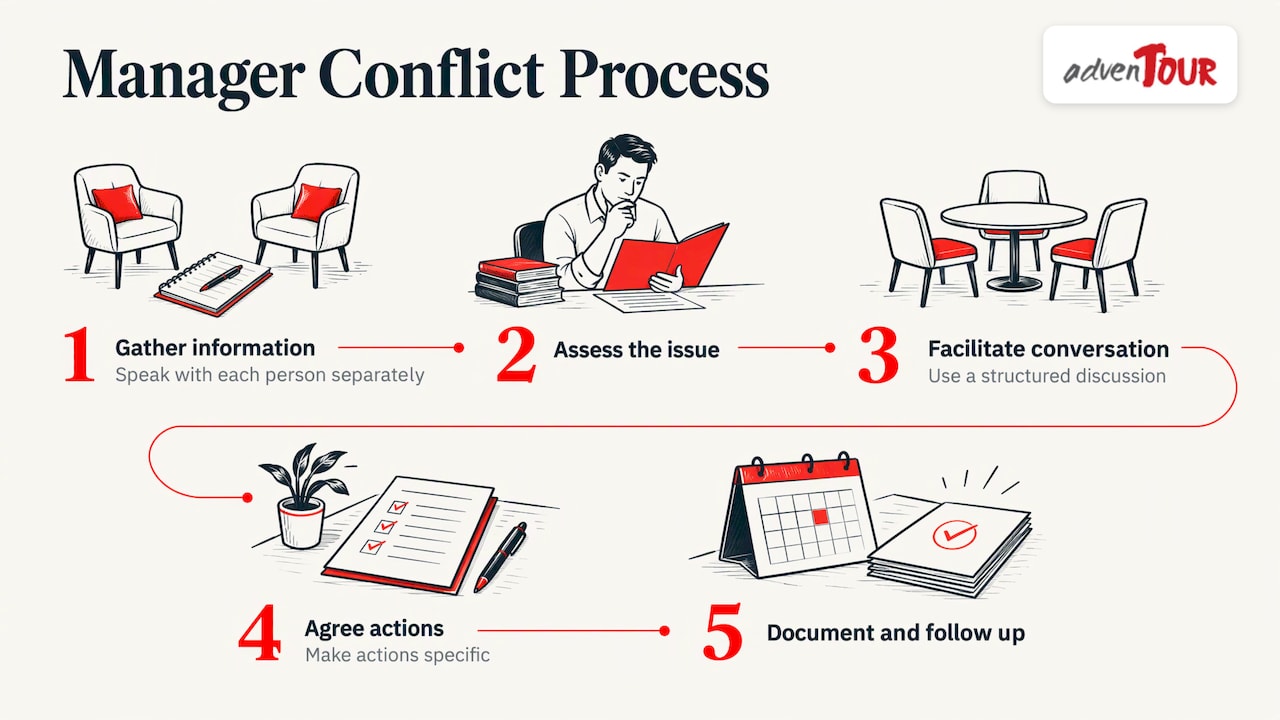
Step 1: Gather information separately
The American Employers Alliance advises speaking individually with each person, asking open-ended questions and listening without taking sides. Resist the urge to solve anything at this stage. You are collecting each person’s account, what they want, and what they think they contributed.
Singapore’s Ministry of Manpower (MOM) makes a similar point in its managers’ guide: identify the root of the problem and clarify each party’s position before anything else.
Step 2: Assess what you are dealing with
Sort the situation into work style, resource or role, personal animosity, or a conduct issue. A conduct issue, such as harassment, is not a mediation topic and goes to HR. The rest can usually be handled by the manager.
Step 3: Facilitate one structured conversation
SHRM’s workplace conflict checklist splits the conversation into two phases. In the identification phase you meet in a neutral location, set ground rules, describe the conflict using “I” statements, restate what you heard and summarize the conflict. In the solution phase you brainstorm options, rule out unworkable ones, summarize what is left, agree next steps and close on a positive note.
The University of Iowa’s HR office offers a script for the person starting the talk: prepare by identifying the main issue, your desired outcome and your own contribution, then open the conversation, deliver the message, listen and respond, close by summarizing agreements, and reflect afterward.
A few practical rules that make the meeting work:
- Talk about impact, not blame. “When the handover arrives after 5 pm, my team cannot respond to the client that day” lands better than “you are always late.”
- Separate generating options from choosing one. People stop arguing win or lose when they are only brainstorming.
- Let each person speak without interruption for a set time.
- Summarize agreements out loud before anyone leaves.
Step 4: Agree specific actions
“Communicate better” is not an outcome. ExperTrain gives a useful model of a good one: if a client deadline changes, update the shared project board and message both account leads the same working day. Anyone can check whether that happened.
Step 5: Document and follow up
Write down the key points, share the summary with both people, and set a check-in. The American Employers Alliance suggests a follow-up date two to four weeks out. Randstad Singapore recommends a quiet check-in after a week or two. Either works. Pick one and put it in the calendar before the meeting ends.
Deal with it early, before it hardens
Speed matters. MOM’s guide says to resolve conflicts quickly to limit the damage to morale, communication, cohesion and trust. The CIPD’s Asia guide for people managers advises being proactive: start informal discussions when a problem is brewing, stay objective, avoid taking sides, and establish what each person needs in order to move forward.
What early intervention looks like in practice:
- You notice two people have stopped sharing information. You ask each one, privately, how the project is going.
- A meeting gets tense. You do not rule on it in the room. You ask for ten minutes with each person afterward.
- A recurring complaint appears in one-to-ones. You raise it with the team as a process question, not a person question.
People in the middle of a heated moment need to calm down before problem-solving. Facilitators Network Singapore’s Saba puts it this way: let people offload and give the conversation AIR (acknowledge, intrigue, reflect) first, and remember that acknowledgement is not agreement.
Know your own default style
The Singapore Mediation Centre outlines five conflict styles drawn from the Thomas-Kilmann model: collaborating, competing, compromising, accommodating and avoiding. None is always wrong. Competing suits an emergency. Avoiding suits a trivial issue or a cooling-off period. Collaborating is the right default for recurring team friction because it targets the root cause. Most managers lean on one style. Knowing yours helps you notice when you are using it out of habit.
When to bring in a neutral third party in Singapore
Bring someone neutral in when direct conversations are not working, when there is a power imbalance, or when the issue is affecting wellbeing. Randstad Singapore says bringing in HR early is good people management, not a sign you cannot handle your team. Employees can also go to HR or a skip-level manager, ideally after documenting what has happened.
MOM’s guide specifically suggests involving a neutral mediator when conflict comes from differences in values or languages across nationalities. That is a common situation in Singapore’s multinational offices. Managers can also help by facilitating understanding of the other party’s cultural norms and values.
The Singapore Mediation Centre also stresses that conflict management takes more than “talking it out”. It names conflict mapping (root causes, power dynamics, outside stakeholders), emotional intelligence and psychological safety as the skills that de-escalate high-stakes situations.
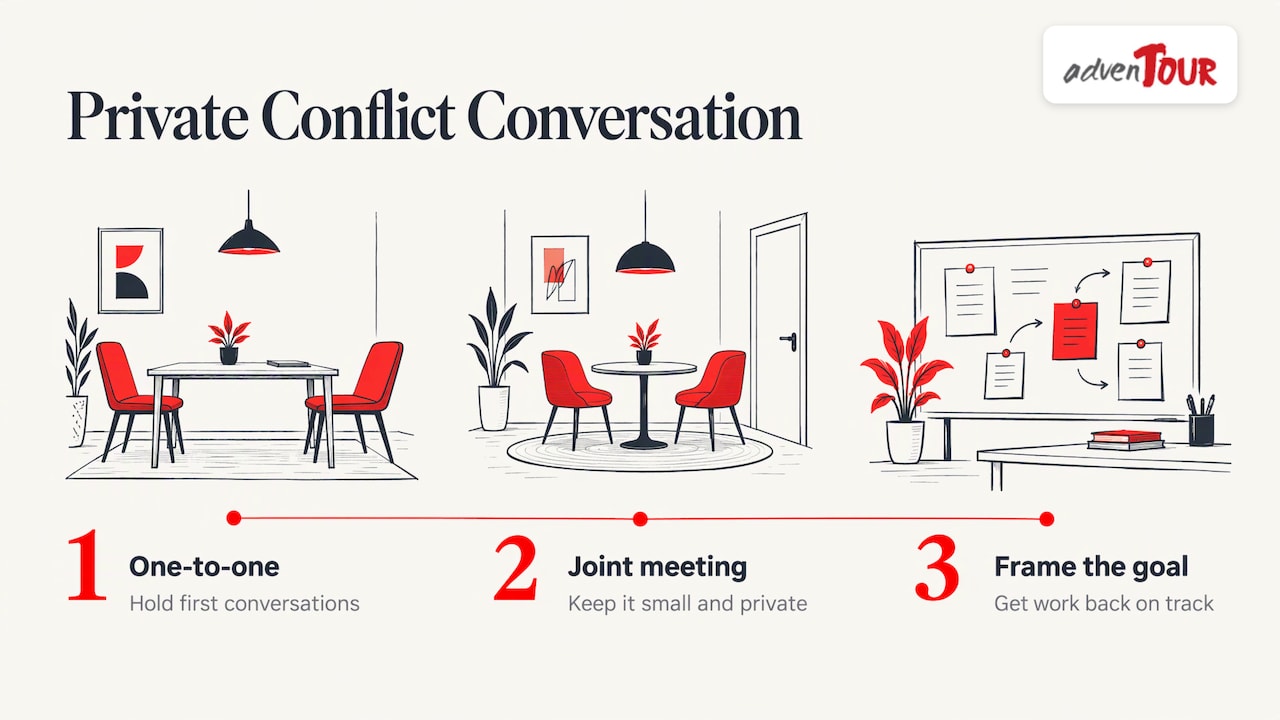
A practical point for the local context: many teams here prefer indirect language and avoid public confrontation. So the sequence matters. Hold the first conversations one to one, keep the joint meeting small and private, and frame the goal as getting the work back on track, not deciding who was wrong. That keeps dignity intact on both sides.
For team-wide patterns, an outside voice helps. Cornell researcher Mannix notes that an outside facilitator or coach can get derailed teams back on track by stopping to reassess where the team is and why. That might mean agreeing on roles, on punctuality for meetings, or on a team contract.
Team activities that rebuild working relationships
Activities do not replace the conversation. They come after it, or alongside it, to give colleagues a low-stakes way of practicing listening, negotiating and sharing credit. Pick one that targets the skill your team lacks.
Short exercises you can run in a meeting
- Active listening pairs (15 to 20 minutes). One person speaks for two minutes on a work frustration. The other summarizes it without adding an opinion. Swap.
- Facts, assumptions, emotions. Ask each person to sort a recent disagreement into those three columns. It often shows that the dispute is mostly assumptions.
- Structured debate alternative. The Conflict Resolution Network’s Conflict-Resolving Game uses two teams of three and three rounds: analysis (conflicts and needs), options, and solutions (an action plan), with no interruptions and one speaker at a time.
Shared experiences outside the office
MOM’s guide recommends that managers give employees chances to interact, including regular team lunches that respect dietary restrictions, informal activities such as sports and family outings, and celebrations of the holidays of team members’ cultures. In a Singapore team, that advice fits naturally.
When a team needs more than a lunch, a facilitated program works because people have to coordinate under light pressure. Here is how our programs map to common conflict patterns:
| Team situation | Program type | Published price per person |
|---|---|---|
| Silos and poor handovers between groups | App-based Amazing Race | $40–55 |
| Clashing working styles | Modified DISC Workshop | $70–82 |
| Leaders and managers who struggle to read each other | DISC Personality Profiling | $150–159 |
| Tension between colleagues with different cultural backgrounds | Katong/Joo Chiat Cultural Food Immersion | $82–98 |
| Low energy and distrust after a rough quarter | Kinball or Bloop Bubble Soccer | $35–45 and $36–43 |
All of these are listed on our budget, quality and premium program pages. Our guide to team bonding for engagement explains how to choose between them.
Adapting for large groups and tight budgets
For groups of 50 or more, split people into mixed teams of six to ten so that each person has a real role. Mix departments deliberately, because the point is to build ties across the lines where conflict tends to form. Keep any debrief tied to one question, such as “what would we do differently next time we hand work over?”
When budget is tight, run short in-office exercises such as listening pairs for the conflict itself, and save a facilitated outing for the moment a team needs a reset. Our budget-friendly formats are priced from $35 per person, and they scale with group size. If you need a larger setup, we also offer event rentals such as laser tag guns at $25–33 per hour per gun, and tentage at $95 per day per tent.
Check whether it is working
Resolution is not a one-off meeting. The Cornell study led by Mannix found that how teams dealt with conflict mattered most to success, not the type of conflict. The best teams were proactive about resolving it, assigned roles by expertise, understood how each member’s interests aligned with team goals, and made decisions on evidence rather than personality clashes.
Use that as your checklist. A simple review at four to six weeks can ask:
- Did the agreed actions happen?
- Do both people say the working relationship has improved?
- Are the same issues raised again in one-to-ones?
- Are decisions being made faster and with less back-and-forth?
- Do people feel they can raise a concern without penalty?
If the answer to the last question is no, the conflict is not really the problem. Psychological safety is. Fix that first, and every other step gets easier.
Perspective: why we pair conversations with shared experiences
In our work with teams across Singapore, we see the same pattern. The conversation settles the issue. The relationship needs something else.
People who have just had a difficult talk go back to desks, back to the same habits, and the old assumptions creep back in. A well-run team experience gives them a different context. They solve a problem together, they see each other’s strengths, and they get a shared story that is not about the dispute.
That is why our programs focus on experiential learning and skill transfer, not passive entertainment. We tailor each one to the objective: better handovers, clearer communication, or simply trust between two groups that rarely speak. We scale for group size and budget, and we use experienced facilitators so that the debrief connects the activity to real work.
Our advice to HR leaders is to treat the activity as a follow-up step, not a replacement for the hard conversation. Do both, and give the team a reason to look forward to working together again.
Joshua
Plan a team session with us
If your team has worked through a conflict and needs to rebuild, we design programs around your goal, group size and budget. Our offer ranges from budget-friendly formats to premium executive programs, including DISC-based workshops that help colleagues understand each other’s communication styles.
See our premium programs or get in touch through our site and tell us what your team needs to change.
FAQ
What is the first thing to do when two employees are in conflict?
Speak to each of them privately before doing anything else. Ask open-ended questions, listen without taking sides, and find out what each person wants and how they see their own part. Only then decide whether it is a work-style issue, a role issue, personal friction or a conduct matter.
How long should I wait before involving HR?
Do not wait for it to fester. If direct conversations are not resolving it, if there is a power imbalance, or if someone’s wellbeing is affected, involve HR early. Conduct issues such as harassment go to HR straight away.
Can team building activities resolve a conflict?
They help most after the underlying issue has been discussed. A shared activity gives colleagues a neutral setting to practice communication and cooperation, and a debrief links it to daily work. Use it as a follow-up, alongside agreed actions and a check-in.
How do I handle conflict in a multicultural Singapore team?
Start with private one-to-one conversations and keep the joint meeting small. MOM’s managers’ guide suggests helping each side understand the other’s cultural norms and bringing in a neutral mediator when values or languages differ.
Sources
- Creating inclusive and harmonious workplaces, MOM managers’ guide
- The Process of Conflict Resolution, University of Iowa HR
- A Manager’s Guide to Handling Workplace Conflict, American Employers Alliance
- Workplace Conflict Checklist, SHRM
- Workplace conflict guide, Randstad Singapore
- Conflict resolution in the workplace, ExperTrain
- How winning teams navigate conflict to stay on course, Cornell University
- Navigating Workplace Conflict, University of Minnesota
- Managing Conflict, The GitLab Handbook
- Workplace conflict guide for people managers, CIPD Asia
- Strategic Conflict Management: A Guide for Singapore Leaders, Singapore Mediation Centre
- Disagree without Drama, Facilitators Network Singapore
- Conflict-Resolving Game, Conflict Resolution Network
Recommended
- Office Dynamics Workshop
- Unlocking the Benefits of DISC Profiling for Success
- Team Building: Fostering Collaboration
- Master Effective Team Communication Strategies Today