

To reduce employee turnover, work out first who is leaving and why, then fix the causes that sit inside your control: pay clarity, career paths, workload, flexible work, manager quality and a real sense of belonging in the team. No single perk does it. Companies in Singapore that keep people tend to measure exits every quarter, act on what the data shows, and build team relationships deliberately rather than leaving them to chance.
This guide walks through the numbers for Singapore, the reasons people leave, a step-by-step plan, and where team experiences fit in.
TL;DR
- Singapore’s overall attrition rose to 19.3% in 2025, with voluntary exits at 12.7%. Voluntary exits are the part you can influence most.
- Pay, career growth, workload and manager quality come up again and again in Singapore surveys. Start by finding which of them drives exits in your own company.
- Measure first: turnover rate, retention rate, regrettable attrition, time-to-fill and exit-interview themes, reviewed every quarter.
- Flexible work, clear growth paths and manager check-ins are the most commonly recommended fixes. Team connection supports all three.
- Facilitated team building works best as part of the plan, not as a one-off treat after people have already decided to leave.
Table of Contents
- What turnover looks like in Singapore right now
- Why people leave
- What turnover costs you
- A practical plan to lower staff turnover
- Where team building fits
- Perspective
- Choosing a format and budget
- Plan your retention-focused team event with us
- FAQ
- Sources
What turnover looks like in Singapore right now
The basic formula is simple: divide the number of departures in a period by your average headcount, then multiply by 100. CoreStaff’s Singapore retention guide uses exactly this calculation, and it also suggests keeping voluntary turnover under 10% for a healthy organization.
There are two national yardsticks worth knowing, and they measure different things.
Ministry of Manpower (MOM) data. MOM publishes a labour turnover summary table with average monthly recruitment and resignation rates. It notes that both rise when job openings are plentiful and fall in downturns. In 1Q 2026, the Labour Market Report put the average monthly recruitment rate at 1.6% and the average monthly resignation rate at 1.0%, both seasonally adjusted.
Annual attrition surveys. An Aon study reported by Business Times found that Singapore’s overall attrition rate rose to 19.3% in 2025, up from 16.7% in 2024 and 16.5% in 2023. Voluntary turnover was 12.7% and involuntary turnover 6.6%.
These figures are not directly comparable: one is a monthly resignation rate across the whole labour market, the other an annual attrition rate among surveyed companies. The useful lesson is the direction. Attrition is climbing, and the part driven by employees choosing to go is the largest share.
A third data point matters for your hiring plans. In a Hays survey of professionals, 57% in Singapore said they were looking or planning to look for a new job in 2025. Even if your people are not leaving today, many are open to it.
Why people leave
Singapore surveys point to a fairly consistent set of reasons. Here is how the main ones line up.
| Reason | What Singapore data says |
|---|---|
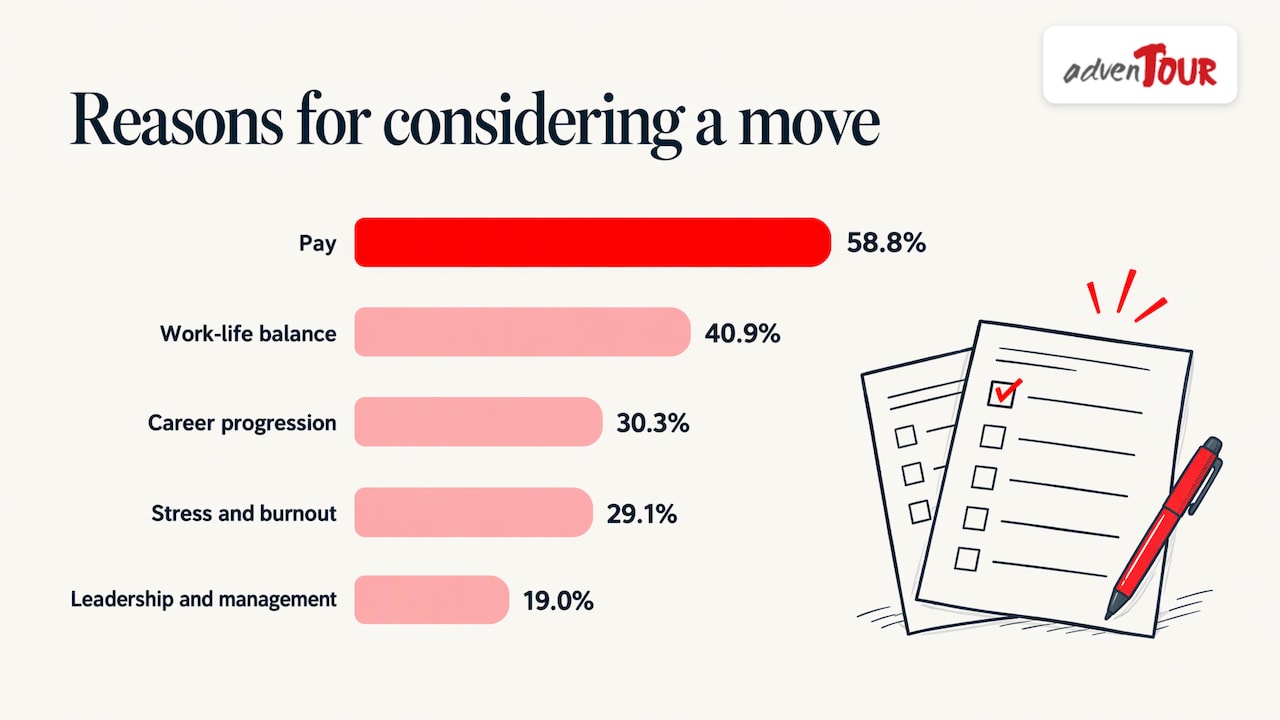
| Pay | In a survey of 337 Singapore employees, salary was the top reason for considering a move at 58.8% |
| Work-life balance | The same study put it at 40.9% |
| Career progression | 30.3% in that study; Hays found 43% of Asian professionals cited a lack of future opportunities, up from 35% in 2024 |
| Stress and burnout | 29.1% in the same study; ManpowerGroup reports that 72% of Singapore workers recently experienced burnout, with stress, heavy workloads and job insecurity the leading causes |
| Leadership and management | 19.0% in that study |
Engagement sits underneath all of this. Gallup’s Singapore snapshot reports that 14% of employees are engaged at work and 43% experienced a lot of stress the previous day. A disengaged, stressed person does not always resign, but is far easier for a recruiter to move.
The pattern is useful. Some drivers, such as pay, need budget and benchmarking. Others, such as workload, manager habits, recognition and how connected people feel to colleagues, can be improved with decisions and routines that cost far less than a replacement hire.
What turnover costs you
Before asking for budget, put a number on the problem.
- Replacement cost. A commonly cited benchmark puts it at 30% to 200% of annual salary, higher for specialised, senior or client-facing roles.
- Hiring costs in Singapore. One 2025 market analysis estimates agency fees of 15% to 20% of annual salary for professional roles, internal HR time of SGD 1,500 to 2,000 per hire, and job ads at SGD 400 to 1,800 per posting.
- Ramp-up time. New recruits take eight to 26 weeks to become productive, depending on role complexity. Remaining staff often absorb the extra work, which can push them toward the door too.
- Management time. CoreStaff’s guide mentions 20 to 50 hours of management time per replacement, plus knowledge loss and effects on morale and customers.
A simple way to use this: take your last twelve months of voluntary leavers, multiply by a conservative replacement-cost percentage for each role, and you have a figure to set against the cost of retention work.
A practical plan to lower staff turnover
Step 1: Measure your own baseline
Calculate overall turnover with the formula above, then split it into voluntary and involuntary exits. Focus on voluntary exits. Then cut the data by team, manager, tenure band and role. A 15% company average often hides one team at 35%.
Track retention too. A retention-rate formula from Xero’s Singapore guide is: (employees at end of period minus new hires during the period) divided by employees at start of period, times 100. It tells you how many people you kept, regardless of how many you hired to refill seats.
Step 2: Find the real causes
Exit interviews are the starting point, but look for recurring themes over time rather than reacting to one story. Xero’s guide also recommends tracking time-to-fill and engagement scores and reviewing them with leadership quarterly. Add stay interviews with current high performers: “What would make you leave? What keeps you here?” gives you information before the resignation letter does.
Step 3: Fix the drivers you control
Pay and recognition. Benchmark against your market and explain how pay decisions are made. People who understand the logic are less likely to assume the worst. Recognition costs little, and it matters most when it is specific and timely.
Career growth. Rakuten Insight’s Singapore study recommends visible skills pathways tied to role progression and internal mobility. Write down what the next role requires, and review it in every annual conversation.
Workload and burnout. The same study suggests auditing workload hot spots and agreeing team norms for after-hours messages. Look at who is consistently covering for vacancies, because they are your next leavers. Our own guide on preventing employee burnout goes deeper on this, and corporate wellness programs can support the day-to-day side.
Flexible work. MOM says flexible work arrangements can help retain and attract workers, but there is no one-size-fits-all approach. It also points out that they include staggered hours, flexi-shift and part-time work, not only working from home. Employers are expected to follow the Tripartite Guidelines on FWA Requests, which took effect on 1 December 2024 and set out how to handle requests and communicate decisions in a transparent and timely way.
Manager capability. People often leave a manager rather than a company. Rakuten Insight recommends strengthening manager capability through regular check-ins and feedback. A weekly 15-minute one-to-one beats an annual review for catching problems early.
Grievance handling. MOM has stated that when the Workplace Fairness Act comes into force at end-2027, employers will need grievance handling processes for harassment and discrimination, with confidentiality protected where possible. Building a trusted process now is good retention practice as well as good preparation.
Step 4: Make the first year count
New hires are the most exposed. They are still deciding whether they made the right call, and they have few relationships to anchor them. A structured first 90 days, a named buddy, and early shared experiences with colleagues help. See our ideas for team building during new employee onboarding.

Step 5: Review every quarter
Rakuten Insight recommends quarterly tracking of measures such as offer acceptance rate, regrettable attrition by role and team, internal mobility rate, manager consistency, training participation and pulse indicators like workload pressure, burnout risk and manager support. Pick five or six, put them on one page, and review with leadership. Retention work fades when nobody is looking at a number.
Where team building fits
Team building does not replace fair pay or a good manager. What it can do is strengthen the human side of the plan: relationships across departments, trust between a manager and their team, shared language for how people work together, and recognition moments. Those are things many people say they miss when they feel disconnected from their workplace.
Here is how different formats map to retention goals.
| Retention goal | Format that suits it | Examples from our programs |
|---|---|---|
| New hires feel they belong | Active, low-pressure group games | Kinball, App-based Amazing Race |
| Managers and teams communicate better | Facilitated workshops | Modified DISC Workshop, Office Dynamics Workshop |
| Cross-team trust, leadership alignment | Premium, discussion-led formats | DISC Personality Profiling, Office Shark Tank |
| Recognition and appreciation | Celebration events | Employee appreciation events, events celebrating achievements |
| Stress relief and wellbeing | Outdoor, active, relaxed formats | Corporate wellness team building, corporate sports days |
Timing matters. A session after a hard quarter, a restructuring, or a new manager’s arrival does more than one held at a random point in the year. Tie it to a goal: “We want the two merged teams to know each other’s working styles” is a brief a facilitator can design around. “Let’s do something fun” is not.
Perspective
We plan team experiences for HR leaders who are worried about people leaving, and what we notice is that the teams that stay together share something: they know each other as people, not only as job titles.
That is why our programs are built around experiential learning and skill transfer, not passive entertainment. A session should leave a team with a better way to talk to each other on Monday morning. In our DISC-based workshops, for example, colleagues learn how they and their teammates tend to communicate, and then practice adapting to it.
We would also say, plainly, that the format should match the problem. A large group that needs to loosen up after a stressful season may want a high-energy outdoor game. A leadership team with friction may need a facilitated workshop. We customize each program to the client’s objectives, group size and budget, and we work with facilitators who keep the focus on outcomes the HR team can observe afterwards.
Used together with fair pay, growth paths and good managers, a well-chosen team experience gives people one more reason to look at their colleagues and decide that this is a place worth staying.
Joshua
Choosing a format and budget
Our published per-person ranges, as listed on our site, give you a starting point. Final pricing depends on group size, venue and customization.
- Budget-friendly programs: Kinball at $35 to $45, Bloop Bubble Soccer at $36 to $43, Combat Skirmish Laser Tag at $37 to $45, App-based Amazing Race at $40 to $55, and Bicycle Scavenger Hunt at $45 to $55 per person. See the budget-friendly activities.
- Quality programs: Amazing Race at $65 to $78, Garden Odyssey at $68 to $90, Modified DISC Workshop at $70 to $82, Running Man Challenge at $72 to $82, and Laser Clay Shooting from $69 per person. See our quality team building programs.
- Premium programs: Office Dynamics Workshop at $80 to $90, Katong/Joo Chiat Cultural Food Immersion at $82 to $98, Office Shark Tank from $92, Corporate Sailing Team Building at $125, and DISC Personality Profiling at $150 to $159 per person. See the premium programs.
A useful rule of thumb: compare the per-person cost with the replacement-cost benchmarks earlier in this guide. Even a premium session for a whole department costs a small fraction of replacing a single mid-level employee, though it should never be presented as a guarantee that nobody will leave.
Plan your retention-focused team event with us
If you are building a retention plan for next year, we can help you design the team experience part of it. Tell us your headcount, the problem you want to address, and your budget range. We will recommend a format, from a lively laser tag session to a facilitated workshop, and tailor it to your objectives.
Browse our corporate team building solutions or get in touch through adventour.com.sg to discuss your goals.
FAQ
What is a good employee turnover rate in Singapore?
There is no single number, because it varies by industry and role. As a reference, Aon’s study put Singapore’s overall attrition at 19.3% in 2025, with 12.7% voluntary. One Singapore guide suggests aiming for voluntary turnover below 10%. Compare yourself with your own sector and your own history first.
How long does it take to see turnover fall?
Expect to see early signals, such as better engagement or pulse scores, within a quarter or two. Turnover itself moves more slowly because people who have already decided to leave will still go. Track it every quarter and look at trends over at least a year.
Is a pay rise the only way to keep people?
Pay is the most cited reason for considering a move in one Singapore survey, at 58.8%, but it is not the only one. Work-life balance, career progression, burnout and management issues all appear in the same study. A balanced plan addresses several of them.
Can team building really help with retention?
It can support it by strengthening relationships, communication and recognition, which are part of why people choose to stay. It works best alongside the other steps in this guide, with a clear objective set before the event and follow-up afterwards.
Sources
- Labour Turnover Summary Table, Ministry of Manpower
- Labour Market Report First Quarter 2026, Ministry of Manpower
- Singapore’s turnover rate rises more steeply amid steady wage growth, Business Times
- Employee retention strategies for Singapore companies, CoreStaff
- Employee retention strategy guide, Xero Singapore
- Hays 2025 Asia Salary Guide, Singapore
- Singapore employers spend more replacing talent than retaining it, Reeracoen
- State of the Global Workplace: Singapore, Gallup
- Singapore workers job hugging while battling burnout, ManpowerGroup
- The true cost of employee turnover in Singapore, The Work Project
- The true cost of bad hires in Singapore 2025, Mavenside
- Why small businesses in Singapore need to care about employee retention, Dollars and Sense
- Beyond the Paycheque: Singapore Employee Sentiment Study, Rakuten Insight
- Response to Adjournment Motion on Flexible Work Arrangements, Ministry of Manpower
- Launch of Tripartite Guidelines on FWA Requests, Ministry of Manpower
- Written answer on protecting employees from workplace bullying, Ministry of Manpower
Recommended
- How to Prevent Employee Burnout: A Singapore Guide for Employers
- Employee Appreciation Event Ideas Singapore
- Employee Engagement Measurement: A Practical Guide for Singapore Teams
- Team Building for New Employee Onboarding in Singapore