
A corporate mindfulness event works when it is built around one clear team problem, such as stress, poor focus or strained communication, and delivered in a setting where people feel safe taking part. That is a planning question as much as a wellbeing one. We design and run corporate team building and wellness events in Singapore, and the same brief logic applies here: define the goal, match the format to the group, and decide in advance how you will know it helped.
This guide is for HR leaders and event planners at SMEs and MNCs who are weighing mindfulness activities for an offsite, a regional meeting or a staff wellness day. It covers what the research says, which formats suit which groups, how to handle large and mixed-culture groups, and how to measure the result.
Key Takeaways
- Workplace mindfulness programmes have been linked to lower stress, anxiety and burnout across dozens of studies, but the benefit depends on a team that feels safe to take part.
- Match the format to the goal: a short guided break suits a conference, a longer facilitated session suits a team with a specific stress or communication issue.
- Mindfulness lands best inside a wider wellness or team building day, where bonding and reflection support each other.
- Decide your measure before the event: a short pulse survey, a burnout scale or a follow-up check-in after four to six weeks.
- Always offer an easy opt-out and an alternative, and never present a one-off session as medical treatment.
Table of Contents
- What a corporate mindfulness event actually is
- What the evidence says, and what it asks of employers
- A Singapore result worth knowing
- Choosing a format: goal first
- Why mindfulness works better inside a wider event
- Planning checklist for Singapore events
- Fitting group size and budget
- Large groups, conferences and mixed cultures
- Measuring whether it helped
- Our perspective
- Talk to us about your event
- FAQ
- Sources
What a corporate mindfulness event actually is
Mindfulness means paying deliberate, non-judgmental attention to what is happening in the present moment: your breath, your body, your thoughts, the people in the room. A corporate mindfulness event applies that practice to a work group. It might be a 20-minute guided pause during a conference, a half-day workshop on handling pressure, or a themed wellness day where mindfulness sits alongside movement and team activities.
The term “workplace mindfulness activities” covers the same ground at a smaller scale: guided breathing, a mindful walk, a reflective exercise, a listening drill in pairs. For planning purposes, the useful distinction is not the technique but the purpose. Are you giving people a reset, teaching a skill, or building a shared experience? Each answer leads to a different format, duration and budget.
What the evidence says, and what it asks of employers
The strongest summary we can point you to is a 2021 realist review of mindfulness-based programmes for workplace stress. It drew on 75 primary studies and reported reductions in perceived stress, anxiety, depression, medical symptoms and burnout, along with gains in vigour, well-being, sleep quality, relaxation and compassion.
The same review contains the point every planner should take seriously. Offering a programme is not enough. Professionals need to feel safe to look after themselves at work and to be open with colleagues. Where people worry about looking unproductive or exposed in front of peers, they tend to use the exercises sparingly, disengage or drop out. In other words, the room matters as much as the technique.
What this means in practice:
- Senior visibility helps. When managers take part alongside their teams, the session reads as legitimate rather than optional or remedial.
- Participation should be easy to decline. A quiet alternative, such as a seat at the edge or a different task, protects the people who are uncomfortable.
- Framing counts. Present the event as a skill for focus and handling pressure, not as a fix for people who are struggling.
A Singapore result worth knowing
Local evidence exists too. A February 2025 Singapore study of mindfulness for burnout prevention among allied health professionals ran a 10-week programme of five face-to-face sessions. Emotional exhaustion scores on the Maslach Burnout Inventory, a widely used burnout questionnaire, fell from a median of 34.50 to 25.50 (p = 0.012). Participants also reported better emotional regulation and communication, and a more supportive workplace culture.
Two design features are worth borrowing. The programme used small groups, and it kept a group chat and regular check-ins running during working hours so that people could apply the techniques between sessions and feel safer being open with supervisors. A single event can be the start of that rhythm, not the whole of it.
Choosing a format: goal first
Start with the problem you want the event to address, then choose the format. The table below is a planning shortcut, not a rulebook.
| Your goal | Suitable format | Typical length | Group size to plan for |
|---|---|---|---|
| Give a conference or regional meeting a reset | Short guided pauses between sessions | 15 to 20 minutes each | Whole room |
| Reduce day-to-day stress | Facilitated workshop with practice and debrief | 60 to 90 minutes | Small to medium cohorts |
| Improve how a team communicates | Workshop that combines self-awareness with group exercises | Half day | One team at a time |
| Mark a wellness day or staff appreciation | Mixed programme of movement, reflection and bonding | Half to full day | Large groups, rotated in cohorts |
| Build a lasting habit | Series of short sessions with check-ins | Several weeks | Same cohort throughout |
Short guided breaks work well in conferences because they fit between intensive working blocks. They land better when you tell people what to notice and why it matters for their work, for example how stress shows up before a difficult decision, rather than promising general relaxation.
Why mindfulness works better inside a wider event
A stand-alone session can feel abstract, particularly for teams that have never tried it. Placed inside a broader wellness or team building day, it has context. People arrive already loosened up by a shared activity, and reflection afterwards has something concrete to attach to.
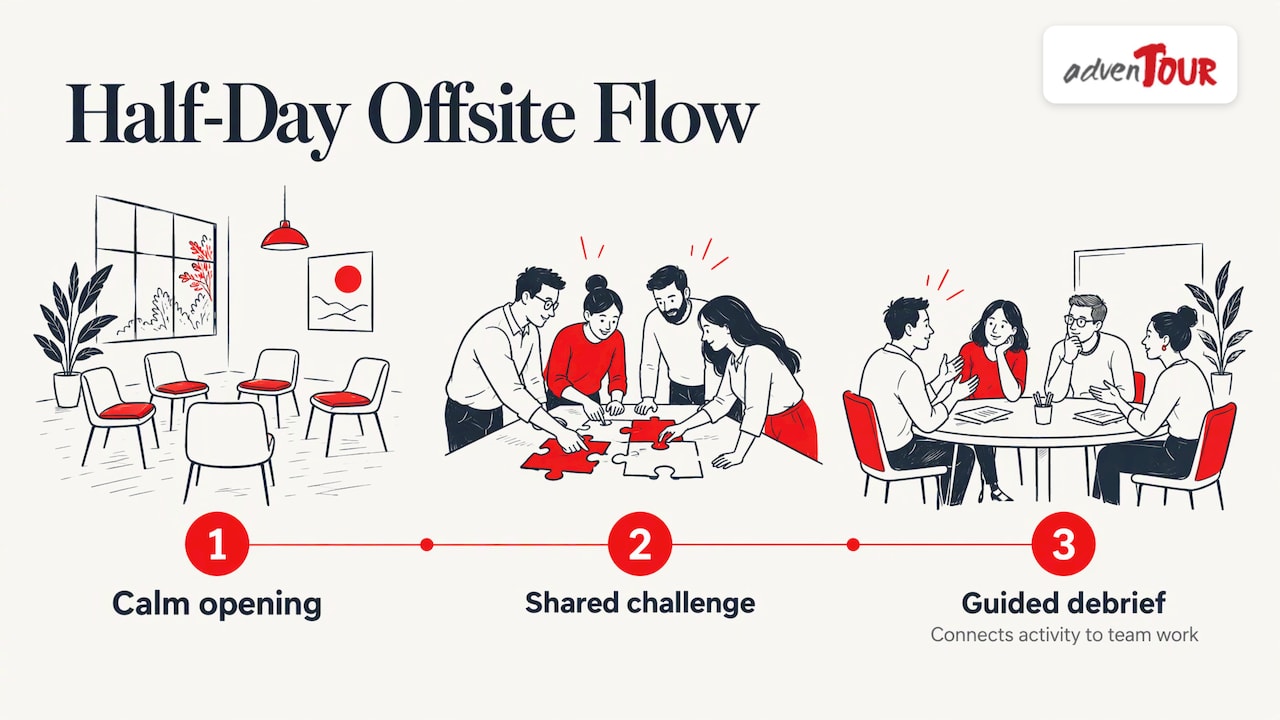
This is where team building formats earn their place. Our corporate wellness team building programmes are designed to foster collaboration, bonding and communication, and our guide to staff wellness events sets out formats, budgets and planning for wellness days. A typical structure for a half-day offsite is a calm opening, a shared challenge in the middle, and a guided debrief at the end that connects what happened to how the team actually works.
If self-awareness and communication are your goals, a personality-based workshop is a natural companion to reflective practice. Our Modified DISC Workshop is listed at $70 to $82 per person, and our DISC Personality Profiling at $150 to $159 per person. Both help people understand how they and their colleagues prefer to communicate, which gives a mindful pause something practical to work on.
Planning checklist for Singapore events
Write these into the event brief before you contact any provider.
- Objective and measure. One sentence on what should change, and how you will check it.
- Venue and climate. Singapore heat and sudden rain affect outdoor plans. Book an indoor fallback for any outdoor mindful walk or garden session, and make sure the room is quiet enough for guided practice. Air-conditioner noise and neighbouring events are the usual culprits.
- Accessibility. Ask about language, mobility, sensory and digital-access needs through a general question to all attendees. Never ask for diagnoses.
- Participation options. Offer a private way to ask questions beforehand and a comfortable alternative for people who prefer not to join in.
- Equipment and logistics. Mats, seating, audio, shade, water, and contingencies for weather and late arrivals.
- Facilitation. Choose facilitators who can run a group debrief, not only lead a technique. The debrief is where the learning is tied to work.
- Positioning. Describe the event as skill-building and wellbeing support. A one-off activity is not medical treatment, and anyone in distress should be directed to their own doctor or your employee assistance provider.
Fitting group size and budget
Group size decides more than any other variable. Reflective and guided practice tends to work best in cohorts of roughly 15 to 30 people, because facilitators can notice who is struggling and debrief properly. Beyond that, you have two sensible options: split the group into rotating cohorts across a day, or use short whole-room pauses and keep the deeper work for smaller groups.
Budget follows the same logic. A short pause costs little to add to an existing agenda. A themed wellness day with rotating stations costs more because of the facilitators, venue and logistics. Our team building programmes are published per participant, so you can scale a plan to headcount:
- Budget-friendly formats, for example Kinball at $35 to $45 per person or Bloop Bubble Soccer at $36 to $43 per person, give an energetic start to a day before a quieter session.
- Quality programmes, for example Garden Odyssey at $68 to $90 per person, suit teams that want a more considered shared experience.
- Premium programmes, for example the Office Dynamics Workshop at $80 to $90 per person or Corporate Sailing Team Building at $125 per person, suit executive offsites and senior groups.
You can compare all three tiers on our pages for budget-friendly activities, quality team building programs and premium team building programs.
Large groups, conferences and mixed cultures
Singapore regional meetings often bring together people from several countries, languages and wellness traditions. Some will have practised meditation for years, others will never have tried it. Three habits keep a mixed room comfortable:
- Keep instructions plain and secular. Focus on attention, breathing and noticing, not on belief systems or spiritual vocabulary.
- Assume no experience. Explain each exercise in a sentence, demonstrate it, and keep the first practice short.
- Vary the modes. Some people find stillness hard. A walking or movement-based exercise gives them another way in.
For conferences, keep any guided pause to 15 or 20 minutes and schedule it after your most demanding session, not at the start of the day. For very large groups, rotate cohorts through activity stations so that each cohort is small enough for a facilitator to manage.
If your visitors are travelling in for a regional meeting, we can pair a wellness session with a team activity in the same programme, so that a single provider handles the day. Organisations planning a giving-back component can look at our CSR programmes.
Measuring whether it helped
Most mindfulness events are judged on a feeling in the room. That is a start, but HR leaders need something firmer. Choose one or two of these before the event:
- A short pre- and post-event pulse survey on stress, focus and how supported people feel in the team, using the same questions both times.
- A validated scale, such as the burnout inventory used in the Singapore study above, for longer programmes with a defined cohort. Keep results confidential and report only aggregates.
- A follow-up check-in four to six weeks later, asking what people still use and what has changed in team conversations.
- Team-level signals, such as meeting quality or handovers, noted by managers in their own words.
Treat the results as a guide for the next event, not a verdict. A well-run debrief at the end of the session also generates useful qualitative feedback straight away.
Our perspective
We plan events for HR leaders who want the day to change how a team works, not just to fill a calendar slot. Our experience of this kind of brief is that the format matters less than whether the activity connects to a real objective. That is why we design programmes around each client’s goals and scale them to group size and budget.
Our programmes focus on experiential learning and skill transfer rather than passive entertainment. For a team that wants to slow down, listen better and handle pressure, that means pairing a calming, reflective element with something the group does together, then debriefing so that the lesson comes back to the office with them.
The research points the same way. Benefits depend on people feeling safe with their colleagues, and shared experiences are one of the best ways to build that. A well-designed wellness or team building day does both jobs at once.
Joshua
Talk to us about your event
If you are planning a retreat, offsite or regional meeting in Singapore and want wellness built in, our corporate wellness programmes are the place to start. We run corporate team building, wellness events and CSR programmes end to end, and every programme can be customised to your objectives, group size and budget.
Tell us your headcount, goal and preferred format, and we will propose a programme to match. You can also browse our team building event ideas or reach us through the main site.
FAQ
How long should a corporate mindfulness event be?
It depends on the goal. For a conference or regional meeting, 15 to 20 minutes between working sessions is enough to reset the room. For a workshop that teaches a skill and includes a debrief, plan 60 to 90 minutes. Teams that want lasting change do better with a series of shorter sessions than one long day.
How many people can join one session?
Whole-room pauses can include an entire conference audience. For guided practice with a debrief, cohorts of roughly 15 to 30 work well. For larger groups, rotate cohorts through a programme across the day so that every participant gets proper attention.
What if some employees do not want to take part?
Build in an alternative from the start, such as a quieter task or a seat at the side, and make it clear that no one needs to explain their choice. Research on workplace programmes shows that people who feel exposed in front of colleagues tend to disengage. An easy opt-out protects them and the event.
Can a mindfulness event replace mental health support?
No. A one-off event supports wellbeing and gives people a useful skill, but it is not treatment. Employees who are struggling should be pointed to their doctor or your employee assistance programme, and you should say so when you describe the event.
Can we combine mindfulness with team building?
Yes, and it often works better that way. A shared activity builds the trust that makes reflection easier, and a facilitated debrief connects the experience to how the team communicates. We can design a half-day or full-day programme that does both for your group.
Sources
- Mindfulness-based programmes to reduce stress and enhance well-being at work: a realist review (2021)
- Exploring the use of mindfulness for prevention of burnout among allied health professionals in Singapore (2025)
Recommended
- Staff Wellness Events in Singapore: Formats, Budgets and Planning
- Corporate Wellness Team Building in Singapore
- The Complete Guide to Planning a Corporate Event in Singapore
- Team Building Event Ideas in Singapore