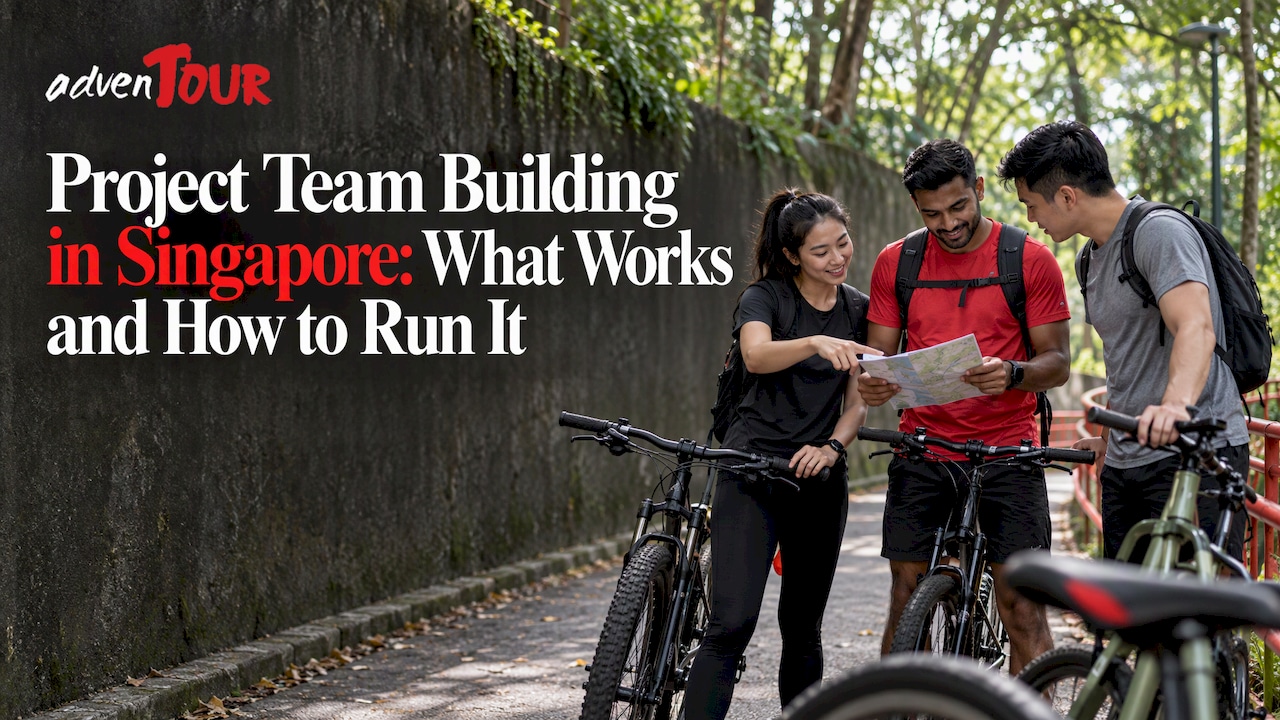
Project team building works when it is tied to the project: shared goals, clear roles, open conversation and a plan for what happens after the event. A fun day out on its own rarely does that. At Adventour we design and run team building programmes in Singapore around the objectives of your project team, from laser tag at the budget end to facilitated DISC workshops and sailing at the premium end, and the sections below show how to choose and structure them.
Key Takeaways
- Team building improves trust, coordination and shared understanding. The strongest evidence favours goal setting and role clarification, so build both into the session.
- Match the format to the project stage: a short activity during a status review, a half-day workshop at kick-off, or an offsite when the team hits friction.
- Budget-friendly formats in Singapore start at $35 per person, while facilitated and premium programmes run from about $65 to $159 per person, depending on the format.
- The activity is only half the job. Agree an action plan before you leave and review it with the team afterwards.
Table of Contents
- What project team building actually is
- What the research says it can improve
- Set the foundations before the activity
- Choosing activities by project stage
- What it costs in Singapore
- Make it stick: from activity to project work
- When team building does not seem to help
- Planning for MNCs and regional meetings
- Our perspective
- Plan your project team session with us
- FAQ
- Sources
What project team building actually is
A project team is a group assembled for a fixed piece of work, often from several departments, sometimes across several countries. Members may not have worked together before, and the project has a deadline. That is why project team building differs from general bonding.
Singapore’s SAFTI Military Institute describes team building as improving teamwork: members agree on shared outcomes, examine how they currently work, explore strengths and weaknesses, and set action plans. Notice that the output is a plan, not just a good mood.
What the research says it can improve
An American Psychologist review reports a 2009 meta-analysis of 60 effect sizes. Team building significantly improved cognitive outcomes (shared understanding), affective outcomes such as trust, and process outcomes such as coordination. Of the four components studied, goal setting and role clarification were the most effective. The other two were interpersonal relationship management and problem solving.
A Pepperdine University study of a multicultural work group found that participants felt the greatest impact on task cohesion, meaning teamwork and working processes. The most valued elements were deeper awareness of others, deeper self-awareness, a platform for collaboration and fun activities.
For an HR leader the practical reading is simple. Choose activities that make people see how colleagues work, and finish with decisions about goals and roles.
Set the foundations before the activity
An activity lands better when the team already knows what it is for. The Project Management Institute says a team charter should clarify goals, reporting lines, which decisions the team can take alone, and how often the client is contacted. It also notes that more participation in writing the charter raises motivation and commitment.
Roles matter just as much. The commonly cited four are:
- Project manager: guides the work from start to finish.
- Team lead: coordinates daily operations.
- Subject matter expert: brings specialist knowledge to key milestones.
- Team members: do the project tasks.
Those definitions follow a team-management guide. Larger projects usually add a sponsor, a senior executive who champions the project and secures resources. If your team has overlapping or unclear roles, a facilitated session is a good place to settle them.
Choosing activities by project stage
The Center for Project Innovation notes that team building can range from a five-minute agenda item in a status review to a professionally facilitated offsite. It also suggests arranging a social or team event during the “storming” stage, when many teams struggle. Here is how that maps to the options we run.
| Project stage | Goal | Format that fits |
|---|---|---|
| Kick-off | Get to know working styles, agree roles | Modified DISC Workshop, Office Dynamics Workshop |
| Early friction (storming) | Rebuild trust, open up communication | Amazing Race, Garden Odyssey, Running Man Challenge |
| Mid-project energy dip | Reset morale, mix sub-teams | Laser tag, bubble soccer, Kinball |
| Leadership or steering group | Decision-making, pitching, strategy | Office Shark Tank, corporate sailing |
| Large regional meeting | Connect people from several offices | Large group outdoor formats, CSR programmes |
Problem-solving formats
The App-based Amazing Race sends teams around Singapore solving challenges together. It suits groups that need to divide tasks, share information and decide quickly, which is much like a project. The Bicycle Scavenger Hunt works the same way with a more active route.
Energetic formats for cohesion
Combat Skirmish Laser Tag and Bloop Bubble Soccer are quick to learn and put people of every seniority on the same footing. They work well as a mid-project reset or the closing event of a regional meeting. For a bigger crowd, our guide to outdoor activities for large corporate groups covers the options.
Self-awareness formats
The Pepperdine study singled out self-awareness and awareness of others as high-impact. That is exactly what a DISC session addresses. Our DISC Personality Profiling workshop helps team members see how different personalities communicate and decide, which is useful when a cross-functional team has to agree on how to work together.
Light touches between events
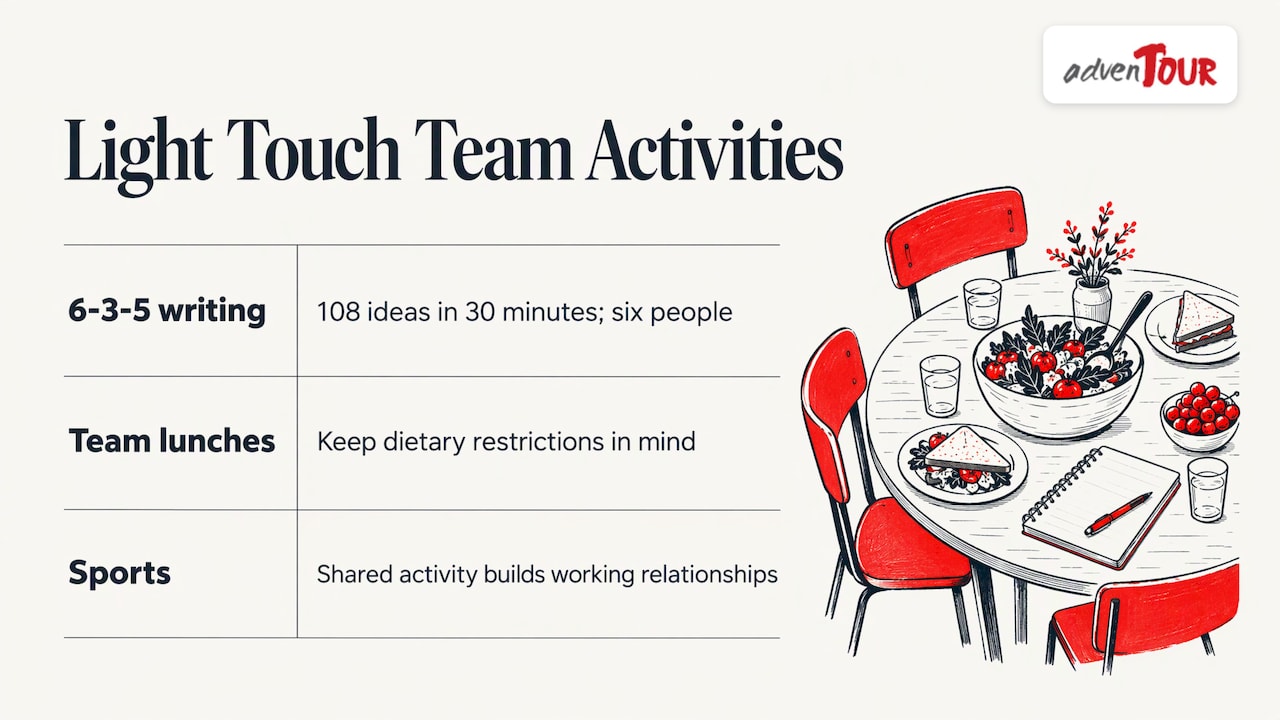
Not every moment needs an event. Singapore’s Public Service Division lists brainstorming techniques that level the playing field for quieter members, such as 6-3-5 brainwriting, which it says can generate 108 ideas in 30 minutes in a group of six. Try one at your next planning meeting. The Ministry of Manpower’s guide for managers also suggests regular team lunches and informal activities, keeping dietary restrictions in mind. Sports can add another route, and this overview of sport-based team building shows how shared physical activity builds working relationships.
What it costs in Singapore
Our published per-person prices fall into three bands. Your final figure depends on group size, venue and customisation.
| Band | Examples | Published price per person |
|---|---|---|
| Budget-friendly | Kinball | $35-$45 |
| Bloop Bubble Soccer | $36-$43 | |
| Combat Skirmish Laser Tag | $37-$45 | |
| App-based Amazing Race | $40-$55 | |
| Bicycle Scavenger Hunt | $45-$55 | |
| Quality | Amazing Race | $65-$78 |
| Garden Odyssey | $68-$90 | |
| Laser Clay Shooting | from $69 | |
| Modified DISC Workshop | $70-$82 | |
| Running Man Challenge | $72-$82 | |
| Premium | Office Dynamics Workshop | $80-$90 |
| Katong/Joo Chiat Cultural Food Immersion | $82-$98 | |
| Office Shark Tank | from $92 | |
| Corporate Sailing | $125 | |
| DISC Personality Profiling | $150-$159 |
You can browse each band on our budget-friendly, quality and premium pages. If your team already has a venue, equipment such as laser tag guns and bubble suits can be rented by the hour, and portable tentage is available by the day.
Make it stick: from activity to project work
The review in American Psychologist cautions that lighthearted activities such as icebreakers and ropes courses may help in the short term but have limited evidence without science-based components. Its recommendation is to cover goal setting, relationship management, role clarification and problem solving, backed by concrete action plans and follow-up. Here is a routine you can use with any format:
- Name the project goal before the event. Tell participants what the session supports, for example faster hand-offs between two departments.
- Pick one behaviour to observe. Examples are how the team splits tasks, how it handles disagreement, or who is left out of decisions.
- Debrief straight after. Ask what happened, why, and what it means for Monday. A facilitator keeps this focused.
- Write two or three agreements. Link them to roles, decision rights or communication habits, in line with the charter.
- Review in two to four weeks. Put it in the project calendar as a standing item.
We design our programmes around experiential learning and skill transfer rather than passive entertainment, with experienced facilitators and a focus on outcomes in engagement, collaboration and communication.
When team building does not seem to help
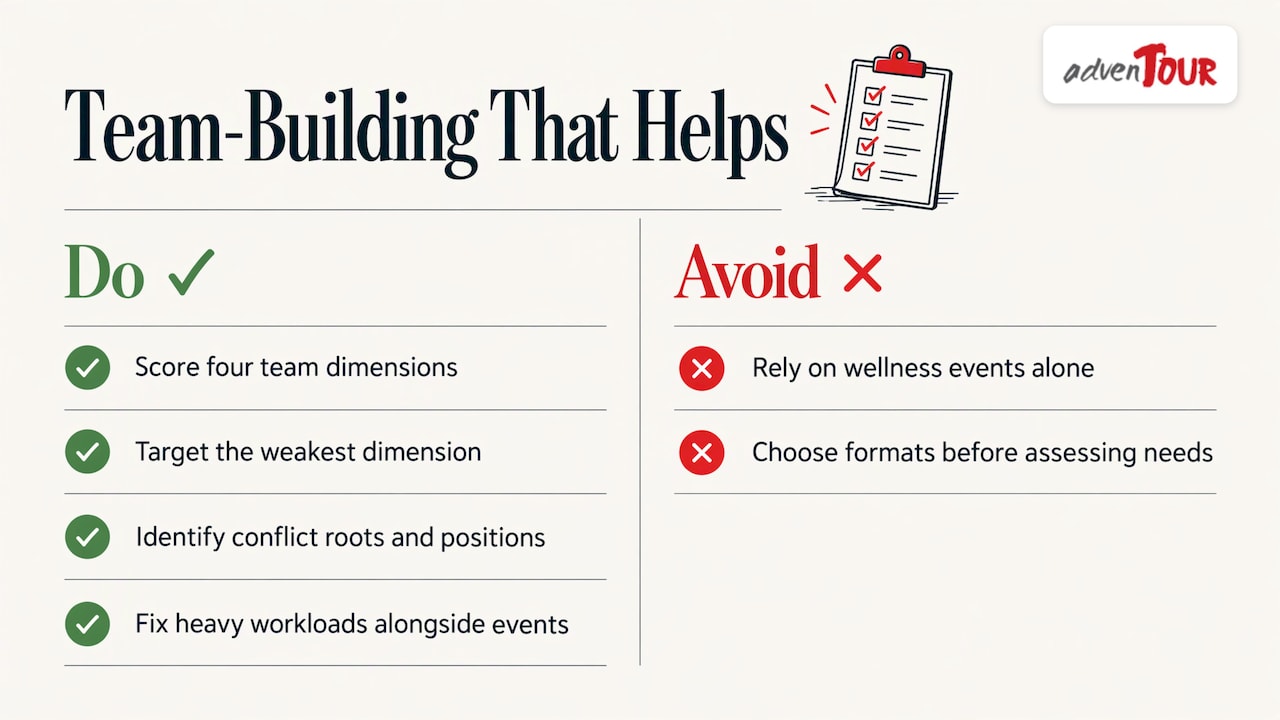
MOM’s managers’ guide suggests assessing a team across four dimensions: communication, collaboration, mutual care and support, and morale. Score your team on each before choosing a format, then pick the activity that targets the weakest one. For conflict, the guide advises identifying the root problem and clarifying each person’s position before moving to compromise.
The Singapore Workplace Report from the Society for Inclusive Development also notes that wellness initiatives address consequences rather than root causes, so heavy workloads need fixing alongside any event. Pair the two and the session has more to build on.
Planning for MNCs and regional meetings
If your project team is spread across Asia and meets in Singapore, the team building slot is often the only time everyone is in the same room. Use it for the relationship work that video calls do not do well. Choose formats that need no shared language or prior skill, such as Amazing Race or the Katong/Joo Chiat food immersion, and schedule it early in the programme so that the connections help during the sessions that follow. Our CSR programmes let visiting teams give back locally as part of the agenda.
Our perspective
Most requests we get say “we want a fun event”. The better brief is “we want our project team to decide faster and trust each other’s handovers”. Once that is on the table, the choice of activity becomes easy.
We build programmes around your objectives and scale them to your group size and budget. A $35 per person Kinball session and a $159 DISC profiling day can both work, provided each has a clear purpose and a debrief that connects it to the project.
Our advice to HR leaders: decide the one outcome you want, tell the team before the day, and leave time at the end to agree what changes on Monday.
Joshua
Plan your project team session with us
We plan and run team building from budget-friendly games to premium facilitated programmes, as well as CSR days and carnivals, for companies in Singapore and visiting regional teams. Tell us your project objectives, group size and budget, and we will tailor the programme. Start from our programme pages or reach us through adventour.com.sg.
FAQ
What is project team building?
It is a set of activities and conversations that help a project team agree on goals, understand each other’s strengths and coordinate better. Research shows gains in trust, coordination and shared understanding, with goal setting and role clarification the most effective parts.
How often should a project team do team building?
There is no fixed rule. The Center for Project Innovation suggests anything from a five-minute item in a status review to an offsite. A common pattern is one session at kick-off and another when friction appears, with short exercises in between.
Which activities suit a tight budget?
Kinball, Bloop Bubble Soccer, laser tag, the App-based Amazing Race and the Bicycle Scavenger Hunt are our budget-friendly formats, priced from $35 to $55 per person. Add a short debrief to turn them into project learning.
Can you run team building for a regional meeting?
Yes. We plan and run programmes for companies visiting Singapore for regional meetings, including large group formats and CSR activities, tailored to the meeting’s objectives.
Sources
- SAFTI Military Institute: Team Building and Team Learning
- American Psychologist review on team building
- Pepperdine University: impact of team building on group cohesion
- PMI: Project teams
- ProofHub: team management guide
- Asana: Project team roles
- Center for Project Innovation: Developing project teams
- Public Service Division: Better brainstorming
- MOM: Creating inclusive and harmonious workplaces
- Singapore Workplace Report
Recommended
- Best Team Building Activities in Singapore
- Team Building Event Ideas in Singapore
- Sales Team Building in Singapore: Activities That Work
- How to Plan Corporate Team Building Events in Singapore: A Step-by-Step Guide