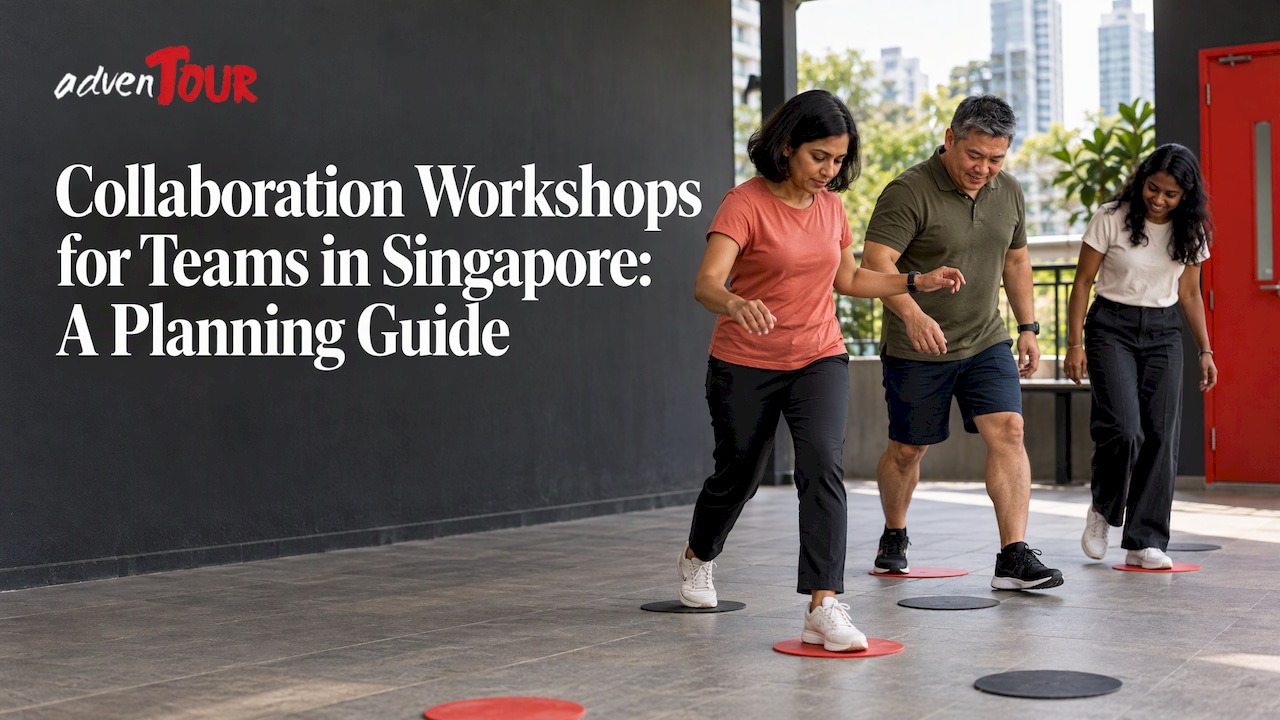
A collaboration workshop is a structured, facilitated session in which every participant works on a shared challenge and then reflects on how the team handled it. The best ones are built around a business goal, run by an experienced facilitator and followed by a debrief that links what happened in the room to daily work. That is how we design them at AdvenTOUR, with programs tailored to each client’s objectives, group size and budget, and with per-person prices from $35 to $159 that you can compare before you brief anyone.
This guide is for HR leaders, event planners and management teams in Singapore, including regional teams visiting for meetings and conferences. It covers what to include, how to choose a format, how to plan it step by step and how to tell afterward whether it worked.
Key Takeaways
- A collaboration workshop is built around active contribution from everyone and a debrief, not a presentation or an update meeting.
- Pick the format from the goal first (communication, problem-solving, trust, understanding working styles), then from group size and budget.
- Published per-person prices for our programs run from $35 for the lightest activities to $159 for a full personality profiling workshop.
- Decide what you will measure before the session: a short survey before and after, and a follow-up a few months later.
- Workshops fit naturally into regional meetings, offsites and CSR days when the activity is chosen to match the room, not the other way round.
Table of Contents
- What a collaboration workshop actually is
- What teams practice in a collaboration workshop
- Matching format to goal, group size and budget
- How to plan a collaboration workshop, step by step
- Hybrid teams and regional meetings in Singapore
- Measuring whether it worked
- Fitting workshops into corporate events and CSR days
- Plan your workshop with AdvenTOUR
- Our perspective
- FAQ
- Sources
What a collaboration workshop actually is
People use “workshop”, “team building” and “training” loosely, so it helps to separate them. A workshop is a structured, interactive process in which participants work toward a meaningful outcome, rather than sitting through a presentation or a status update. A collaborative one goes further: it is goal-oriented, and every participant contributes actively instead of one person presenting ideas.
That gives you three tests for any session you are considering:
- Is there a goal? “Better communication between product and sales” is a goal. “Have fun” is a nice side effect.
- Does everyone do something? If half the room watches, it is a demonstration.
- Is there a debrief? The debrief is where an experience becomes a skill the team can reuse on Monday.
This is why we put experiential learning and skill transfer ahead of passive entertainment. A laser tag match or a city race is the vehicle. The facilitated reflection afterward is the workshop.
What teams practice in a collaboration workshop
Most collaboration workshops train a handful of skills: communicating clearly under pressure, solving a problem together, building trust, and understanding why colleagues work differently. The exercises used for these are often simple. For example, a well-known communication exercise called Traffic Jam takes 15 minutes or more, suits six or more people and is followed by a debrief about leadership and inclusion. Blind Square, in which a group has to form a shape without sight, is listed at 40 to 45 minutes for groups of 4 to 20 and targets communication, trust and collaboration.
Those short exercises are useful as openers or breaks inside a longer agenda. For a half-day or full-day event, you will usually want a larger format that gives teams time to plan, split roles, make mistakes and recover. Here is how we group ours by what they develop.
Communication and problem-solving under time pressure
Race-style formats put teams through a series of challenges where the quickest route is not the one a single person picks. Our Amazing Race team building is $65 to $78 per person, and the app-based version is $40 to $55. Teams must divide tasks, share information and agree on a route, which makes weak handovers visible quickly. If your goal is sharper problem-solving habits, our guide to team problem solving methods and activities shows how the debrief is structured.
Energy, trust and role-taking
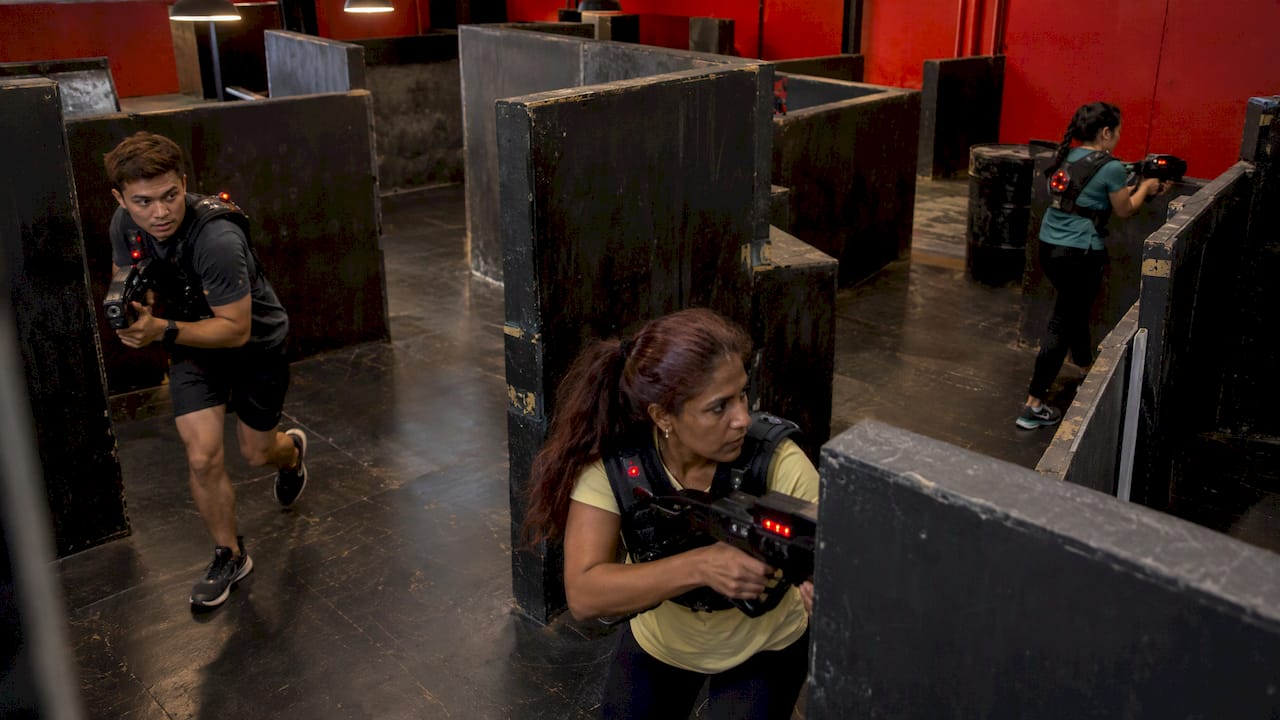
Active team games get quieter colleagues involved and let people see each other outside job titles. Combat Skirmish Laser Tag is $37 to $45 per person, Bloop Bubble Soccer is $36 to $43 and Kinball is $35 to $45. Because everyone is on the field at once, these formats work well for larger groups. Our page on outdoor team bonding games explains which suit which group size.
Understanding how colleagues work
When friction comes from different working styles rather than a lack of effort, a profiling workshop is the right tool. Our Modified DISC Workshop is $70 to $82 per person, and the full DISC Personality Profiling is $150 to $159. DISC is a model that describes four broad behavioral styles, and the workshop gives teams a shared vocabulary for how they prefer to communicate and decide. Read more in our guide to communication workshops for teams in Singapore.
Creative and strategic collaboration
Office Shark Tank, from $92 per person, has teams pitch and challenge ideas, which suits cross-functional groups that need to practice making a case and giving feedback. Office Dynamics Workshop is $80 to $90 per person and looks at how teams behave day to day.
Matching format to goal, group size and budget
The most common planning mistake is choosing the activity first and the goal second. Reverse that. Write one sentence describing what should be different after the day, then choose from the table below. All prices are the per-person ranges published on our site in October 2026 and are one-off fees.
| Goal | Format | Per-person price | Good fit |
|---|---|---|---|
| Quick bonding, tight budget | Kinball, Bloop Bubble Soccer, Combat Skirmish Laser Tag | $35 to $45 | Large groups, mixed fitness levels, half-day |
| Communication and navigation | App-based Amazing Race, Bicycle Scavenger Hunt | $40 to $55 | Cross-department groups |
| Problem-solving and planning | Amazing Race, Running Man Challenge | $65 to $82 | Teams that need to coordinate roles |
| Working styles and feedback | Modified DISC Workshop, Office Dynamics Workshop | $70 to $90 | Teams in transition or with friction |
| Executive offsites | DISC Personality Profiling, Corporate Sailing, Office Shark Tank | $92 to $159 | Leadership groups, premium events |
| Culture and connection | Katong/Joo Chiat Cultural Food Immersion | $82 to $98 | Regional visitors, small to mid-size groups |
You can browse the full lists on our pages for budget-friendly activities, quality team building programs and premium team building programs.
Two practical notes on budget. First, per-person pricing means the total scales with headcount, so for a 100-person event the gap between a $40 and a $80 format is $4,000. Decide whether the extra spend buys a deeper debrief or just a longer activity. Second, if you already have a venue or office space, equipment hire can cover part of the plan: we rent laser tag guns at $25 to $33 per hour per gun, Bloop bubble suits at $28 per hour per ball and portable tents at $95 per day per tent, listed on our event rentals page.
How to plan a collaboration workshop, step by step
Here is the routine we follow, and where each step usually goes wrong.
- Define the problem in plain terms. “Sales and operations hand off orders late” gives a facilitator something to design around. “Improve synergy” does not. Talk to two or three team leads before the brief.
- Set one to three outcomes. Fewer is better. Each outcome should be observable, such as clearer handovers, more voices in meetings or a shared way to resolve disagreements.
- Choose the format and group size. Teams of five to eight work best inside a larger event, so a group of 80 becomes ten or so teams. Our programs are scalable for group size and budget, which matters when the headcount is still changing.
- Brief the facilitator, not just the vendor. The facilitator needs to know the team’s history, who is new and which topics are sensitive. We tailor programs to organizational goals, so a clear brief goes straight into the design.
- Build the debrief into the schedule. Reserve at least 20 to 30 minutes after the main activity. Skipping it to save time is the most common way a workshop turns into a fun afternoon with no carry-over.
- Plan the follow-up. Agree one small action per team, owned by a named person, before everyone leaves.
- Measure. See the next section.
If you need ideas for smaller groups, our page on creative team building ideas for small groups is a good companion.
Hybrid teams and regional meetings in Singapore
Singapore is a regional meeting hub, so many workshops mix local staff, visitors from other offices and sometimes colleagues dialing in. The principle from the facilitation guidance above still applies: everyone contributes actively. In practice that means:
- Mix teams across offices. Put visitors and locals together so the activity builds the relationships the meeting needs.
- Choose low-language-barrier formats. Physical and visual challenges level the field when participants have different first languages.
- Keep the energy level flexible. An activity with roles for runners, navigators and strategists lets people take part at their own pace.
- Place it well in the agenda. Early in a multi-day conference, a workshop makes later sessions more open. At the end, it works as a celebration of the work done.
Our Katong/Joo Chiat Cultural Food Immersion, at $82 to $98 per person, is a natural fit for visiting teams because the shared task is local and the conversation comes easily.
Measuring whether it worked
The question leaders ask after the event is whether it improved teamwork and morale. Answering it takes planning before the event, not a hopeful survey afterward.
Take a baseline. Ask three to five questions on a five-point scale about communication, trust and clarity of roles, and repeat them right after the session.
Follow up later. A published example from Singapore shows the pattern: the 2018 Citi-SMU financial literacy programme used pre- and post-quizzes to measure learning and a second survey three to six months later to track longer-term outcomes. In that sample, 674 of 1,124 learners (60%) improved their understanding between the two quizzes. That is a different topic from teamwork, but the method carries over: a before-and-after measure plus a delayed check.
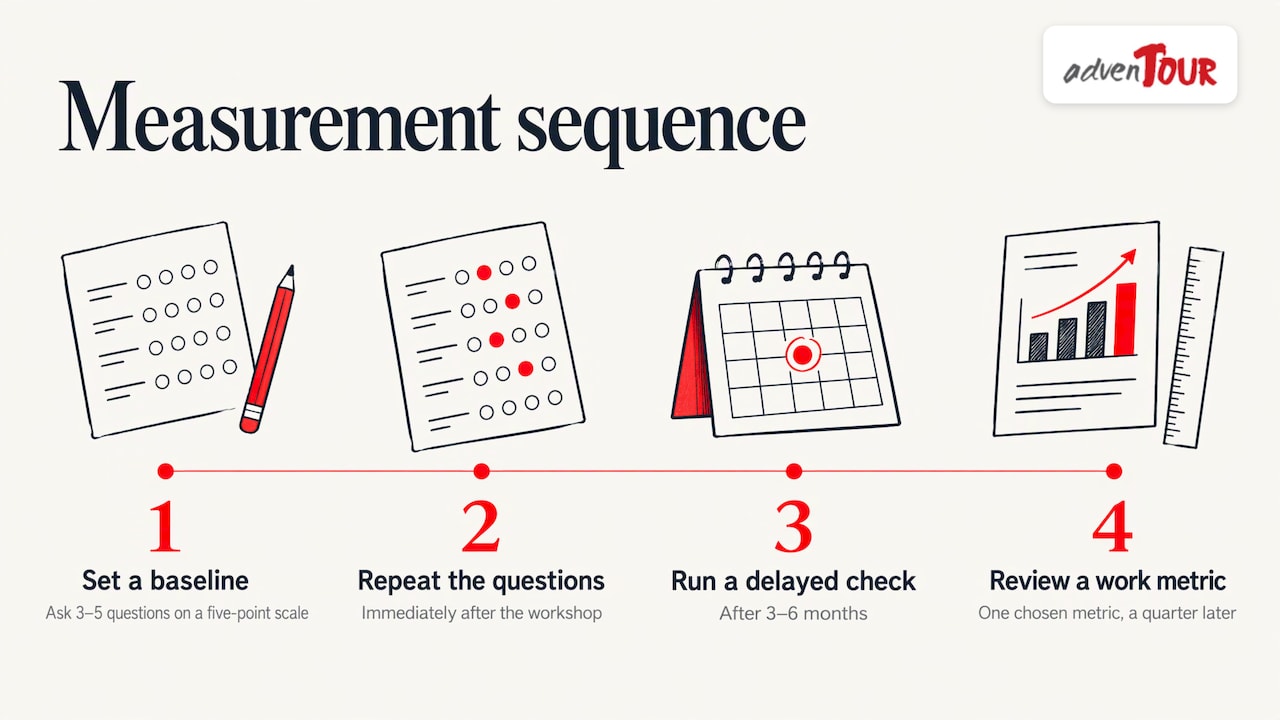
Pick a work metric. Choose one thing the workshop should affect, such as handover errors, meeting length or the share of cross-team projects delivered on time, and look at it a quarter later.
Expect measurement to be a capability. Measuring impact is not trivial for any organization. In a 2025 Maybank Singapore survey of nonprofits, 40% reported a robust social-impact measurement framework, while more than 25% faced significant measurement challenges, mainly around capability and capacity. The lesson for a corporate event is to keep the measurement small and repeatable. Our programs are designed with measurable outcomes in engagement, collaboration and communication in mind, so share your metric in the brief and we will build the debrief around it. For a worked example from a client team, see how one team strengthened communication and collaboration.
Fitting workshops into corporate events and CSR days
A collaboration workshop does not need its own day. Three common ways to fold one into an existing plan:
- Offsite or retreat. Anchor the morning in a facilitated activity and use the afternoon for the team’s actual planning. People discuss strategy differently after they have solved something together.
- Company event or family day. A large-group format such as laser tag, Kinball or bubble soccer brings departments together without needing meeting-style structure. We also run a Family Day Carnival, and you can see the details on our carnivals and rentals page.
- CSR program. Teams that work together for a cause build collaboration as a by-product. Our SG60 CSR programs are designed to help companies celebrate, give back and connect, and they suit both local teams and groups visiting Singapore.
Whichever you choose, keep the three tests from earlier: a goal, full participation and a debrief.
Plan your workshop with AdvenTOUR
If you are planning a collaboration workshop in Singapore, we design and run it for you: the format, the facilitation and the debrief, matched to your goals, your headcount and your budget. Our recognition as one of Asia’s Top 10 Corporate Team Building Companies in 2023 reflects the standard we hold ourselves to. Start with the quality team building programs for a balanced mix of activity and learning, or visit adventour.com.sg to tell us what you want your team to do differently.
Budget-conscious teams can begin with the activities on our budget-friendly page, and executive groups can look at the premium programs.
Our perspective
Most teams we meet do not lack goodwill. They lack a shared experience of solving something together, and a chance to say out loud how they work. That is what a collaboration workshop is for.
We design every program around the client’s objective, then choose the activity that best serves it. A budget-friendly laser tag session and a premium DISC profiling day can both be effective, as long as the goal is clear and the debrief is done properly. We scale for group size and budget because the right workshop is the one your team will actually take part in fully.
Our facilitators focus on experiential learning and skill transfer. The activity creates the moment, the conversation afterward turns it into a habit. If you take one thing from this guide, let it be that: protect the debrief, and measure something small before and after.
Joshua
FAQ
How long should a collaboration workshop be?
Short exercises can run 15 to 45 minutes, and a full workshop usually takes a half-day or a full day. The right length depends on how many skills you want to address and how much time the debrief needs. For a single goal, such as communication between two departments, a half-day format with a solid debrief is often enough.
What is the difference between team building and a collaboration workshop?
Team building is the broad category of activities that bring people together. A collaboration workshop is a team building session designed around a specific goal, with active participation from everyone and a facilitated debrief. Our programs are built to do both: engage the group and transfer skills to the workplace.
How much does a corporate collaboration workshop cost in Singapore?
Our published per-person prices run from $35 to $45 for activities like Kinball up to $150 to $159 for DISC Personality Profiling. Total cost is the per-person rate multiplied by headcount, so share your group size and goals and we will recommend a format to fit your budget.
Can a workshop work for large groups or regional teams?
Yes. Large groups are divided into teams of a manageable size, and mixed teams across offices help visitors and local staff build relationships. Formats such as laser tag, bubble soccer, Amazing Race and cultural food tours scale well and work across language backgrounds.
How do we know the workshop made a difference?
Choose a few survey questions and one work metric before the event. Ask the same questions right after the session, and again three to six months later. Comparing before and after gives you evidence to decide whether to repeat or adjust the program.
Sources
- What is a workshop and why should you run one? | SessionLab
- Tips for Creating Interactive Online Workshops | Miro
- 57 team building activities to improve collaboration | SessionLab
- Citi-SMU Financial Literacy Program for Young Adults, 2018 research report
- Maybank Hosts Inaugural Community Leaders Roundtable, June 2025
Recommended
- Innovation Workshops for Corporate Teams in Singapore
- Communication Workshops for Teams in Singapore: A Guide
- Interactive Corporate Workshops Singapore: Top Picks
- Meeting Facilitation: A Practical Guide for Singapore Teams