
Meeting facilitation means one person guides the group through a purpose, an agenda and a decision, without pushing their own view. The difference between a meeting that ends in action and one that ends in a calendar invite for another meeting is usually structure, not talent. For regional meetings, offsites and conferences held in Singapore, the strongest results come when the discussion is designed and guided, and when the group has also built the trust to speak openly. That is why we pair structured facilitation with experiential team sessions.
This guide covers what a facilitator does, how to prepare, the techniques that work for decisions and difficult conversations, how to handle hybrid rooms, and how to follow up so that decisions turn into action.
Key Takeaways
- A facilitator guides the process (who speaks, in what order, toward which outcome) and stays neutral on the content.
- Most of the work happens before and after the meeting: a clear goal, a timed agenda, named roles, written actions.
- Simple structures such as timed small groups and a five-step workshop sequence help quiet participants contribute and groups reach decisions.
- Hybrid meetings need deliberate facilitation so remote attendees are not treated as an afterthought.
- For regional meetings and offsites in Singapore, a designed facilitated session, with experiential activities to build trust, gives the group a stronger start than a standard conference-room agenda.
Table of Contents
- What a meeting facilitator actually does
- Before the meeting: the preparation that decides the outcome
- During the meeting: techniques that work
- Facilitating hybrid and virtual meetings
- After the meeting: turn decisions into action
- When facilitation needs more than an agenda
- What facilitation costs in Singapore
- Our perspective on facilitation
- Plan a facilitated session with us
- A simple facilitation checklist
- FAQ
- Sources
What a meeting facilitator actually does
A chair or manager usually has a stake in the outcome. A facilitator’s job is to make the group’s thinking work. The Marketing Institute of Singapore Academy lists facilitator responsibilities such as soliciting opinions, clarifying information, guiding participants toward consensus, gate-keeping and evaluating. Read plainly, that is five jobs:
- Drawing people out. Asking for views from those who have not spoken, so the loudest voice does not decide by default.
- Clarifying. Restating a point so everyone has the same understanding before moving on.
- Steering to agreement. Summarizing where the group stands and testing whether it can decide.
- Gate-keeping. Controlling the flow: stopping side conversations, parking off-topic points, holding the time.
- Evaluating. Checking at the end whether the meeting reached its purpose.
Notice what is missing: giving the answer. When a senior leader runs the session and also pushes a preferred solution, participants tend to agree rather than think. That is the main reason companies separate the role, either by asking a neutral colleague to facilitate or by bringing in an outside facilitator for important sessions.
Facilitated discussion versus an ordinary meeting
A facilitated discussion is a conversation with a designed structure: a stated question, a method for collecting input, and a defined way to reach a conclusion. The Institute for Adult Learning describes its Workshop Method as a structured, inclusive approach built around collaboration, dialogue, respect for diverse perspectives and consensus-building. Use one when:
- the decision needs buy-in from people who will carry it out;
- several departments or countries see the problem differently;
- the topic is sensitive, such as restructuring, a failed project or a change in priorities;
- you want ideas, not just status updates.
For a simple information update, an ordinary short meeting, or an email, is enough.
Before the meeting: the preparation that decides the outcome
Singapore Business Review’s commentary on productive meetings treats a meeting as three phases: preparation, collaboration and decision-making, then execution. The point is that the discussion itself is only the middle. Here is a preparation routine you can use for any meeting that matters.
1. Write the purpose as an outcome
“Discuss Q1 plans” is a topic. “Agree the three priorities for Q1 and an owner for each” is an outcome. If you cannot write the outcome in one sentence, the meeting is not ready. It is also the sentence you will use to judge afterward whether the meeting worked.
2. Decide who needs to be in the room
Invite the people who decide, the people who know, and the people who must act. Everyone else gets the notes. In regional meetings, where flights and time zones make each seat expensive, this step saves the most money.
3. Build a timed agenda
Give each item a time, a purpose (inform, discuss or decide) and an owner. Put the hardest decision early, when energy is highest, not in the last ten minutes. Share the agenda in advance so participants can think before they arrive.
4. Assign roles
Name a facilitator, a timekeeper and a note-taker. If the facilitator also takes notes, they cannot watch the room. For a large group, add a person per table or breakout group to consolidate key points, an approach the Singapore Business Review piece recommends together with time-limited round-table discussions.
5. Set ground rules in one minute
Open by saying how decisions will be made (by consensus, by vote, or by the owner after input), that phones are down, and that disagreement is welcome but interruptions are not. Stating the decision rule up front prevents the common frustration of people discovering at the end that their input was only advisory.
During the meeting: techniques that work
Use a repeatable sequence
The Institute for Adult Learning teaches a five-step Workshop Method: Context, Brainstorm, Organise, Name and Resolve. In practice, that looks like this:
- Context: state the question and why it matters now.
- Brainstorm: everyone writes ideas individually, then shares. No debate yet.
- Organise: group similar ideas together.
- Name: give each cluster a short label so the group can talk about themes, not individual people’s suggestions.
- Resolve: choose, rank or assign next steps.
The sequence works because it separates generating ideas from judging them. Judging too early is what shuts down the quieter participants.
Use small groups for big rooms
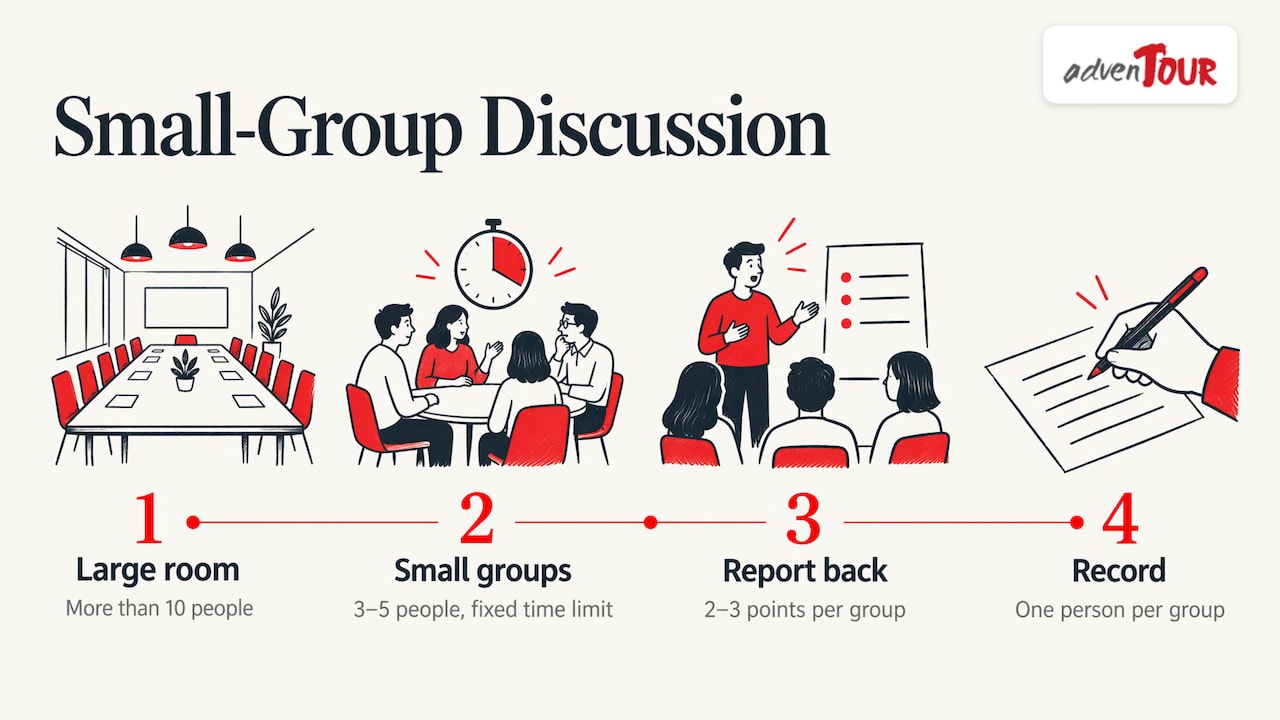
When more than ten people are in the room, discussion drifts to the same few speakers. Split into groups of three to five with a fixed time limit, ask each group to report back two or three points, and have one person per group record them. Everyone speaks, and the facilitator receives condensed input rather than a dozen overlapping monologues.
Handle difficult behavior without drama
| Situation | Facilitator move |
|---|---|
| One person dominates | Say “let’s hear from someone who hasn’t spoken yet” and use written input before open discussion |
| Quiet room | Pose the question, give 2 minutes of silent writing, then go round the room |
| Off-topic tangent | Write it on a visible “parking list” and promise to return to it |
| Open resistance to a decision | Ask what would need to be true for them to support it, and record the answer |
| Debate going in circles | Summarize the two positions, then ask the group which criteria should decide between them |
Capture as you go
Singapore Business Review argues that capturing and prioritizing key issues in real time gives participants a shared reference for follow-up and for communicating outcomes. A visible flipchart, whiteboard or shared screen does this. It also reduces repeated arguments, because people can see their point has been recorded.
Facilitating hybrid and virtual meetings
When some people are in the room and others are on a screen, the room tends to win. Remote participants cannot catch side comments, see body language or jump in during a pause. The practical fixes are simple:
- Start with the remote voices. Ask remote participants first, not last.
- Use a second facilitator or a chat monitor to watch the chat and raise questions that appear there.
- Use shared digital tools for brainstorming, so in-room and remote people contribute the same way.
- Ask people in the room to speak to the camera and to repeat questions asked from the back.
- Test equipment and share the timed agenda in advance so the first ten minutes are not lost to technical issues.
The principle is that remote attendees should have the same ways of contributing as anyone in the room. If you cannot give them that, consider whether the decision session should be held in person.
After the meeting: turn decisions into action
A meeting that does not produce written actions has not finished. Within 24 hours, send a short note containing:
- the decisions made, in one line each;
- every action, with a named owner and a due date;
- items parked for later, with who will pick them up;
- the date of the next check-in.
Then run the check-in. The most common reason meeting decisions fail is not that they were wrong but that nobody was asked about them a week later. A five-minute status item at the start of the next meeting is enough.
When facilitation needs more than an agenda
Process tools help, but they cannot fix a team that does not trust each other enough to disagree. That is the typical situation in a regional meeting where colleagues from several countries meet in person for the first time, or in an offsite after a reorganization. Participants hold back, defer to seniority and say what they think the room wants to hear.
This is where facilitation and team building overlap. Experiential sessions let people work on a shared problem in a low-stakes setting, so by the time the formal agenda begins, they have already practiced listening, dividing roles and disagreeing productively. Our conference and meeting team activities are built around that idea for groups meeting in Singapore, and our communication workshops guide explains how structured exercises improve the way teams talk to each other.
Workshops that give a facilitated session its content
Two of our workshop formats fit the facilitated meeting especially well:
- The Office Dynamics Workshop is priced at $80-90 per person. It looks at how people work together day to day, which gives a group a common language before it tackles a contentious agenda.
- The Modified DISC Workshop is priced at $70-82 per person. DISC is a behavioral model that describes different communication styles, and it helps participants understand why a colleague argues, listens or decides differently. For teams that want a deeper individual profile, the DISC Personality Profiling program is $150-159 per person.
Prices are as published on our site and vary within the range by group size and format.
Matching the format to the budget
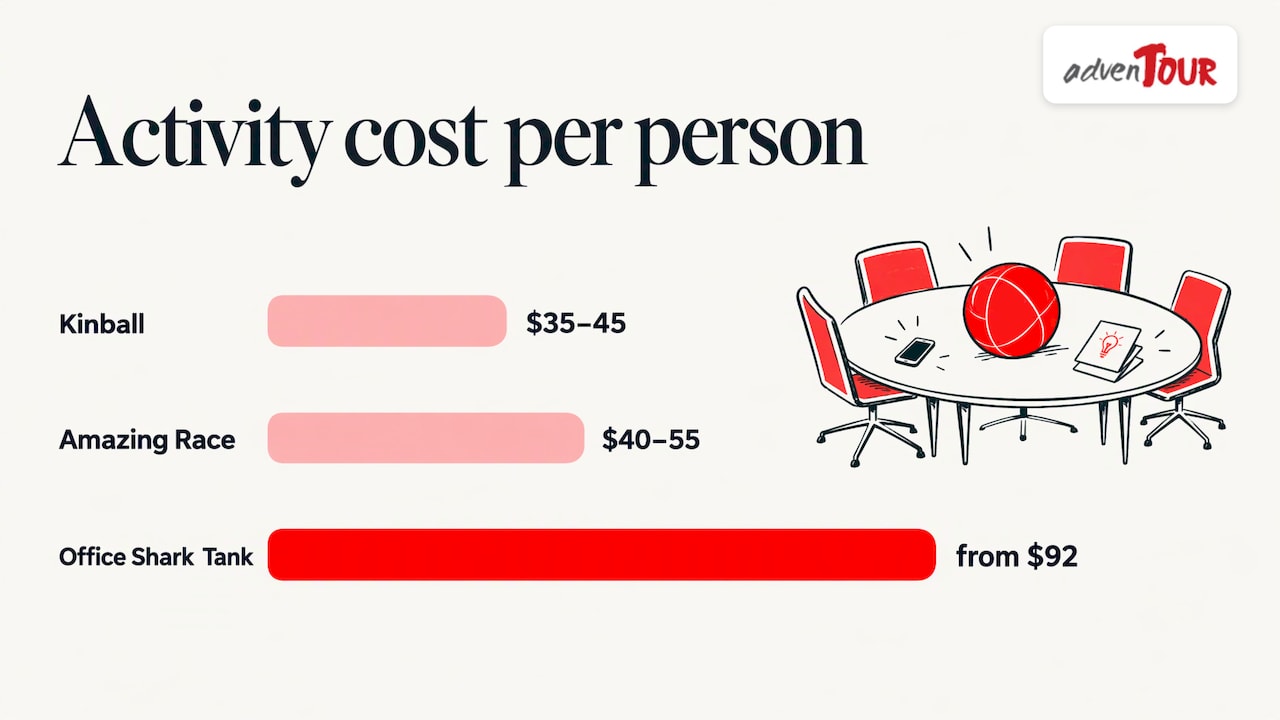
Not every meeting day needs a full workshop. Active formats for the social part of a program start lower: budget-friendly activities such as Kinball ($35-45 per person) or the app-based Amazing Race ($40-55 per person) give a large group a shared experience to talk about over the next session. For an executive offsite where the group needs to make a hard decision together, the Office Shark Tank, from $92 per person, has teams develop and pitch ideas to each other, which exercises the same skills of persuading, questioning and deciding that a strong facilitated meeting relies on.
What facilitation costs in Singapore
There is no single going rate for a facilitator, because the price depends on the length of the session, the number of participants, the amount of design work and whether the content is customized. Two reference points help you plan:
- If you want to build the skill internally, the Institute for Adult Learning lists its Workshop Method course at S$708.50 full fee, with lower nett fees for eligible Singapore citizens and permanent residents. That is a per-person training fee, not the cost of hiring a facilitator, and the listed fee is subject to change.
- For a facilitated team session at your event, our programs are priced per participant, so the total scales with group size. Add up the participants, multiply by the per-person price in the range, and you have a planning figure before you speak to anyone.
A per-person price also makes comparison easy across vendors: ask for what is included (facilitator time, materials, venue support, reporting) in each.
Our perspective on facilitation
We see meeting facilitation as a design problem. The agenda, the sequence of activities and the way people are grouped decide most of what happens in the room, long before anyone speaks.
Our programs are built to be customized to each client’s objectives and scaled to group size and budget. A regional leadership meeting and a 200-person company day need different tools, but both need a clear purpose, experienced facilitators and a way to measure whether engagement, collaboration and communication actually improved.
We also believe people learn to collaborate by doing, not by watching. That is why our programs focus on experiential learning and skill transfer rather than passive entertainment. When a group has solved a challenge together on a Garden Odyssey route or in a DISC session, the next agenda item is easier, because people already know how to listen to each other.
If you are planning a meeting or offsite in Singapore, start with the outcome you need, then work backward to the format. We are glad to help with that design.
Joshua
Plan a facilitated session with us
If you are organizing a regional meeting, leadership offsite or company event in Singapore, we design and run team building programs and workshops around your objectives, from budget-friendly activities to premium formats. Our premium team building programs include the Office Dynamics Workshop, DISC profiling and Office Shark Tank, and our programs are priced per participant so you can plan the budget early. We were named one of Asia’s Top 10 Corporate Team Building Companies in 2023.
To discuss your group, goals and dates, contact us through our website.
A simple facilitation checklist
Print this and keep it next to your agenda.
Before
- Outcome written in one sentence
- Only decision-makers, knowledge holders and doers invited
- Timed agenda shared in advance
- Facilitator, timekeeper and note-taker named
- Equipment tested for hybrid participants
During
- Decision rule stated in the first minute
- Individual writing before open discussion
- Small groups for rooms over ten people
- Parking list visible
- Decisions and actions written where everyone can see them
After
- Notes sent within 24 hours
- Every action has an owner and a date
- Check-in scheduled
- Outcome judged against the original sentence
FAQ
What is a facilitated discussion?
It is a conversation guided by a neutral person using a defined structure: a clear question, a method for collecting everyone’s input and a way to reach a conclusion. The facilitator manages the process and does not push a preferred answer. It works best when a decision needs buy-in from several groups.
What is the difference between a facilitator and a meeting chair?
A chair often owns the decision and contributes opinions. A facilitator stays neutral on content and focuses on participation, time and outcomes. For high-stakes or sensitive meetings, splitting the two roles gives better input because people feel safer speaking.
How do I facilitate a Teams or other virtual meeting?
Share a timed agenda beforehand, test your audio and camera, and name a chat monitor. Call on remote participants first, use shared digital boards for brainstorming and end with written actions. Keep the same ways of contributing open to everyone, whether they are in the room or online.
How much does a meeting facilitator cost?
The price depends on session length, group size and how much design is involved, so there is no single rate. Our team building and workshop programs are priced per participant, for example $80-90 per person for the Office Dynamics Workshop, which makes a group budget easy to estimate. Contact us with your numbers for a tailored proposal.
Sources
- Facilitating Productive Meetings, Marketing Institute of Singapore Academy
- How to create effective and productive meetings in Singapore, Singapore Business Review
- Facilitate with Flair: The Workshop Method Unleashed for Ultimate Impact, Institute for Adult Learning
Recommended
- Corporate Team Building Activities: What Works
- Team Building Guide: Singapore
- Leadership Team Activities That Build Real Skills in Singapore
- How to Plan Corporate Team Building Events in Singapore: A Step-by-Step Guide