
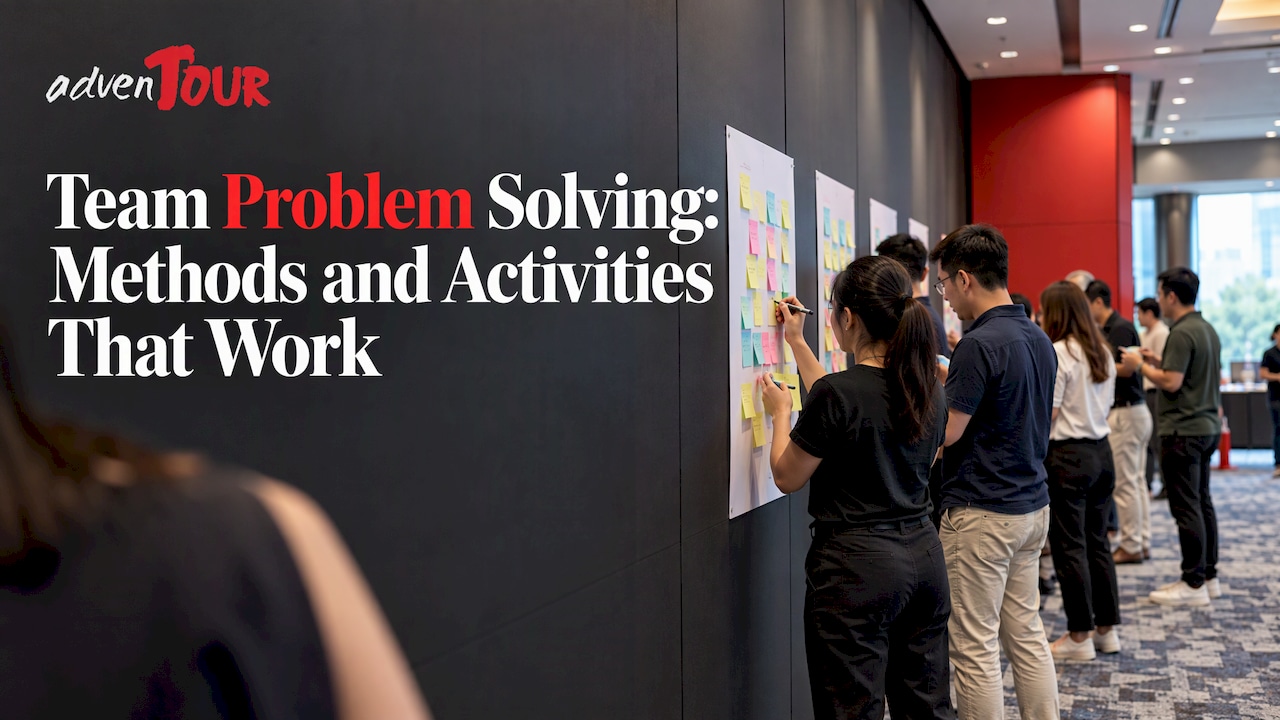
Teams solve problems well when they share one picture of the problem, hear every voice, and agree who does what next. Those habits can be taught, but they stick best when people practice them under light pressure, together, on a task that feels real. For Singapore companies, that usually means a facilitated session: a short method for the meeting room, plus a live activity where the team has to coordinate in real time. At AdvenTOUR, we design and run those sessions, from budget formats to premium programs.
Key Takeaways
- Collaborative problem solving is a mix of thinking skills and social skills: sharing understanding, acting, and keeping the group organized.
- A simple sequence works for most work problems: define, generate, evaluate, decide, act, follow up.
- Silent idea generation, such as 6-3-5 Brainwriting, gives quieter people the same airtime as the loudest voice.
- Match the activity to group size, time and budget. Published Singapore prices for our formats range from about $35 to $159 per person.
- Learning only counts when it returns to daily work, so end every session with owners, tests and a review date.
Table of Contents
- What team problem solving actually requires
- A process your team can use on any work problem
- Four methods for the meeting room
- Activities that let a team practice, not just discuss
- How to choose: goal, group size, time and budget
- Making it stick after the session
- Our view on team problem solving
- Plan a session with AdvenTOUR
- FAQ
- Sources
What team problem solving actually requires
Most teams assume problem solving is about smart individuals. The research says otherwise. A U.S. assessment framework for collaborative problem solving, built around the PISA international test, identifies three core competencies: establishing and maintaining shared understanding, taking appropriate action, and establishing and maintaining group organization.
In plain terms:
- Shared understanding. Everyone describes the problem the same way before anyone proposes a fix.
- Action. The group turns talk into specific steps and tests them.
- Group organization. Roles, turns and follow-up are clear, so effort is not duplicated or dropped.
ACT’s research team describes the skill as a composite of problem solving, communication and behavior. A member needs the drive to solve a hard problem and also the willingness to use what other people know. Both halves matter, and the second half is the one most workplaces never practice.
It is also a skill that is rarer than people expect. A Cambridge chapter on collaborative problem solving reports that in the 2015 PISA test only 8% of evaluated students excelled at it. The point for an HR leader is practical: do not assume your team already has it because individuals are capable.
A process your team can use on any work problem
George Washington University’s team dynamics guide lists ten steps, from defining the problem and setting evaluation criteria to following up and evaluating both outcomes and process. For a busy team, that compresses into six moves.
- Define the problem in one sentence. Write it down and check that everyone reads it the same way. Teams often discover at this step that they were arguing about different problems.
- Agree the criteria. What would a good answer look like: cost, time, effect on customers? Decide this before ideas appear, or the loudest idea wins.
- Generate options without judging. Keep diverging and converging apart. Evaluating ideas while they are still being produced shrinks the pool.
- Evaluate against the criteria. Score the options openly, so the reasoning is visible to the whole group.
- Decide and assign. One owner per action, one date.
- Follow up. Review what happened and how the team worked, not only whether the fix worked.
Where it goes wrong: step 3 and step 5. Idea generation is dominated by a few people, and decisions end with no owner. The methods below address the first, and the activities later in this article give teams practice at the second.
Four methods for the meeting room
Singapore’s Public Service Division explains why plain brainstorming underperforms: verbal sessions are largely driven by people who speak up first, so not all ideas are heard. Its guide describes four structured alternatives, each short enough for a regular team meeting.
6-3-5 Brainwriting
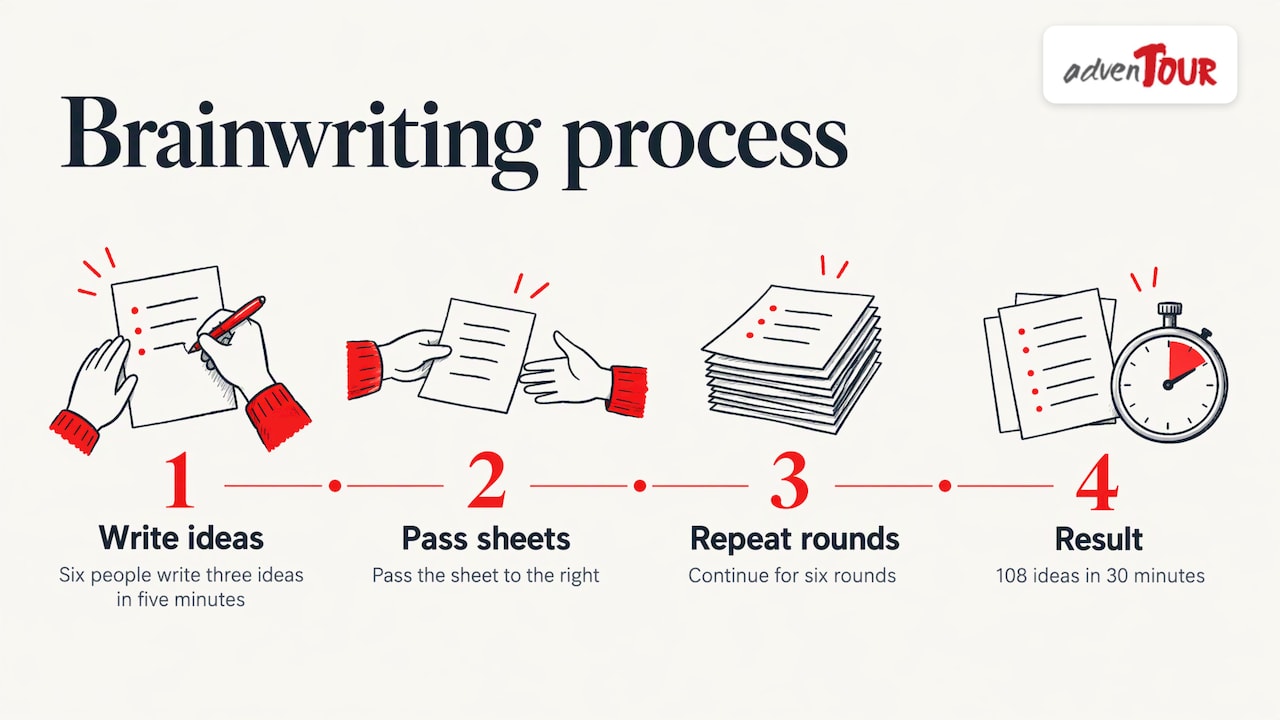
Six people each write three ideas in five minutes, in silence, then pass the sheet to the right. After six rounds, the team has 108 ideas in 30 minutes. The PSD guide recommends it for cross-disciplinary teams and for introverts. It suits a team that mixes seniority levels, because a junior colleague’s idea sits on the page next to a director’s with no name-based filter.
Starbursting
Instead of generating answers, the team explores one idea through six questions: Who, What, Where, When, Why and How. It is useful at step 4 of the process, when a promising option needs stress-testing before anyone commits budget.
Crazy 8s
Each person sketches eight ideas in eight minutes, then the group votes. The time limit is the feature: it stops people polishing the first idea and forces range. It works well for product, process and customer-experience problems that benefit from a visual rough draft.
Silent Circuit
Problem statements are posted around the room, and participants move between them, writing responses. It suits larger groups, since several problems are worked in parallel and nobody waits for a turn to speak.
A practical note for facilitators: pick one method per session and run it to the clock. Teams that mix three methods in an hour usually finish none of them properly.
Activities that let a team practice, not just discuss
Meeting-room methods build the routine. Live activities test it under time pressure, where habits show up quickly: who takes the lead, who goes quiet, whether the team splits the work or all chase the same clue. Our programs focus on experiential learning and skill transfer rather than passive entertainment, so each format is designed around a collaboration objective that we agree with you beforehand.
Our published per-person prices, as read from our site in October 2026, are grouped into three tiers.
| Tier | Format | Price per person |
|---|---|---|
| Budget-friendly | Kinball | $35 to $45 |
| Budget-friendly | Bloop Bubble Soccer | $36 to $43 |
| Budget-friendly | Combat Skirmish Laser Tag | $37 to $45 |
| Budget-friendly | App-based Amazing Race | $40 to $55 |
| Budget-friendly | Bicycle Scavenger Hunt | $45 to $55 |
| Quality | Amazing Race | $65 to $78 |
| Quality | Garden Odyssey | $68 to $90 |
| Quality | Laser Clay Shooting | from $69 |
| Quality | Modified DISC Workshop | $70 to $82 |
| Quality | Running Man Challenge | $72 to $82 |
| Premium | Office Dynamics Workshop | $80 to $90 |
| Premium | Katong/Joo Chiat Cultural Food Immersion | $82 to $98 |
| Premium | Office Shark Tank | from $92 |
| Premium | Corporate Sailing Team Building | $125 |
| Premium | DISC Personality Profiling | $150 to $159 |
For teams that need to coordinate and communicate
Race and hunt formats put a team in front of a series of challenges where splitting tasks, sharing information and keeping a common plan decide the result. That maps directly to the three competencies above. Our App-based Amazing Race and Bicycle Scavenger Hunt sit in the budget tier, and the Amazing Race in the quality tier. For an outdoor format with more energy, the Combat Skirmish Laser Tag session is built around team play.
For teams that need to understand each other first
Many problem-solving failures are communication failures between different working styles. Our Modified DISC Workshop and DISC Personality Profiling give a team a shared vocabulary for how colleagues prefer to communicate and decide. That vocabulary helps at the first step of any problem: agreeing what is being discussed and how.
For leadership and executive groups
Offsites for senior teams often need something more demanding than a game. Office Shark Tank and the Office Dynamics Workshop are in our premium tier, alongside Corporate Sailing Team Building, where a crew has to coordinate without the comfort of the meeting room.
For large groups and visiting regional teams
We scale programs for group size and budget. If your regional meeting brings colleagues to Singapore from several offices, a food immersion such as our Katong/Joo Chiat Cultural Food Immersion gives mixed groups a shared task that is also a local experience. For community-minded groups, our CSR programs add a give-back element.
How to choose: goal, group size, time and budget
Start with the goal, not the activity. Three questions narrow the choice quickly.
What problem is the team actually having?
- Ideas are not surfacing: choose a format that forces everyone to contribute, and add a silent method from the previous section.
- Colleagues misread each other: start with a profiling workshop.
- Plans fall apart in execution: choose a race or challenge format with a clear time limit and shifting tasks.
- Cross-office teams have never worked together: choose a shared, unfamiliar task so nobody has home advantage.
How large is the group? Facilitation methods work best in small groups. A Public Service Division technique like 6-3-5 is built for six people, so a group of 30 runs as five tables. Active formats scale by splitting into teams, which also adds friendly competition.
How much time and budget do you have? A 30-minute silent brainstorm costs nothing but the room. A half-day experiential program costs per participant. Budget formats start from the $35 to $45 range per person, and quality and premium formats add depth, facilitation focus and customization. If a client wants us to tie the session to a real objective, we shape the program around that goal.
NUS Institute of Systems Science makes a related point about learning design: its active-learning approach has participants apply tools to organisation-related projects, with tangible, measurable outcomes and progress shared with project sponsors. The lesson for a team-building plan is to name the outcome you want to see afterwards, such as fewer handover errors or faster cross-team decisions, and decide in advance how you will check it.
Making it stick after the session
A good day out that changes nothing is the most common result. Three habits close the gap.
Debrief on the spot. Ask what the team did when the plan failed, who changed it, and what they would repeat at work. Concrete observations beat general praise.
Pick one behavior to carry back. For example: every project kickoff starts with a one-sentence problem statement, or every brainstorm starts with five silent minutes.
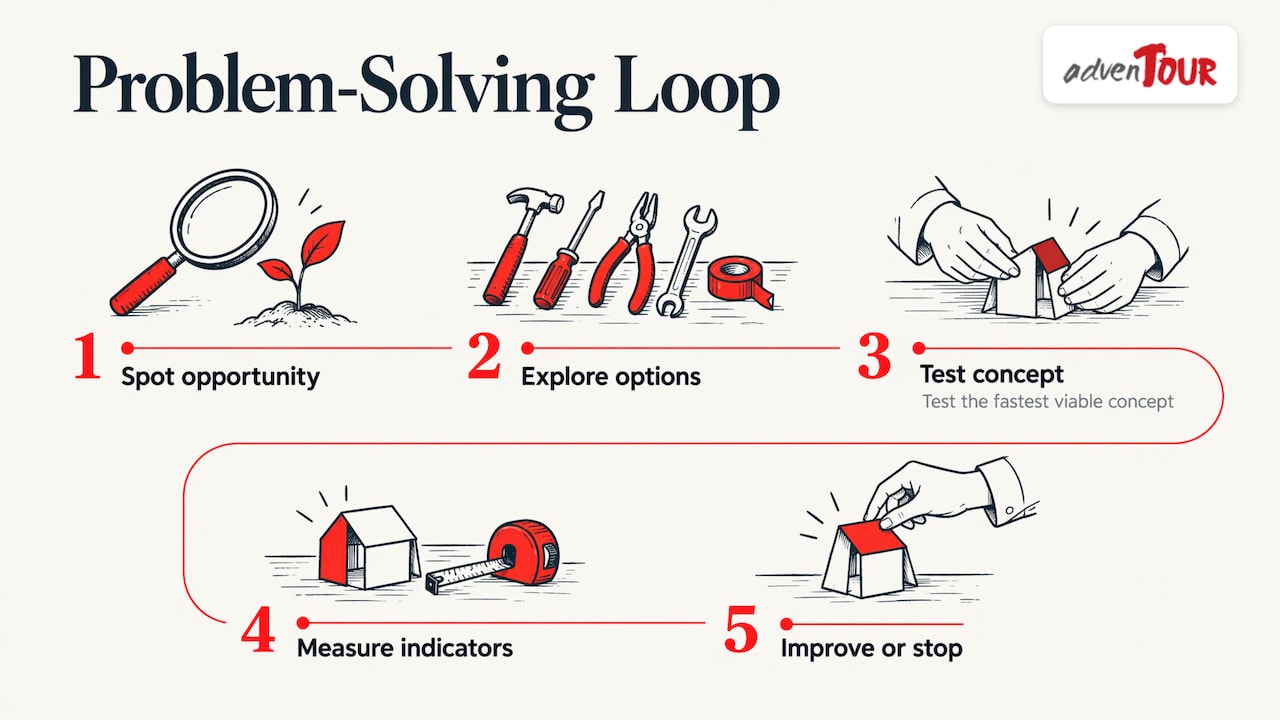
Treat it as a loop. The Singapore Government Developer Portal frames problem solving as an iterative loop: spot the opportunity, explore options, test the fastest viable concept, measure indicators, then improve or stop. A team that tests small and reviews often does not need to get the first answer right.
NUS ISS also reports a participant who applied a design approach within her own team to encourage colleagues to share ideas and propose solutions. That is the realistic scale of success: one practice, brought back to one team, repeated.
Our view on team problem solving
We see team problem solving as a skill set that has to be rehearsed, not a personality trait. Teams do not get better at it by being told to communicate more. They get better when they are put in a situation where communication decides the result, and then help each other see what happened.
That is why we build our programs around the objective you bring us. A team that struggles with handovers needs a different session from one that struggles with trust across offices. We scale each format for group size and budget, from budget-friendly formats to premium ones, and our facilitators run the session for experiential learning and skill transfer, not passive entertainment.
Our advice to HR leaders and event planners: choose one problem, choose one format, and decide what behavior you want to see back at work. Everything else follows from that.
Joshua
Plan a session with AdvenTOUR
We plan and run corporate team building in Singapore for local teams, regional meetings and large groups, with budget, quality and premium formats and programs customized to your goals. AdvenTOUR was recognized as one of Asia’s Top 10 Corporate Team Building Companies in 2023. Browse our quality team building programs, or start from the budget-friendly options if cost is the first constraint.
Tell us your group size, your goal and your budget, and we will shape the program around them. You can reach us through adventour.com.sg.
FAQ
What are collaborative problem-solving skills?
They are the abilities that let a group solve something none of its members could solve alone: building a shared understanding of the problem, taking appropriate action, and keeping the group organized. ACT describes them as a combination of problem solving, communication and behavior skills. Each can be practiced in a facilitated session.
How do you encourage team problem solving when a few people dominate?
Use silent methods. Brainwriting and Silent Circuit let everyone contribute before discussion starts, so ideas are judged on content rather than on who spoke first. Singapore’s Public Service Division notes that silent brainstorming levels the playing field for everyone to pitch in.
What problem-solving activities work for a large group?
Split the group into teams of about six and run the same task in parallel. Methods like 6-3-5 Brainwriting run table by table, and race or challenge formats scale by adding teams. We can plan large-group sessions in Singapore, including for regional meetings.
How much do corporate problem-solving activities cost in Singapore?
Our published prices run from $35 to $45 per person for budget formats such as Kinball, to $150 to $159 per person for DISC Personality Profiling. Quality formats like the Amazing Race sit at $65 to $78 per person. Prices were read from our site in October 2026, so check the program page for the current figure.
Sources
- Collaborative Problem Solving (NCES, PISA framework)
- Collaborative Problem Solving (ACT)
- Collaborative Problem Solving, Encouraging Innovation (Cambridge)
- Problem-Solving and Decision Making, Team Dynamics (George Washington University)
- How To Kickstart a Better Brainstorming Session (Public Service Division, Singapore)
- Transforming Workplaces through Active Learning for Problem Solving (NUS ISS)
- Enabling Loop for Solving Complex Problems (Singapore Government Developer Portal)
Recommended
- Creative Team Building Ideas for Small Groups That Inspire
- Team Building Programs for Every Team
- How to Choose Team Building Activities
- Leadership Team Activities That Build Real Skills in Singapore