
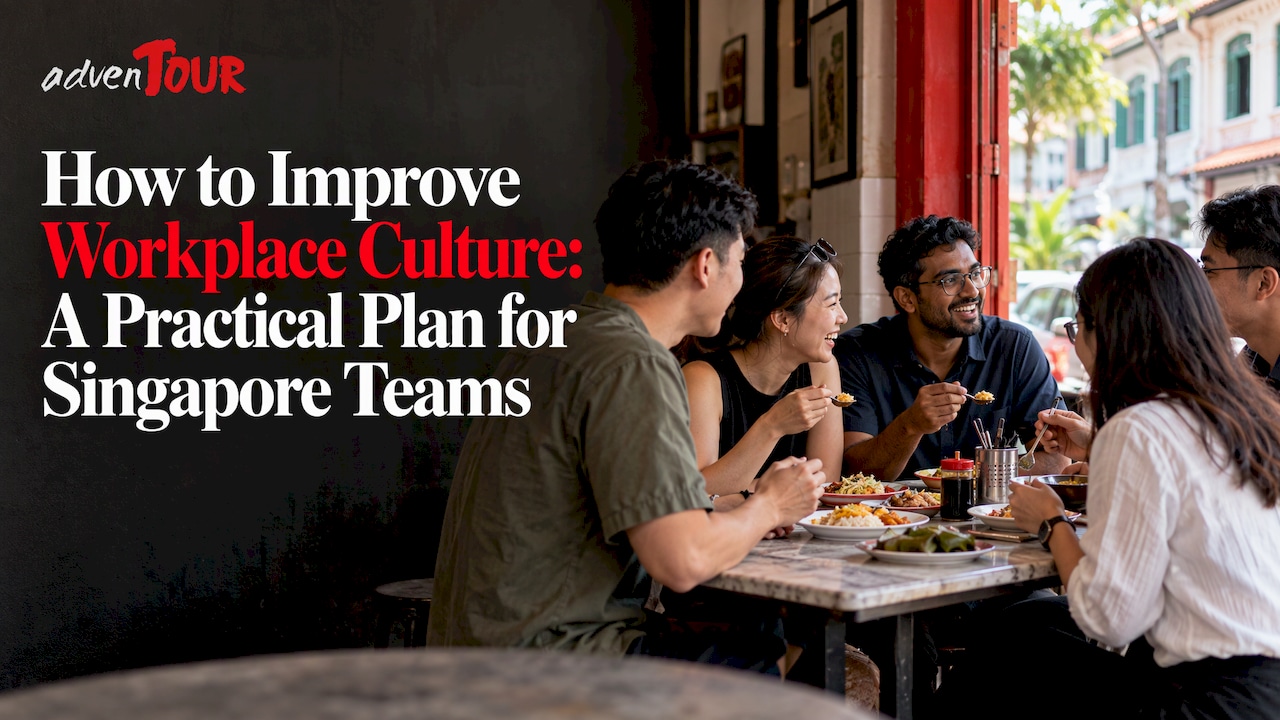
You improve workplace culture by changing what people experience every day: how leaders behave, how fairly people are treated, how well colleagues know each other, and how often the team practices its values together. Start with a diagnosis, fix the daily habits, then use well-designed shared experiences to make the new behaviours stick. We design and run those experiences for companies in Singapore, and this guide shows where they fit in the plan.
TL;DR
- Diagnose before you act: anonymous surveys, interviews and focus groups show which culture drivers need work.
- Culture is built through fair treatment, development, supportive supervisors and good colleague relationships, so leaders must model the values daily.
- Shared activities turn values into practice. Pick them by goal (communication, trust, collaboration), group size and budget.
- Multicultural, hybrid and large teams need mixed groupings and full participation by design.
- Re-measure after about 18 months and keep the routines going. One event is a starting point, not a programme.
Table of Contents
- Why culture is worth the effort in Singapore
- Step 1: Diagnose the culture you actually have
- Step 2: Fix the daily practices that carry culture
- Step 3: Use shared experiences to make values visible
- Make it work for large, hybrid and multicultural teams
- Measure it and keep it going
- Plan your team’s culture programme with us
- Our view on culture and team building
- FAQ
- Sources
Why culture is worth the effort in Singapore
The gap between being employed and being engaged is wide. In a June 2026 speech launching the Singapore Workplace Report, MOM noted that only 14% of Singapore employees reported being engaged at work, against 40% who rated their lives positively. Engagement is the part employers can influence.
Culture also shapes who stays. NTUC reported that in Randstad’s 2025 Workmonitor survey of 750 Singaporean workers, three in five said they would resign without a sense of belonging, and 21% had already left because their workplace lacked community.
The upside is measurable too. Ipsos’ Singapore employee-experience report found that 82% of employees who felt their culture was supportive would recommend their organisation. Among those who described their culture mostly in negative words, only 30% would. The same report found 68% of respondents described their workplace culture positively, so most teams are starting from a decent base and the job is to strengthen it.
An older academic study of Singaporean companies in the Journal of Managerial Psychology found that culture affects organisational processes and performance, which is why HR and management teams treat it as an operating matter, not a soft one.
Step 1: Diagnose the culture you actually have
Most culture efforts fail because they start with a solution. The Monetary Authority of Singapore’s 2026 information paper on culture says organisations should carry out a robust culture diagnosis to identify the relevant culture drivers before deciding what to change. The paper is written for financial institutions, but the logic applies to any employer.
A practical diagnosis for a company of any size has four parts:
- Anonymous survey. Boston University’s HR guidance suggests anonymous surveys that compare current culture with the ideal, plus 360-degree feedback on leadership impact.
- Interviews and focus groups. Gallup recommends culture audits that combine interviews, surveys and focus groups, and involving employees from different levels and functions in defining values and behaviours.
- Observation. Watch how meetings run, who speaks, how mistakes are handled and how new joiners are welcomed. Gallup also advises identifying the strengths worth keeping, rather than imposing a generic culture from the top.
- Inclusion check. SNEF recommends monitoring inclusivity across age, race, gender, religion, marital status and disability, and using surveys and exit interviews to see whether integration efforts work.
For a structured model, the University of Michigan’s OCAI framework compares current and preferred culture across six dimensions. The output you want is short: two or three specific gaps, such as “departments do not talk to each other” or “new hires feel like outsiders for six months”. Those gaps decide which activities make sense later.
Step 2: Fix the daily practices that carry culture
MOM’s June 2026 speech points to the conditions that help employees feel engaged, valued and supported: fair treatment, worker development, and good relationships with supervisors and colleagues. These are not events. They are habits, and they come first.
MOM’s Community Engagement Programme guide gives a concrete list for employers. Leaders should model organisational values, use ambassadors to champion inclusion, adopt fair hiring, objective rewards and equal training opportunities, and provide feedback channels with quick handling of grievances. The same guide says values such as respect and inclusiveness should be reinforced through everyday interactions and activities.
Translate that into routines your managers can run this quarter:
- Say the values as behaviours. “Respect” becomes “we share the agenda 24 hours ahead and everyone speaks once before anyone speaks twice.”
- Make feedback two-way. One channel for questions, one for grievances, with a stated response time.
- Spread development evenly. Check who actually gets training and stretch assignments.
- Reward on clear criteria. Publish what good looks like so recognition feels fair.
- Onboard on purpose. Pair every new joiner with a buddy from another team.
Great Place To Work Singapore’s 2024 report, which analysed the voices of more than 440,000 employees, recommends management integrity, engagement, wellbeing, leadership development and broader diversity, equity, inclusion and belonging efforts. Wellbeing and belonging come up again and again. If your team is stretched, how community supports wellness is a useful lens: people recover and perform better when they feel part of a group.
Deloitte’s model of culture change adds the sequencing: diagnose and validate the current culture, reframe the narrative, role-model and communicate new behaviours, then reinforce the new belief system. Activities belong in the last two stages, where people practise the behaviours together.
Step 3: Use shared experiences to make values visible
Values written on a wall do little. Values practised under mild pressure, with colleagues you do not normally work with, become memorable. This is where well-designed team building earns its place in a culture plan.
MOM’s guide suggests employers use festive celebrations, cross-cultural workshops, lunchtime talks, regular teambuilding, values-based induction and visits to places of worship, tailored to the organisation’s needs and size. SNEF similarly lists CSR, staff-development programmes, major-festival celebrations and lunch-and-learn sessions as bonding activities, with groupings that mix nationalities, ethnicities and departments.
The mixing point matters most. A culture activity that lets people sit with their usual lunch group has done little. Assign teams across departments, seniority and nationality, and the activity starts to build the connections that the diagnosis said were missing.
Match the activity to the gap
Use the gap from your diagnosis to choose. Our programmes are customisable to an organisation’s goals, and the table shows where each type typically fits. Prices are our published per-person rates.
| Culture gap | Programme | Published price per person |
|---|---|---|
| Silos, low energy, need quick bonding | Combat Skirmish Laser Tag | $37-$45 |
| Cross-team problem solving | App-based Amazing Race | $40-$55 |
| Trust and playfulness | Bloop Bubble Soccer | $36-$43 |
| Inclusive, low-skill entry for all ages | Kinball | $35-$45 |
| Collaboration under challenge | Running Man Challenge | $72-$82 |
| Understanding how colleagues communicate | Modified DISC Workshop | $70-$82 |
| Leadership thinking, innovation | Office Shark Tank | from $92 |
| Deep self-awareness and team dynamics | DISC Personality Profiling | $150-$159 |
| Cultural appreciation in a diverse team | Katong/Joo Chiat Cultural Food Immersion | $82-$98 |
| Working relationships and office dynamics | Office Dynamics Workshop | $80-$90 |
| Executive bonding and reward | Corporate Sailing Team Building | $125 |
A few notes on choosing well.
Communication and understanding. Profiling workshops give a team a shared vocabulary for how each person prefers to work, which makes feedback easier to give. Our DISC profiling workshops are built for this, and the Office Dynamics Workshop applies it to day-to-day working relationships.
Collaboration and problem solving. Races and hunts split people into mixed teams, set a clear goal and force quick decisions. Our Amazing Race formats range from an app-based version to a fuller facilitated one. The facilitated debrief is where the learning is transferred back to work: what did we do when we disagreed, and who spoke up?
Morale and energy. Active games such as laser tag, bubble soccer and Kinball lower the barrier to participation. People laugh together first and talk later, which helps teams where hierarchy makes conversation stiff.
Appreciating diversity. A cultural food immersion in Katong and Joo Chiat gives a multicultural team a shared story about the neighbourhood and each other, which supports the cross-cultural aims MOM and SNEF describe.
If you are comparing formats, our guides to classic team bonding activities and outdoor team building exercises go into more detail.
Budget: what the numbers look like
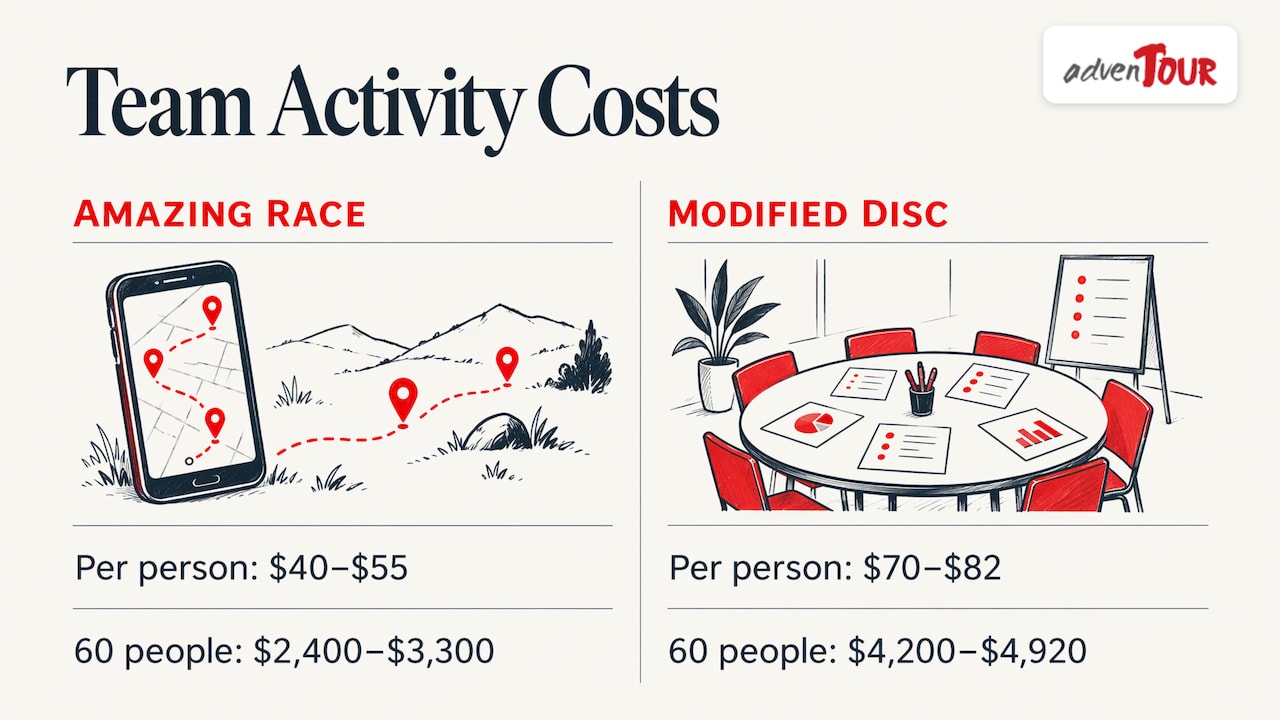
Because pricing is per person, you can estimate quickly. A 60-person team doing App-based Amazing Race at $40-$55 per person is $2,400-$3,300 before any add-ons. The same team doing Modified DISC Workshop at $70-$82 is $4,200-$4,920. A common approach is a lighter, lower-cost activity each quarter for energy and one deeper workshop each year for understanding. MOM’s guide itself recommends keeping initiatives non-resource-intensive and in proportion to organisational size, so a regular cadence of modest events can beat one lavish offsite.
If you already have a venue or a facilitator-free format in mind, our event rentals cover Bloop bubble suits at $28 per hour per ball, laser tag guns at $25-$33 per hour per gun, and mobile portable tentage at $95 per day per tent.
Make it work for large, hybrid and multicultural teams
Singapore workplaces are among the most diverse anywhere, and large groups and regional meetings add scale on top. Three principles from MOM and SNEF guidance apply directly.
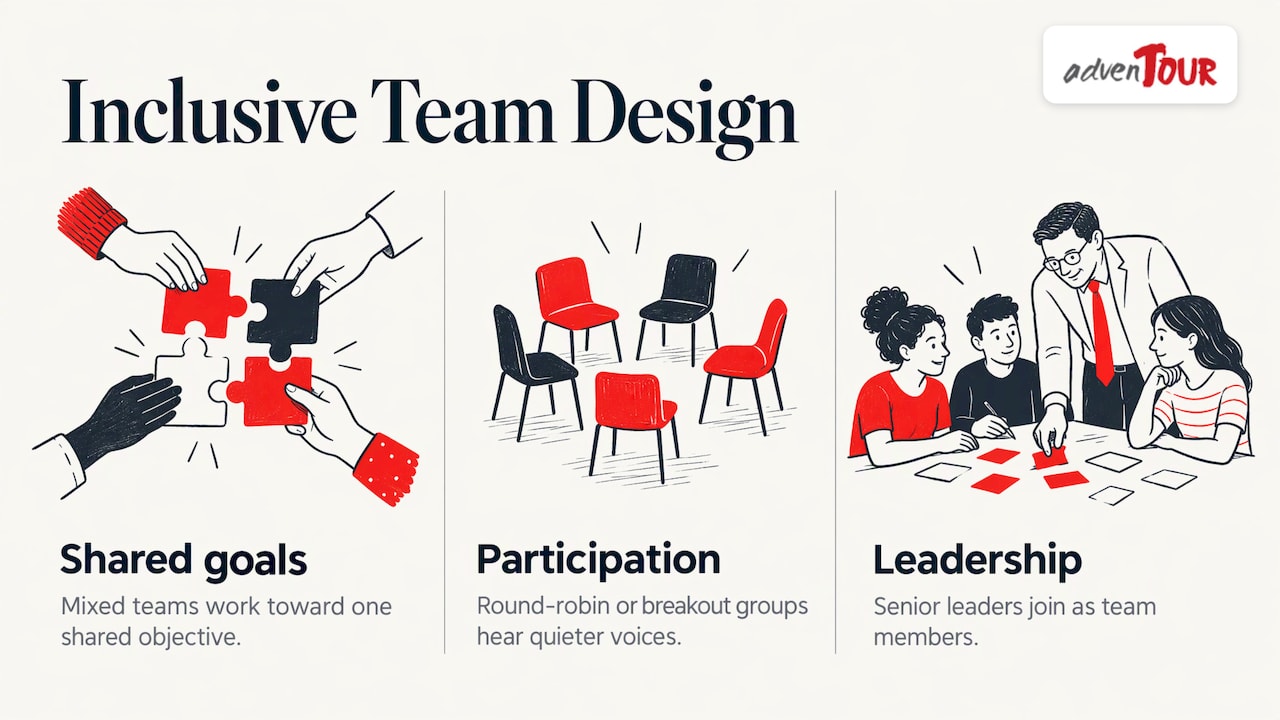
Build common goals and remove “us and them”. MOM’s Workplace Diversity Management Toolkit recommends common goals, removing distinctions between “us” and “them”, and communicating the benefits of inclusion. In an activity, that means mixed teams with one shared objective, not department against department.
Design for full participation. The same toolkit suggests inviting perspectives from different employee profiles and using round-robin discussion or breakout groups so quieter people are heard. Ask your facilitator to build these into debriefs, and choose formats where physical ability, language and seniority matter least.
Treat integration as a leadership job. SNEF says workforce integration requires sustained leadership action, not only adaptation by foreign employees. Have senior leaders take part in the activity as team members, not observers.
For large groups, our outdoor programmes for large corporate groups are scaled for group size and budget. For regional teams flying in for a meeting or conference, a half-day programme alongside the agenda lets people who rarely meet build rapport quickly. Our SG60 CSR programmes, which combine celebrating, giving back and connecting, suit visiting teams that want their time in Singapore to carry a community purpose; see the CSR initiatives page for the format.
Measure it and keep it going
Culture work without measurement turns into a yearly ritual. Boston University’s guidance recommends action plans and re-measurement after 18 months. Between those points, track a few simple signals:
- Pulse-survey scores for belonging, trust in leadership and fairness, asked the same way each time.
- Participation and follow-through: how many people attended, and how many acted on the commitments from the debrief.
- Retention and exit-interview themes, especially from newer joiners.
- Cross-team collaboration: how many projects now involve people from more than one department.
Deloitte’s change model implies that activities work when leaders visibly model the desired behaviours and systems reinforce them over time. So close every event with two or three commitments, assign owners, and review them at the next team meeting. MOM’s 2026 perspective that engagement is built deliberately through fair treatment, autonomy, development and healthy relationships tells you what to reinforce between events.
Plan your team’s culture programme with us
Our programmes are tailored to each client’s objectives, scalable for group size and budget, and led by experienced facilitators, with a focus on experiential learning and skill transfer rather than passive entertainment. We were recognised as one of Asia’s Top 10 Corporate Team Building Companies in 2023.
Tell us the gaps your diagnosis found, your headcount and your budget, and we will shape a programme around them. Browse the budget-friendly, quality and premium options, or contact us through our site.
Our view on culture and team building
Culture is what people do when nobody is watching, and teams only change what they do when they have practised something new together. That is why we design programmes around a specific outcome, whether it is communication, trust or collaboration, rather than around entertainment.
The best results we aim for come when a company treats an event as one step in a longer routine. Leaders take part, teams are mixed across departments, and the debrief turns what happened on the day into agreements about Monday morning.
Our range runs from budget-friendly games to premium profiling and sailing programmes because culture work looks different for a 20-person start-up and a regional MNC team. We customise each programme to the organisation’s goals, so what people experience connects to the behaviours the company wants to see.
Joshua
FAQ
What is the fastest way to improve workplace culture?
Start with a short anonymous survey and a few focus groups to find your two or three biggest gaps. Then pair one visible leadership habit, such as a regular two-way feedback session, with a shared team experience that mixes departments. Lasting change takes longer, so plan to re-measure after about 18 months.
What are good workplace culture activities for a mixed, multicultural team?
Choose formats where people are placed in mixed teams and where language, seniority and fitness matter little, such as an app-based race, Kinball or a cultural food immersion. MOM also suggests festive celebrations and cross-cultural workshops. Ask the facilitator to build in round-robin or breakout discussion so everyone contributes.
How much should we budget for a culture-focused team building event in Singapore?
Our budget-friendly programmes are priced from $35 to $55 per person, quality programmes from $65 to $90, and premium programmes from $80 to $159 per person depending on the format. Multiply by headcount for a first estimate, then add rentals or customisation if needed.
Can one team building event change our culture?
One event can start the change by giving people a shared experience and a common language. Culture shifts when leaders model the behaviours and systems such as feedback, rewards and development reinforce them. Pair the event with follow-up commitments and a review at your next team meeting.
Sources
- MOM: Speech at the launch of the Singapore Workplace Report 2026
- NTUC: Workers are leaving jobs over culture, not pay
- Ipsos: What Singapore thinks, feels and does at work
- Journal of Managerial Psychology: Corporate culture and organizational performance
- MAS: Culture capabilities for effective remediation and sustainable change
- Boston University HR: Organizational culture and climate study
- Gallup: Diagnosing a broken culture
- SNEF: OWP Starter Kit
- University of Michigan: Diagnosing and changing organizational culture
- MOM: Community Engagement Programme implementation guide
- MOM: Workplace Diversity Management Toolkit
- Great Place To Work Singapore: 2024 Singapore Insights Report
- Deloitte Insights: Catalyzing organizational culture change
- How Community Supports Your Wellness Journey
Recommended
- How to Reduce Workplace Stress: Practical Steps for Singapore Teams
- Team Building Event Ideas in Singapore
- Best Team Building Activities in Singapore
- Communication Workshops for Teams in Singapore: A Guide