
A corporate activity day is a half-day or full-day event where employees leave their desks to take part in a facilitated programme: a race, a workshop, a sport, a cultural trail or a community project. In Singapore, the activities we run for companies cost roughly $35 to $159 per person depending on format, and the right choice depends on your goal, your group size and your venue. This guide shows you how to pick a format, what to budget, and what to check before you book.
TL;DR
- Start with the outcome you want (bonding, communication, strategy thinking, giving back), then choose the format. The activity is the means, not the goal.
- Our published programmes run from $35-45 per person for budget formats to $150-159 per person for premium profiling workshops.
- Large groups and regional visitors do best with team-based formats that scale: races, laser tag, bubble soccer and trail-based games.
- Plan the logistics early: venue, transport, a wet-weather option and a clear timeline for the day.
- CSR can be built into the day, and the impact is easier to judge when you set objectives beforehand.
Table of Contents
- What a corporate activity day actually is
- Activity formats by goal
- What a corporate activity day costs in Singapore
- Choosing by group size and event type
- Planning checklist: venue, timing, transport and weather
- Adding CSR to your activity day
- Does it actually work? What the research says
- Our perspective
- Plan your day with AdvenTOUR
- FAQ
- Sources
What a corporate activity day actually is
The phrase covers a lot of ground. A team of twelve playing a scavenger hunt through Katong is a corporate activity day. So is a 300-person regional meeting that ends with an afternoon of bubble soccer and laser tag. What they share is a purpose beyond entertainment: people work with colleagues they do not usually work with, solve problems under light pressure and talk differently afterwards.
For HR leaders and event planners, the day usually serves one of four purposes:
- Bonding and morale, for example after a reorganisation, a busy season or a new hire wave.
- Communication and collaboration, where the activity is paired with a debrief that links what happened to daily work.
- Self-awareness and working styles, typically through a facilitated workshop.
- Community and CSR, where the team gives time to a cause as well as bonding with each other.
Our programmes focus on experiential learning and skill transfer rather than passive entertainment. That is the difference between a fun afternoon and a day your team refers back to in meetings the following month.
Activity formats by goal
Singapore gives you plenty of options, indoor and outdoor, and most can be customised to organisational goals. Here is how the main formats map to what you are trying to achieve.
High-energy, active formats
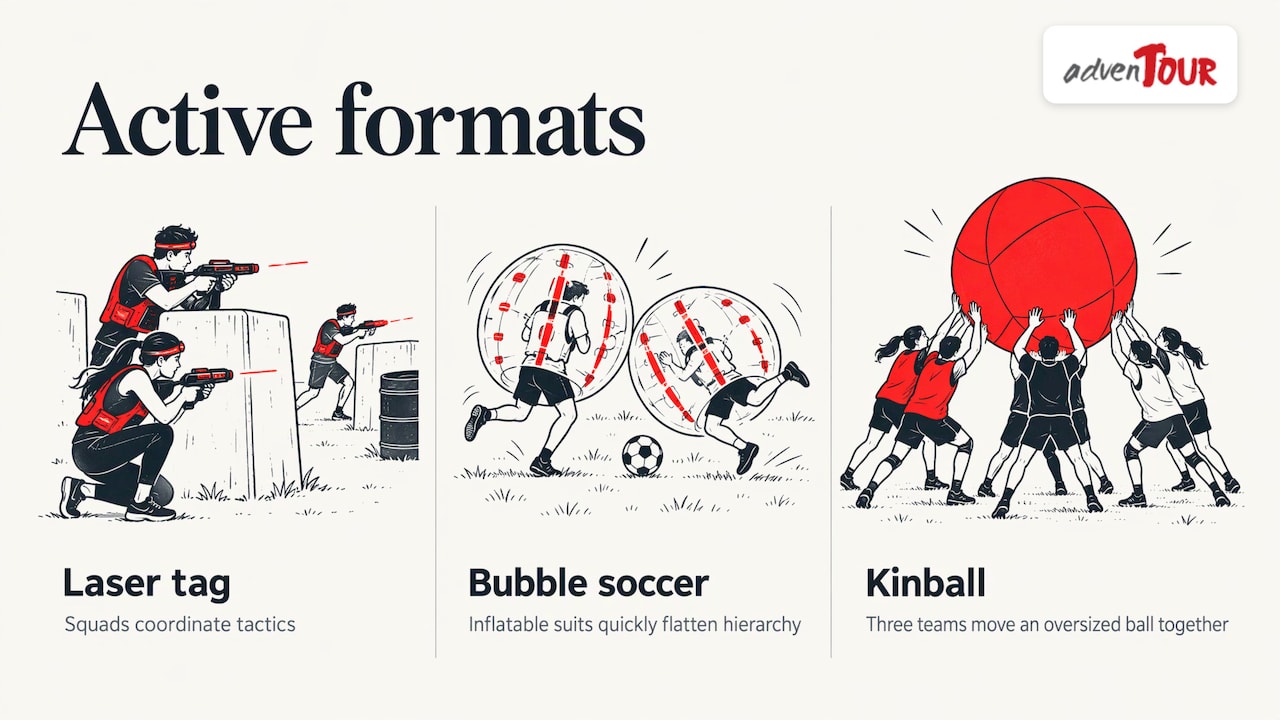
These suit teams that need to release tension and laugh together. Combat Skirmish laser tag splits people into squads that must coordinate tactics. Bloop bubble soccer has players in inflatable suits, which flattens hierarchy quickly because nobody looks senior while bouncing across a pitch. Kinball uses an oversized ball and requires all three teams to move together. If you want to bring the equipment to your own venue, we also offer event rentals for bubble suits, laser tag guns and portable tentage.
Exploration and race formats
Races and hunts reward planning, delegation and communication under time pressure. The app-based Amazing Race uses a phone app for clues and scoring. The Bicycle Scavenger Hunt adds cycling to the mix. Garden Odyssey is a race-style adventure around Gardens by the Bay, and the Running Man Challenge brings in game-show style tasks. Each of these works well for mixed-seniority groups because the tasks are unfamiliar to everyone.
Workshops and reflective formats
When the goal is better communication rather than pure fun, a facilitated workshop does more. Our Modified DISC Workshop and DISC Personality Profiling help people understand how colleagues prefer to work and talk. The Office Dynamics Workshop looks at team interactions directly, and Office Shark Tank has teams pitch ideas under pressure, which suits leadership and strategy groups.
Cultural and premium experiences
The Katong/Joo Chiat Cultural Food Immersion turns a neighbourhood into a shared experience, which works well for visiting regional teams who want a taste of Singapore. Corporate Sailing Team Building suits executive offsites where the group is small and the budget is higher.
| Goal | Formats that fit | Typical mood |
|---|---|---|
| Quick bonding, high energy | Laser tag, bubble soccer, Kinball | Loud, competitive, playful |
| Problem-solving under time pressure | Amazing Race, Garden Odyssey, Running Man Challenge | Strategic, collaborative |
| Communication and self-awareness | Modified DISC, DISC Profiling, Office Dynamics | Reflective, conversational |
| Leadership and strategy | Office Shark Tank, Corporate Sailing | Focused, executive |
| Welcoming visitors | Cultural Food Immersion, Bicycle Scavenger Hunt | Relaxed, social |
For more ideas, our pages on team building event ideas and classic team bonding activities go deeper on individual formats.
What a corporate activity day costs in Singapore
Our programmes are priced per participant, so your total scales with headcount. These are the prices published on our site, grouped by tier. Final quotes depend on group size, venue, date and customisation.
| Tier | Programme | Price per person |
|---|---|---|
| Budget-friendly | Kinball | $35-45 |
| Budget-friendly | Bloop Bubble Soccer | $36-43 |
| Budget-friendly | Combat Skirmish Laser Tag | $37-45 |
| Budget-friendly | App-based Amazing Race | $40-55 |
| Budget-friendly | Bicycle Scavenger Hunt | $45-55 |
| Quality | Amazing Race | $65-78 |
| Quality | Garden Odyssey | $68-90 |
| Quality | Laser Clay Shooting | from $69 |
| Quality | Modified DISC Workshop | $70-82 |
| Quality | Running Man Challenge | $72-82 |
| Premium | Office Dynamics Workshop | $80-90 |
| Premium | Katong/Joo Chiat Cultural Food Immersion | $82-98 |
| Premium | Office Shark Tank | from $92 |
| Premium | Corporate Sailing Team Building | $125 |
| Premium | DISC Personality Profiling | $150-159 |
See the full details on our budget-friendly, quality and premium programme pages.
Rentals are priced differently: bubble suits are $28 per hour per ball, laser tag guns are $25-33 per hour per gun, and mobile portable tentage is $95 per day per tent.
What moves the budget
- Headcount. Per-person pricing means the group size is the biggest driver, and some formats scale better than others.
- Format tier. Equipment-led games sit at the lower end; facilitated workshops and specialised venues sit higher.
- Customisation. Tailoring a programme to your objectives, branding or theme can change the scope.
- Add-ons. Tentage for shade, catering and transport are separate considerations.
A quick worked example: a team of 40 doing the Combat Skirmish Laser Tag at $37-45 per person is a programme cost of $1,480 to $1,800. The same 40 people on a DISC Personality Profiling day at $150-159 is $6,000 to $6,360. The second buys a deeper, discussion-led outcome, the first buys energy and togetherness. Many companies mix both across a year.
Choosing by group size and event type
Small teams (under 20)
Small teams can use intimate formats: a cultural food immersion, a sailing session, a DISC workshop or a bicycle hunt. Everyone participates, and the facilitator can tailor the debrief to the actual team.
Mid-sized departments (20 to 100)
This is where races and sports formats shine. Teams of five to eight compete, with scoring and a final reveal. The social mix improves when you assign teams across functions rather than letting people pick.
Large groups and company-wide days
For big groups, you need formats that run in parallel without long waiting times. Laser tag, bubble soccer and race formats can run multiple squads at once, and a Family Day carnival suits whole-company events with families. We have a dedicated page on outdoor activities for large corporate groups, and our Family Day Carnival covers the carnival format.
Regional meetings and conferences
Global MNCs hosting meetings in Singapore often have one free afternoon or an evening. Choose something that needs no preparation, works across languages and shows off the city, such as a trail-based race or a food immersion. Formats built around a single, well-structured booking keep things simple for the organiser. Water-based days elsewhere in the world, such as team surf days on Oahu, follow the same logic: one booking, one facilitator-led schedule, and an activity that levels the room because everyone is a beginner.
Sports-oriented days
If you want a more athletic angle, our guide on corporate sports days and employee engagement covers how to structure it so that less sporty colleagues stay involved.
Planning checklist: venue, timing, transport and weather
- Define the objective in one sentence. For example: help two merged teams communicate better. Share it with your provider so the programme and debrief reflect it.
- Set the headcount and mix. Include mobility needs, dietary needs and any colleagues who may not want physical contact sports. Good programmes offer roles for everyone.
- Pick the venue type. Outdoor parks and gardens suit races and active games. Indoor spaces suit workshops and are not affected by weather. Some formats can come to your office or hotel with portable equipment.
- Choose timing carefully. Morning sessions beat the afternoon heat, and a late afternoon start can flow into dinner. Avoid clashing with peak workload periods and school holidays, when families and venues are stretched.
- Handle transport. Choose a meeting point near an MRT station when you can, and brief staff on the route. For multi-site races, tell participants what to bring and what to wear.
- Prepare for weather. Singapore weather can turn quickly, so agree a wet-weather option in advance: sheltered tentage, an indoor alternative or a reschedule policy. Our tentage rental is built for this.
- Plan the debrief. Fifteen to thirty minutes at the end, linking the activity to real work, is where the learning happens.
- Book early. Popular dates fill up, especially around year-end. Ask your provider for the current booking lead time rather than assuming.
The Singapore corporate team building planning pages on our site give additional ideas for sequencing a day.
Adding CSR to your activity day
Many companies now fold community work into the day, either as the main event or as a second half. The options are wide: packing food hampers, visiting senior care centres, collecting donations, or running a build-and-donate activity. Our CSR team building and SG60 CSR programmes are designed for this, and our corporate volunteering guide walks through the planning.
Public reporting shows what this looks like in practice. Wing Tai’s 2025 Sustainability Report describes Singapore outreach in which staff engaged over 70 elderly at a day care centre, collected over 2,000 food items benefiting 100 families and delivered hampers to 62 beneficiaries.
To judge impact, set your objectives before the day. PHINEO’s corporate volunteering guidebook advises against exaggerated expectations about measuring results and suggests focusing on the objectives most relevant to the people the activity serves. The same guidebook notes that action days offer a change of pace from daily work, support team building and can win over employees who have been less engaged. Practical measures include participation numbers, items or hours contributed, beneficiary feedback and a short staff pulse survey afterwards.
Does it actually work? What the research says
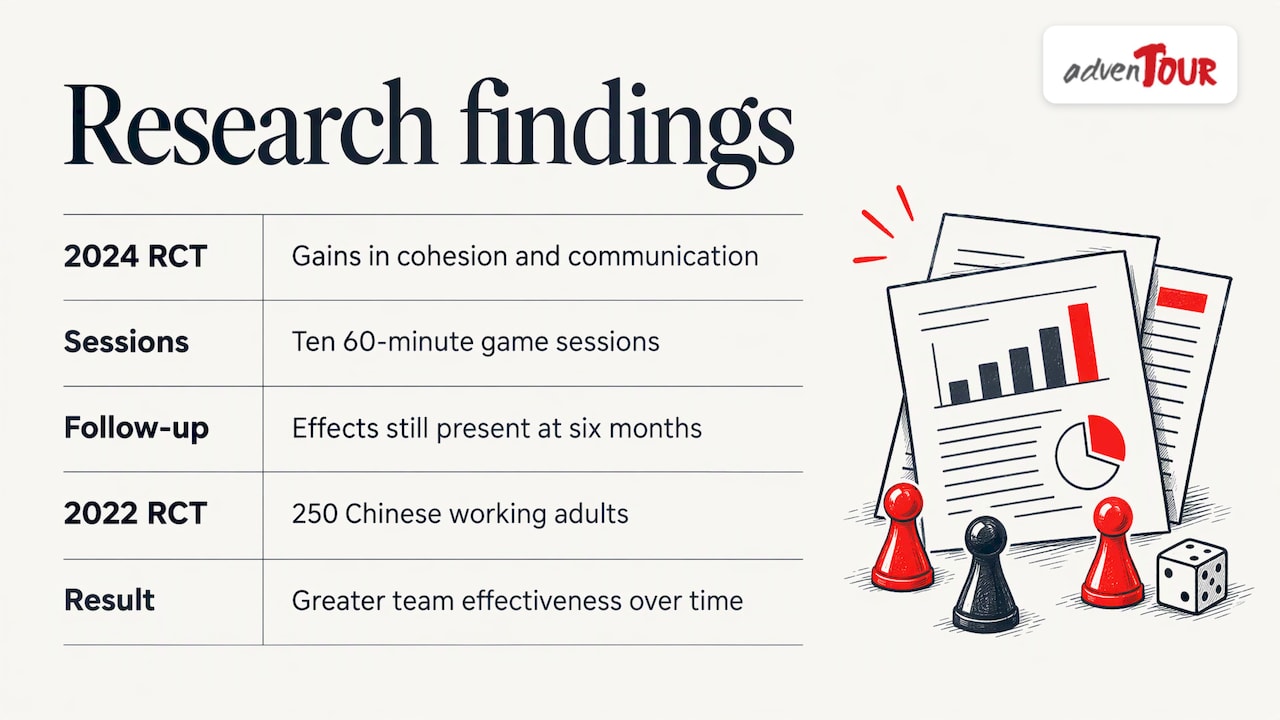
Team activities are only worth the budget if they change how people work together. Recent academic studies are encouraging. A 2024 randomized controlled trial found significant gains in group cohesion and communication quality after ten 60-minute team-building game sessions, with effects still present at six-month follow-up. A 2022 randomized controlled trial in Frontiers in Psychiatry with 250 Chinese working adults found that a gamification-based intervention produced greater team effectiveness over time than the comparison conditions, with group cohesion explaining the improvement.
The practical takeaway: the effect comes from structured, repeated, goal-linked activity, not a single random outing. That is why we build debriefs into our programmes and encourage clients to follow a big day with smaller follow-ups.
Our perspective
We have run corporate days for everyone from lean teams on a tight budget to global MNCs flying in leaders for a regional meeting. The pattern is consistent: the days that work are the ones where the format matches the goal.
A common mistake is choosing the activity first and the objective second. We start the other way round. If the issue is communication between departments, we point toward a facilitated workshop or a race that forces cross-team coordination. If the issue is morale, we lean toward high-energy formats where people laugh together.
We believe in tailored programmes that scale to group size and budget, delivered by experienced facilitators, with an eye on measurable outcomes in engagement, collaboration and communication. Being named one of Asia’s Top 10 Corporate Team Building Companies in 2023 reflects that focus, and we keep it in mind with every brief.
Our advice: choose the tier that fits your budget, customise the details, and always schedule the debrief. Budget-friendly programmes can deliver real bonding when they are well facilitated, and premium programmes go deeper when the goal is behaviour change.
Joshua
Plan your day with AdvenTOUR
We design and run corporate activity days across Singapore, from budget-friendly games to premium workshops, CSR programmes and large-group events. Tell us your headcount, goal and preferred date, and we will recommend a format and quote it per person.
Browse the full range of programmes or start with our reviews and case studies to see how other organisations used their days.
FAQ
How long should a corporate activity day be?
Most formats fit a half day of about three to four hours, including briefing and debrief. A full day suits offsites that combine an activity with meetings, a meal and a CSR element. Tell us your schedule and we will fit the programme around it.
How much should we budget per person?
Our published programmes range from $35-45 per person for budget formats such as Kinball to $150-159 per person for DISC Personality Profiling. Quality programmes sit in between, for example Amazing Race at $65-78. Your final quote depends on group size, date and customisation.
Can we run an activity day for a very large group?
Yes. Formats like laser tag, bubble soccer, races and carnival-style days run multiple teams in parallel, so large groups stay active rather than waiting. We can also supply rentals such as tentage for shade and shelter.
Can we combine team building with CSR?
Yes. Many clients split the day between a bonding activity and a community project, or run a CSR-themed programme as the whole event. Setting objectives beforehand makes the community impact easier to review afterwards.
What if it rains?
Agree a wet-weather plan when you book. Options include sheltered tentage, an indoor workshop format or a backup date. Your planner can confirm which option suits your chosen programme.
Sources
- Effects of a Team-Building Game Intervention on Group Cohesion, Game Nexus 2024
- Gamification-based intervention for enhancing team effectiveness, Frontiers in Psychiatry 2022
- Wing Tai Sustainability Report 2025
- PHINEO Corporate Volunteering Guidebook
- Team surf days on Oahu
Recommended
- Corporate Volunteering in Singapore: A Practical Guide
- Corporate Event Planning Singapore
- Team Building Costs in Singapore: 2026 Pricing Guide
- The Complete Guide to Planning a Corporate Event in Singapore