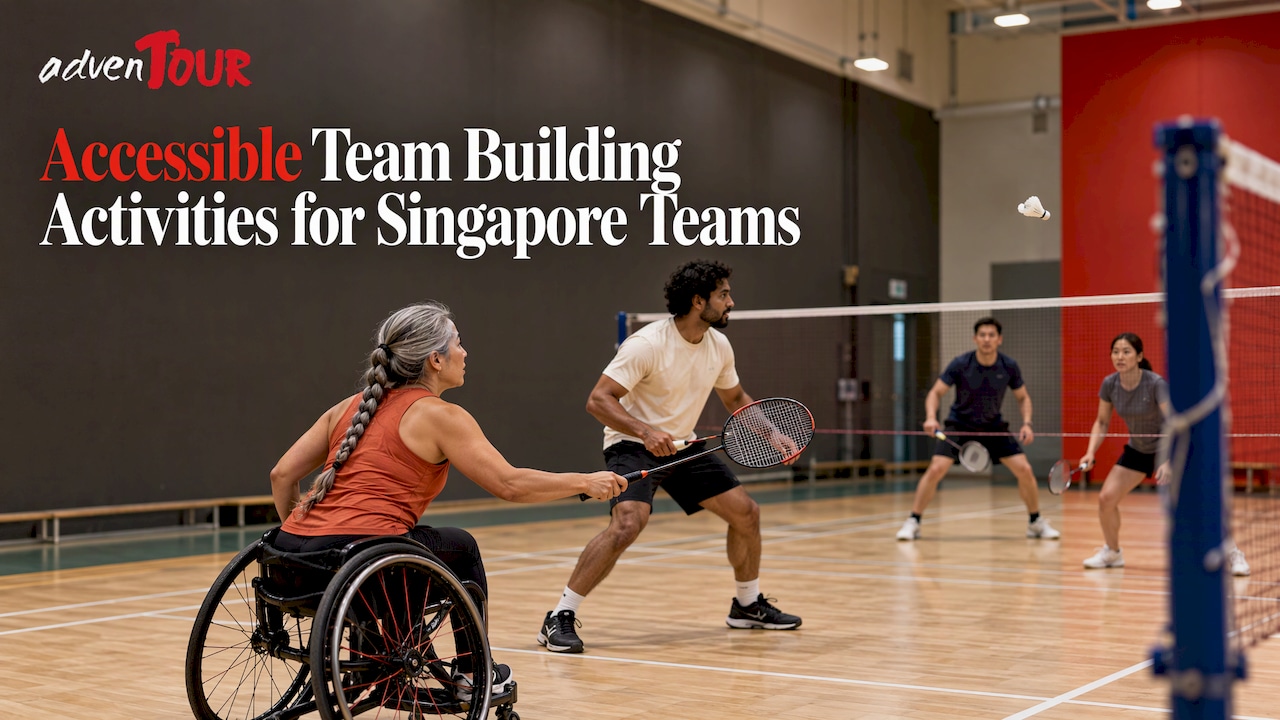
An accessible team building activity is one where every person on your team can take part in the same core experience, whatever their mobility, vision, hearing, energy level or comfort with noise and crowds. You get there by choosing formats that flex (races, workshops, food trails, strategy games), checking the venue before you book, and giving people more than one way to contribute. We design and run customised programs in Singapore, so this guide is written for the HR leads, event planners and regional meeting hosts who have to make the choice.
Key Takeaways
- Accessibility is decided at the planning stage: venue access, communication format and the roles inside the activity matter more than the activity’s name.
- Formats with several roles (navigator, strategist, scribe, presenter, runner) let people with different abilities contribute equally, and they scale from 15 people to several hundred.
- Programs on our budget tier run from $35 to $55 per person, so inclusive does not have to mean premium-priced.
- Brief your provider on access needs before the design is fixed, not after the invitations go out.
- Add a CSR element when you want the day to carry meaning beyond bonding.
Table of Contents
- What makes a team building activity accessible
- Singapore’s accessibility standards and your venue
- Activity formats that flex to different abilities
- Short and low-prep activities
- Planning an inclusive event step by step
- Choosing by budget, group size and event type
- Adding a CSR element
- Our point of view
- Plan your accessible team event with us
- FAQ
- Sources
What makes a team building activity accessible
Most teams think first of wheelchair access. It is the right starting point, but it is only one part of the picture.
Australia’s government guidance on hosting accessible in-person events lists an accessible reception, stage ramps, accessible toilets, hearing loops and a PA system for events of 16 or more people. It also notes that group activities built on visual information can be adapted by turning them into discussion activities, making them physical, or circulating the material early in an accessible form. The advice comes from Australia, but the logic applies to any corporate event.
A UK consultancy’s guide to making team activities more inclusive (September 2023) goes further. It recommends accessible parking near the entrance, large easy-to-read signage, varied seating (chairs, bean bags, standing and seated tables), wide aisles, live captioning or sign interpreters where needed, and several ways to ask questions, such as online polls. It also points to sensory details: noisy hand dryers, lockable gender-neutral toilets with room for a wheelchair, and plain-language instructions all decide who can really take part.
Put together, an accessible activity has four layers:
- Physical access: step-free routes, seating, toilets, shade, rest points.
- Sensory comfort: controlled noise, no strobing or harsh lighting, quiet space to step away.
- Communication: instructions in writing and aloud, captions where needed, material shared in advance.
- Participation: a role for every person that does not depend on running fast, seeing a screen or speaking loudest.
Singapore’s accessibility standards and your venue
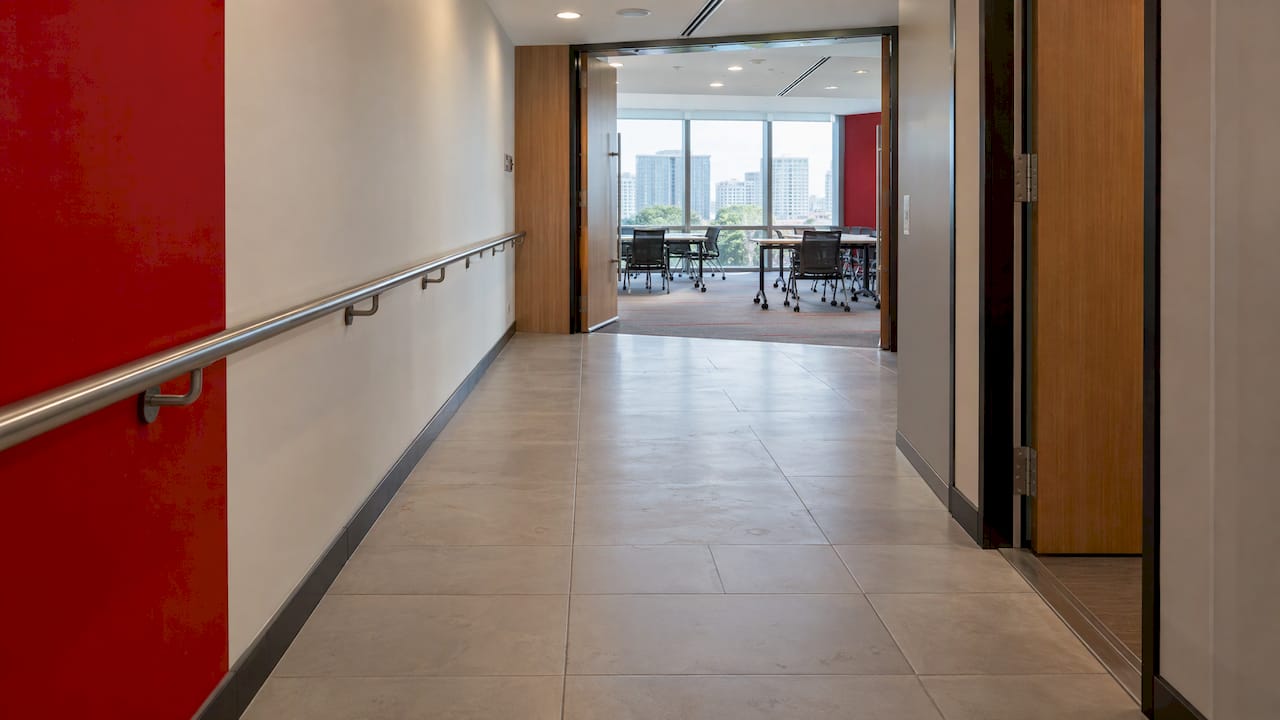
In Singapore, the Building and Construction Authority publishes the Code on Accessibility in the Built Environment, which sets barrier-free design standards for buildings. The 2025 edition is the latest, and the page was last updated in March 2026. For a planner, this means many modern hotels, conference venues and public buildings in Singapore are designed with step-free routes and accessible facilities. That is a good baseline, though it does not tell you whether a specific meeting room, outdoor route or activity space suits your group.
So walk the route in your head, from MRT station or drop-off point to the activity space, the toilets, the refreshment area and back. Ask the venue three questions: is the whole route step-free, where are the accessible toilets, and is there a quiet room? For outdoor programs, add shade, sheltered waiting areas and the distance between stations.
If you plan to hire people with disabilities or already work with them, SG Enable’s employer pages describe the grants and support available for inclusive employment in Singapore. They are useful background when you set your team’s overall inclusion goals.
Activity formats that flex to different abilities
The best accessible formats share one trait: the goal is collaboration, and the physical or sensory challenge is adjustable. Here is how common formats compare.
| Format | Why it flexes | Adaptation to plan |
|---|---|---|
| Amazing Race-style challenge | Many roles: navigator, puzzle solver, photographer, team captain | Short, step-free routes; puzzle stations that rely on thinking rather than speed |
| Cultural food immersion | Seated tastings, conversation-led, paced by the group | Check dietary needs and route length between stops |
| Workshops (personality profiling, office dynamics) | Discussion-based, seated, quiet | Share materials early; offer written and spoken formats |
| Strategy and pitch games | Rewards ideas over movement | Mixed-ability teams; visual timers rather than rapid countdowns |
| Modified sports | Rules can be changed so all abilities play together | Adjust distances, equipment and roles |
Race and hunt formats
An app-based or on-foot race works well because you control the course. Plan a route with no stairs or steep slopes, mix puzzle tasks with movement tasks, and make sure every team has a role that does not need speed. Our App-based Amazing Race is priced at $40 to $55 per person, and the classic Amazing Race is $65 to $78 per person. Because the format is built from stations and tasks, it can be shaped around your group.
Escape-room style games
A European project on inclusive educational escape games, ERSE, gives a practical checklist: passages at least 1 metre wide with no steps, clues that do not require climbing or crawling, accessible-height shelves, quiet neutral music, no strobe or extreme lighting, and visual timers instead of fast countdowns. It also advises flagging any task that not everyone can do in advance, so teams can value complementary strengths. The same checklist is a good test for any puzzle-based team activity you run.
Modified sports and adaptive play
Sports can be inclusive when the rules are adapted. In Singapore, the Agency for Integrated Care and Sport Singapore developed a toolkit with step-by-step modifications for 14 sports, including floorball and badminton, divided into three categories for different cognitive and physical abilities, including wheelchair users, as CNA reported in December 2023. The toolkit was designed for seniors, but the principle transfers: change the rules, not the people. For more ideas on how adults set up mixed-ability games, see these inclusive pickup games, and for how handicap systems keep play fair, read about adaptive play formats.
If your team wants something active, a format like Kinball ($35 to $45 per person) or Bloop Bubble Soccer ($36 to $43 per person) can be paced and structured with your group’s needs in mind, with rules and team sizes set during the brief.
Workshops and seated formats
When mobility or stamina varies widely, a facilitated workshop is the simplest inclusive choice. Our Modified DISC Workshop is $70 to $82 per person, and the Office Dynamics Workshop is $80 to $90 per person on the premium programs page. DISC Personality Profiling is $150 to $159 per person. These help teams understand different communication styles, which is the core of inclusion at work.
The Katong/Joo Chiat Cultural Food Immersion, at $82 to $98 per person, is a seated, conversation-led way to bond over local heritage, and Office Shark Tank, from $92 per person, rewards ideas and presentation rather than athletics.
Short and low-prep activities
Sometimes you do not need a full program. For a 5 to 15 minute opener inside a meeting, quick formats such as Two Truths and a Lie, Hot Seat or sharing a meme about the project work for hybrid and remote colleagues too. A Singapore HR content hub describes these five-minute, no-prep formats and suggests splitting groups above 20 into breakout rooms.
These openers are helpful as warm-ups. For a team that needs a real shift in how it works together, a facilitated program with a debrief delivers more, because the learning transfers back to work.
Planning an inclusive event step by step
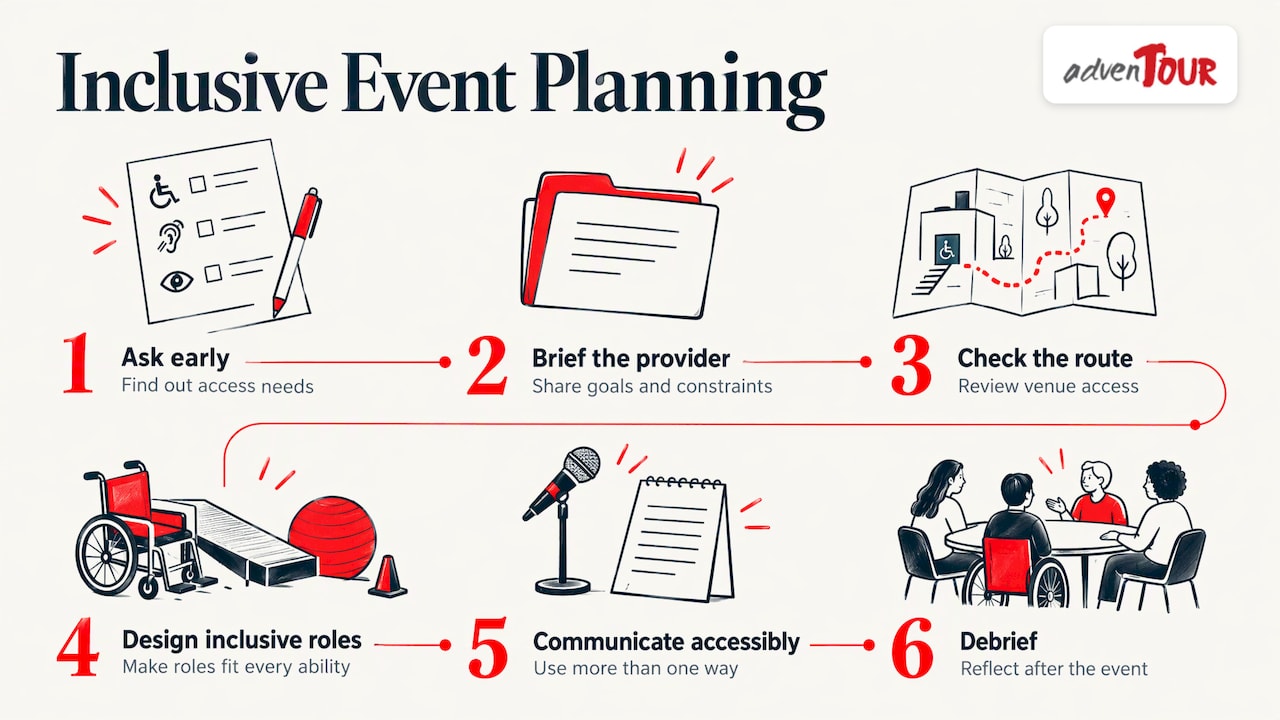
1. Ask about access needs early
Send a short, private form with the invitation. Ask what would help, not what is “wrong”: step-free access, seating, captioning, dietary needs, quiet space, a preferred way to receive instructions. Make it optional and tell people who sees the answers.
2. Brief the provider on goals and constraints
Tell your provider the objective (communication, cohesion after a merger, regional onboarding), the group size, the budget and the access needs. Our programs are customised to each client’s objectives and scalable for group size and budget, and the brief is where that customisation starts.
3. Check the venue, then the route
Walk through the venue checklist above. For outdoor activities, check weather cover. Our mobile portable tentage is available at $95 per day per tent for shade and shelter at outdoor events.
4. Design roles for every ability
Every team needs a mix of thinking, talking, moving and organising roles. Rotate them between rounds so nobody is stuck on the sidelines.
5. Communicate in more than one way
Give instructions aloud and in writing. Share the schedule beforehand. Use visual timers. Offer several ways to ask questions, such as a poll or a note to the facilitator.
6. Debrief
End with a short facilitated reflection: what helped the team, what got in the way, what will you do differently on Monday. This is where the activity turns into skill transfer rather than passive entertainment.
Choosing by budget, group size and event type
Accessible does not need to cost more. Our published per-person prices (one-off) give a guide:
| Tier | Examples | Price per person |
|---|---|---|
| Budget-friendly | Kinball, Bloop Bubble Soccer, App-based Amazing Race, Bicycle Scavenger Hunt | $35 to $55 |
| Quality | Amazing Race, Garden Odyssey, Modified DISC Workshop, Running Man Challenge | $65 to $90 |
| Premium | Office Shark Tank, Cultural Food Immersion, Office Dynamics Workshop, Corporate Sailing | $80 to $159 |
For large groups and regional meetings, race and rally formats scale easily by adding teams and stations. For executive offsites, workshop and strategy formats give depth. For teams in conflict or with low cohesion, pick formats that mix people, give each a distinct role and end with a debrief; avoid head-to-head competition that deepens divides. Our team building programs for different kinds of teams page shows how formats map to team types.
Adding a CSR element
Many Singapore companies want their team day to give something back. A CSR component also suits inclusion well, since people contribute in different ways: assembling packs, writing cards, planning, presenting. Our SG60 CSR programs combine celebration, giving back and connection for companies based in or visiting Singapore.
Our point of view
We see inclusion as a design problem, not a checklist added at the end. The question we start with is what your team needs to achieve, and then we shape the format so that everyone can contribute to it.
That is why we favour experiential learning over passive entertainment. An activity where only the fastest or loudest people shine teaches the team very little. An activity with several roles, clear instructions in more than one form and a proper debrief teaches a team to use all of its strengths.
Our programs are customised to your objectives and scaled to your group size and budget, from budget-friendly races and games to premium workshops and offsites. Start with the brief, tell us who is on your team and what the day should achieve, and build from there.
Joshua
Plan your accessible team event with us
We plan and run team building in Singapore for companies, MNCs and regional meetings, from budget-friendly games to premium offsites and CSR days. Browse the budget-friendly programs, the quality programs or the premium programs, then tell us your team’s needs and objectives so we can shape the day around them.
Visit AdvenTOUR to start your brief.
FAQ
What is the most inclusive type of team building activity?
Formats with many roles and adjustable difficulty are the most inclusive: races with puzzle and movement tasks, facilitated workshops and food trails. They let people contribute through thinking, communication or movement. The key is a design where no single ability decides the result.
How do I find out what my team needs without singling people out?
Send every participant the same short, optional form with the invitation, covering access, seating, dietary needs, communication preferences and quiet space. Say who will see the answers. Share the program in advance so people can raise concerns privately.
Can large groups and regional meetings run accessible team building?
Yes. Station-based and race-style formats scale by adding teams, and workshops can run in parallel rooms. Official guidance suggests extra venue features such as hearing loops and a PA system for events of 16 or more people, so confirm them with the venue.
How much does accessible team building cost in Singapore?
It depends on format and group size, not on accessibility itself. Our published per-person prices start at $35 for budget-friendly games and range up to $159 for premium profiling workshops. Tell us your headcount and budget and we will shape a program to fit.
Sources
- Hosting accessible and inclusive in-person meetings and events, includeability.gov.au
- Making events and team activities more inclusive, LCP
- Code on Accessibility in the Built Environment, BCA
- How to develop an inclusive and accessible educational escape game, ERSE
- Seniors play modified versions of sports, CNA
- 5 Minute Team Building, Glints TalentHub
- Inclusive Pickup Games
- Handicap Pickleball League: Fair Formats, Adaptive Play
Recommended
- Best Team Building Activities in Singapore
- Indoor Team Building Singapore
- 3 Best Outdoor Team Building Activities in Singapore for Large Corporate Groups
- Top 10 Classic Team Bonding Activities Ideas to Engage Employees