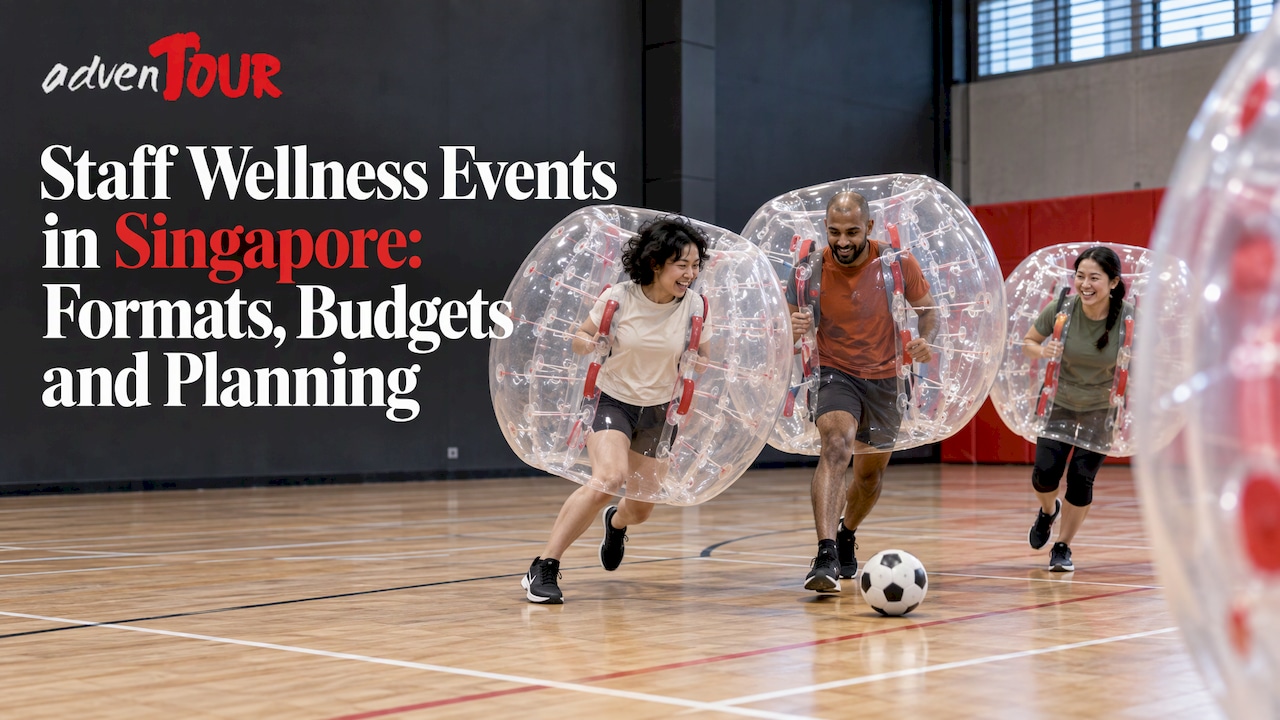
The best staff wellness events in Singapore combine movement, social connection and a clear purpose, are open to every employee whatever their shift or role, and are followed by a visible response to what staff say afterwards. Active team formats such as laser tag, bubble soccer, a city-wide Amazing Race or a DISC workshop suit this brief, and they are priced per person, so you can fit them to the headcount and the budget. We design and run these programs for companies in Singapore, and this guide shows how to choose, budget and plan one that people actually attend.
Key Takeaways
- Stress is a live issue in Singapore: 53% of surveyed workers reported moderate-to-high daily stress in 2025, which is why a dedicated wellness event is worth planning well.
- Match the format to the goal: movement and play for energy and bonding, workshops for communication, cultural or CSR formats for connection and purpose.
- Our published per-person prices run from $35 to $159 depending on format, so you can plan a budget tier before you brief anyone.
- Design for access first: timing, language, mobility and shift patterns decide participation more than the activity itself.
- Close the loop. Ask, act and tell staff what changed, or the event is remembered as a one-off.
Table of Contents
- What counts as a staff wellness event
- Why the need is real in Singapore
- Choose the format by the goal
- Set a budget by tier
- Design for everyone, not the most active third
- How to plan the event, step by step
- Large groups, regional meetings and CSR
- Measure what matters and tell staff what changed
- Our approach to staff wellness events
- Our perspective
- FAQ
- Sources
What counts as a staff wellness event
A staff wellness event is a planned activity that supports how employees feel at work: physical activity, stress and mental wellbeing, financial awareness, or social connection. In practice, companies in Singapore run a mix. Think a wellness week with talks and challenges, a half-day outdoor session, an offsite for a department, or a CSR afternoon where colleagues volunteer together.
The label “workplace wellness event” covers the same ground. What differs is the weight each event puts on three things: the body (movement), the mind (stress, awareness, reflection) and the team (belonging and trust). The strongest events touch at least two.
That matters because the social side drives results. The USC WorkWell Center notes that wellness challenges build social connection and belonging through shared experiences and team support, and that employees join more readily when they sense strong support for health from their workplace. A team event delivers both at once: people move, laugh and solve problems with colleagues they may rarely work beside.
Why the need is real in Singapore
ManpowerGroup’s Singapore Global Talent Barometer, based on 507 workers surveyed between 14 March and 11 April 2025, found that 53% reported moderate-to-high daily stress, with Gen Z highest at 62%. The same report put its Well-Being index at 63% and Job Satisfaction at 55%.
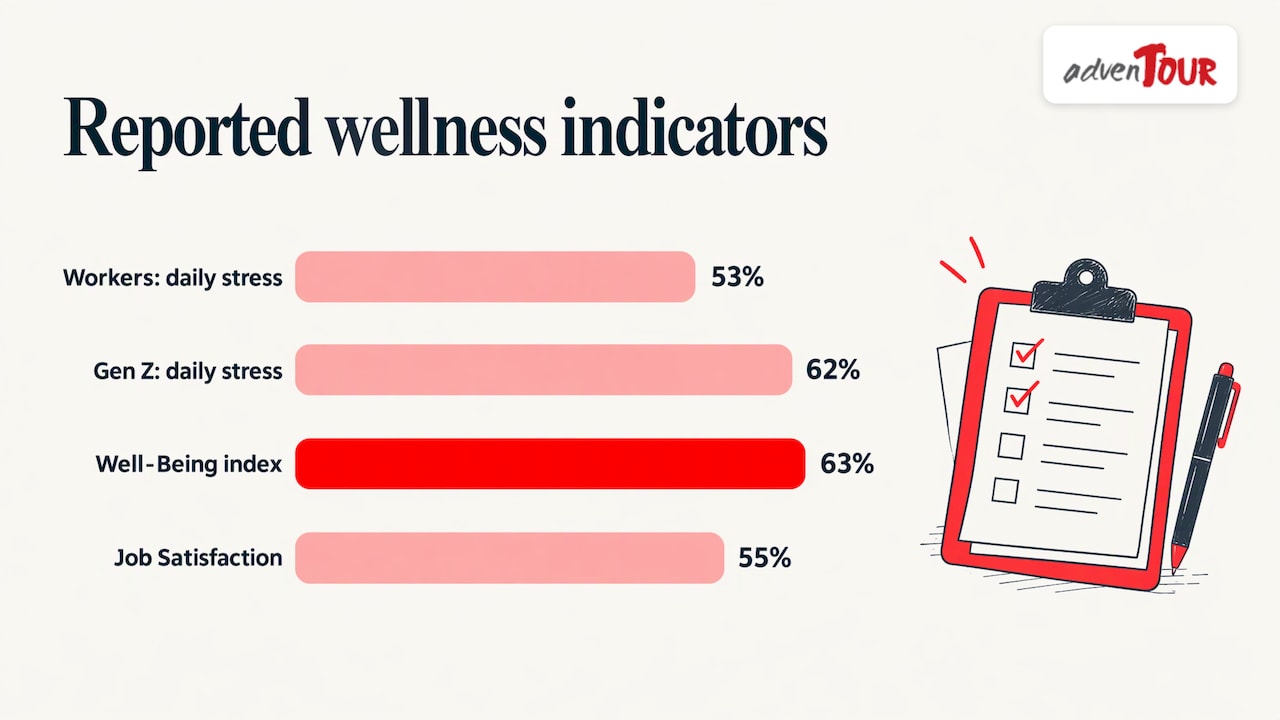
For an HR lead, two points follow. First, a younger workforce reports the most pressure, so formats that feel social and energetic, not like a mandatory seminar, are likely to land better. Second, a single day will not fix workload. It works best as one visible part of a wider routine, which the planning section below covers.
Choose the format by the goal
Start with what you want the day to change, then pick the format. This table maps common goals to formats we run, with our published per-person prices.
| Goal | Format | Published price per person (one-off) |
|---|---|---|
| Release energy, quick bonding | Kinball | $35 to $45 |
| Release energy, quick bonding | Bloop Bubble Soccer | $36 to $43 |
| High-energy competition | Combat Skirmish Laser Tag | $37 to $45 |
| Exploring together, light activity | App-based Amazing Race | $40 to $55 |
| Outdoor movement across the city | Bicycle Scavenger Hunt | $45 to $55 |
| Larger-scale challenge | Amazing Race | $65 to $78 |
| Outdoor, calm and creative | Garden Odyssey | $68 to $90 |
| Understanding how colleagues work | Modified DISC Workshop | $70 to $82 |
| Communication and working styles | Office Dynamics Workshop | $80 to $90 |
| Culture and connection | Katong/Joo Chiat Cultural Food Immersion | $82 to $98 |
| Executive offsites | Corporate Sailing Team Building | $125 |
| Deep personality insight | DISC Personality Profiling | $150 to $159 |
Some formats list only a starting price: Laser Clay Shooting from $69 and Office Shark Tank from $92. Rentals for in-house organisers are priced per hour or per day: Bloop bubble suits at $28 per hour per ball, laser tag guns at $25 to $33 per hour per gun, and portable tentage at $95 per day per tent.
Active formats for energy and morale
If the aim is to get people laughing and moving, the budget-friendly range works well. Combat Skirmish Laser Tag and Bloop Bubble Soccer are team games where the whole group plays at the same time, so nobody sits on the sidelines. Kinball is similar: a giant ball and a simple rule set that anyone can pick up within minutes.
Planning a fitness-led day in a different style? Some companies add a golf outing for senior teams, and this corporate golf outing planning guide covers formats such as scrambles and how to keep scoring simple.
Workshops for mindset and communication
Not every wellness goal is physical. Friction between colleagues is a stressor too, and a facilitated session can help a team understand how each person prefers to communicate. Our Modified DISC Workshop and Office Dynamics Workshop are built around experiential learning, so participants practise what they learn in the session rather than just listen.
Cultural and city-based formats
For teams who sit together daily but rarely step out together, a walk-based format changes the dynamic. The Katong/Joo Chiat Cultural Food Immersion pairs light movement with local food and stories, and the Bicycle Scavenger Hunt and App-based Amazing Race get groups exploring in small teams. They suit regional visitors too, since they show a part of Singapore that a conference venue does not.
Set a budget by tier
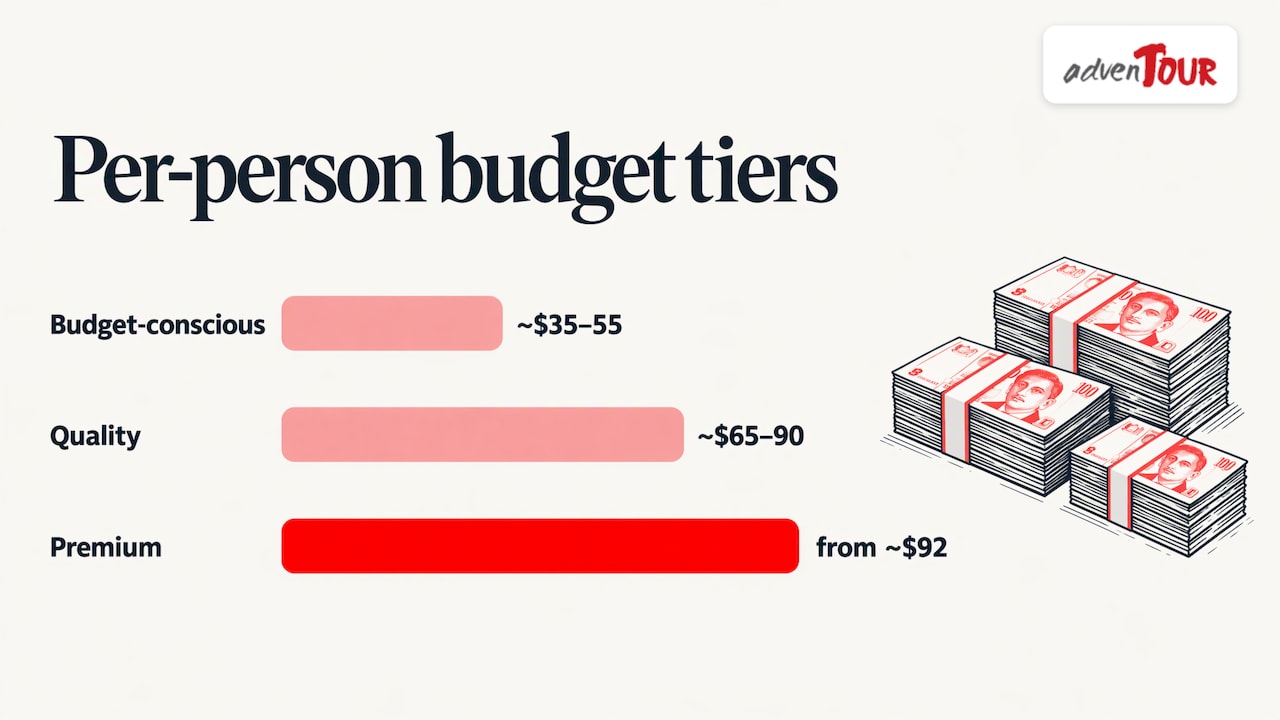
Budgets differ widely, and the format you choose sets the per-person cost more than anything else. Three working tiers help:
- Budget-conscious, about $35 to $55 per person. Kinball, bubble soccer, laser tag, the App-based Amazing Race and the Bicycle Scavenger Hunt. These scale well to large groups.
- Quality, about $65 to $90 per person. The full Amazing Race, Running Man Challenge ($72 to $82), Garden Odyssey and the DISC and office-dynamics workshops. Facilitation does more of the work here.
- Premium, from about $92 per person. Office Shark Tank, the cultural food immersion, sailing at $125 and DISC Personality Profiling at $150 to $159, for leadership groups and offsites.
A simple worked example: a department of 60 people choosing a $45 format pays $2,700 for the activity in total, before any venue or catering you arrange separately. Because pricing is per head, you can see the effect of adding or removing 10 colleagues straight away.
If your company also wants an ongoing wellness rhythm, not just an annual event, our corporate wellness programs page explains how we approach that.
Design for everyone, not the most active third
An event only counts if staff can take part. Plan accessibility at the start, not as an afterthought:
- Timing. Pick slots that work for shift staff, part-timers and people with caring duties. If a slot excludes a group, add a second one.
- Physical range. Choose or adapt formats so that people with different fitness levels and mobility can join in. Team-based games with varied roles, such as navigation or scoring in an Amazing Race, let everyone contribute without running.
- Language and digital access. Briefings should be clear to a multilingual workforce, and app-based formats need a phone-free option for anyone who needs it.
- Privacy. Do not display leaderboards tied to health status or personal results. Competition should be about teams and fun, not individual bodies.
- Opt-out. Offer a meaningful alternative for people who prefer not to take part, such as a quieter workshop at the same time.
These are the same questions a good facilitator asks in the briefing stage, and they are part of why we scale programs to group size and budget.
How to plan the event, step by step
The Workplace Safety and Health Council’s Playbook on Workplace Mental Well-being is the Singapore reference for the wellbeing context around any event. Use it alongside the steps below.
1. Find out what staff actually need
The Playbook recommends regular assessment of employee mental well-being, including iWorkHealth, a free online self-administered survey tool that helps employers and employees identify workplace stressors. It also suggests needs surveys and informal formats such as Pow Wows, Kopi chats and Brown bags. Ask what people want before choosing a format. A team worn out by deadlines may prefer an easy social afternoon to a competitive one.
2. Form a small planning group
The NYC Office of Labor Relations toolkit recommends a wellness committee drawn from all levels that typically meets monthly and shares the work, which it says makes initiatives more sustainable. Three or four colleagues from different teams is enough. They also give you honest feedback on what will and will not appeal.
3. Write down the objective and audience
One sentence is enough: “Give our 80-person sales and support teams a shared afternoon that builds trust after the reorganisation.” Note who is included, including remote, part-time and shift colleagues, because that decides venue and timing.
4. Match format and budget
Use the table and tiers above. For events with several teams, agree how groups will be mixed so that people meet colleagues from outside their usual circle. We tailor programs to organisational goals, so tell your planner the outcome you want, not only the activity.
5. Protect the time
The Playbook suggests protected wellness time, such as meeting-free days, quarterly early finishes for wellness initiatives, and an annual Collective Well-Being Day with an extra paid day off. Staff who must squeeze an event between deadlines will not benefit from it. Make attendance part of the working day, and have managers confirm that workloads are covered.
6. Sort the logistics
Confirm venue or outdoor space, weather backup, transport, water and rest points, first aid, and any rental equipment. For outdoor days, our portable tentage and rentals cover shade and equipment. For a full-service approach, see our corporate event planning and step-by-step team building planning guide.
7. Follow up
Decide before the day how you will gather feedback and what you will share afterwards. That is covered in the measurement section below.
Large groups, regional meetings and CSR
Large groups
Formats built around teams scale better than ones where everyone waits for a turn. Kinball, laser tag, bubble soccer and Amazing Race variants run with several groups at once, and the App-based Amazing Race keeps teams moving independently. For events with many people, we scale the program to the group and the budget, and run it with facilitators so that the day keeps its pace.
Regional meetings and visiting MNC teams
When colleagues fly in for a conference, the wellness need is often fatigue and unfamiliarity. A short, social format on the agenda’s second day helps people who barely know each other. A food immersion in Katong and Joo Chiat, a cultural walk or a sailing session gives visitors a taste of Singapore and a shared story. Our guide to planning a corporate event in Singapore covers how to slot activities into a meeting schedule.
CSR events
Volunteering together is a form of wellbeing: purpose, contribution and shared effort. Our SG60 CSR programs are designed to let companies celebrate, give back and connect in one session. For family-oriented gatherings, there is also the Family Day Carnival. Prices for both are agreed per project.
Measure what matters and tell staff what changed
The Singapore Institute of Directors and Gallup report on engagement finds that the best-performing organisations build measurement that produces actionable insights and leader accountability, and warns that measurement without action breeds cynicism. The same applies to wellness events.
The WSH Council Playbook describes a practical loop: run short pulse surveys, share departmental results with supervisors while keeping individual answers confidential, share consolidated themes with all employees, turn feedback into adjustments or new initiatives, and tell people what was done. In practice:
- Ask three questions right after the event: did you feel able to take part, did you connect with someone new, what should we do next time.
- Track attendance by team, not by individual.
- Report back within a few weeks, including one change you are making.
- Treat the event as social and cultural support. It is not a medical intervention and should not be described as proof of better health.
Our approach to staff wellness events
We plan and run team building and corporate wellness events across Singapore, from budget-friendly games to premium offsites, with programs customised to your goals and scaled for group size. Our focus is experiential learning and skill transfer rather than passive entertainment, and we were named one of Asia’s Top 10 Corporate Team Building Companies in 2023.
If you want a starting point, browse the budget-friendly activities, the quality programs or the premium programs. For a wellness-led angle, read about our corporate wellness team building. To brief us on a date, headcount and goal, start at adventour.com.sg.
Our perspective
Most companies ask us for an activity. What they usually need is a change in how people feel about working together, and the activity is only the vehicle.
We design every program around a stated objective, then scale it for the group and the budget. A $40 laser tag afternoon and a $150 profiling session can both work, if the format matches the goal and the facilitator keeps people engaged rather than watching.
The events that last are the ones where colleagues solve something together. That is why we lean on experiential learning: people practise communication and trust in the game, and then carry it back to the desk.
Our advice is simple. Ask staff first, make it easy for everyone to join, pick a format that fits, and tell people afterwards what you heard. We handle the planning and facilitation so your team can focus on the people.
Joshua
FAQ
How much should we budget for a staff wellness event in Singapore?
Our published per-person prices start at $35 for Kinball and run to $159 for DISC Personality Profiling, so most companies can match a format to a tier. A 60-person team on a $45 format pays $2,700 for the activity. Venue, food and transport are additional unless arranged with us.
How often should we run wellness events?
The WSH Council Playbook suggests building wellness into the working year through regular needs surveys, protected wellness time and quarterly initiatives. Many companies hold one larger team event a year and add smaller sessions between. Let staff feedback set the rhythm.
What if some employees cannot join physical activities?
Choose formats with different roles, such as navigation, strategy and scoring, or run a workshop in parallel. Offer an alternative for anyone who prefers not to take part, and avoid public rankings of individuals. Tell us about access needs at the briefing and we will adapt the program.
Can we run an event for a mixed group of local and visiting staff?
Yes. City-based formats like the Amazing Race, the Bicycle Scavenger Hunt or the Katong/Joo Chiat food immersion work well for mixed groups, since everyone is exploring together. We plan for regional meetings and large groups in Singapore.
Sources
- ManpowerGroup Global Talent Barometer Singapore, June 2025
- USC WorkWell Center, Social Connection and Belonging Toolkit 2025
- Workplace Safety and Health Council, Playbook on Workplace Mental Well-being
- NYC Office of Labor Relations, That Works worksite wellness toolkit
- Singapore Institute of Directors and Gallup, Powering Singapore’s Future
- Corporate golf outing planning guide
Recommended
- Corporate Wellness Programs in Singapore
- Corporate Wellness Team Building in Singapore
- The Complete Guide to Planning a Corporate Event in Singapore
- Corporate Activity Days in Singapore: Formats, Costs, Planning